Parents texting or calling their kids during class is a major source of frustration for many teachers.
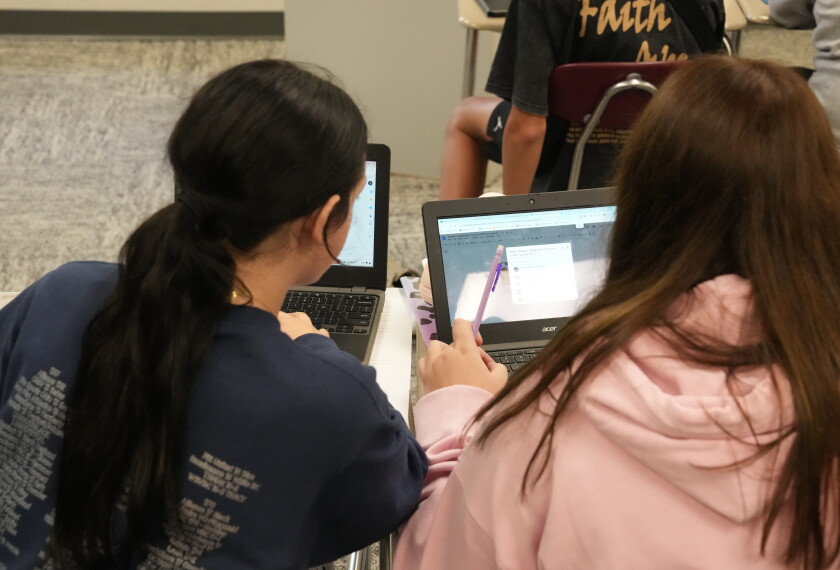
But that’s not the only way that parents are using technology to insert themselves into their kids’ K-12 classrooms: a number of educators report that parents remotely monitor their children’s laptops during class.
One in 5 teachers, principals, and district leaders say that parents are remotely monitoring their kids’ laptops during class at least once a month, according to an EdWeek Research Center survey of 868 teachers, principals, and district leaders conducted in June. Technologies exist that allow parents to monitor their children’s online activity or even remotely watch the screens of their kids’ school-issued laptops during the school day.
Liz Shulman, a high school English teacher in Illinois, didn’t realize that parents were doing this until they told her so last school year. Shulman, who teaches at Evanston Township High School and is an instructor in Northwestern University’s School of Education and Social Policy, wrote about her experiences in a piece for Slate last spring. She isn’t sure if it’s still happening this year or not.
“Parents told me that they were concerned about their kids mostly playing video games, so they were monitoring to make sure that the kids were not doing games,” she said in an interview with Education Week.
She understood the parents’ intentions—she uses software to monitor her students’ laptops during class to make sure they are staying on task and not using ChatGPT to write their assignments. But it still made her uncomfortable.
“As a classroom teacher, I do believe in the sanctity of the classroom space as a place for students to take academic risks and be free of surveillance so they can express themselves,” she said.
Shulman worries that her students will hold back or approach assignments differently if they think their parents are watching them, or that parents might misinterpret what she’s teaching if they’re only observing random, disparate chunks of her lessons.
“When they’re monitoring their kids, they’re also surveilling the teachers as well,” she said. “There is a whole scope and sequence to a teacher’s lesson. It takes a long time to build to ideas and teach these critical thinking skills that we’re trying to teach. So, I found it very distracting knowing that parents are kind of virtually in the classroom with us.”
Overall, 37 percent of teachers, principals, and district leaders say that parents have at some point remotely monitored their children’s laptops in school, with 20 percent saying that it happens at least monthly, according to the EdWeek Research Center survey.
School district leaders were substantially more likely to report that parents remotely monitor their children’s computers in class. Thirty-one percent of district leaders said this is happening, compared with 16 percent of principals, and 15 percent of teachers.
The need of some parents to monitor their kids or be in constant contact with them can disrupt learning
Between remotely monitoring their kids’ laptops and texting and emailing them during class, educators say that parents have become a significant source of distraction during class time. Nearly three-quarters of educators say that this behavior creates distractions at least monthly, 17 percent say it creates distractions a few times a week, and a third say it happens at least daily.
Some experts suggest that the problem of parents remotely monitoring their children’s computers may be a holdover from pandemic remote learning when parents became accustomed to monitoring their children’s actions and screens at home.
Technology, said Shulman, has blurred the demarcation between home and classroom.

It could also be a symptom of the pressure today’s parents—particularly middle class parents—feel to give their children a leg up in life, said Aaron Pallas, a professor of sociology and education at Teachers College, Columbia University.
“In a context where everyone’s trying to get ahead in order to get into scarce, desirable spaces in a selective high school, a selective college, anything that might be seen as a mechanism to provide advantage is going to be taken up,” Pallas said. “And I think this kind of monitoring to ensure that they are on task is potentially one such mechanism.”
If parents’ remote monitoring becomes problematic for educators, Pallas recommends that teachers and school leaders address the issue by first talking with parents to find out why they are doing it. Is it because they’re worried about their kids goofing off or playing video games? Or because they are concerned about what is being taught in class or how it is being taught? That way, he said, schools can address the root cause of the problem.
However, while parents remotely monitoring their children’s laptops during class is an emerging phenomenon, parents contacting their kids during class via cellphones remains a much larger issue for schools. Eighty-three percent of teachers, principals, and district leaders said in the EdWeek Research Center survey that parents are texting, messaging, or emailing their kids during class at least monthly, with 47 percent saying that it’s happening daily or several times a day.

Data analysis for this article was provided by the EdWeek Research Center. Learn more about the center’s work.