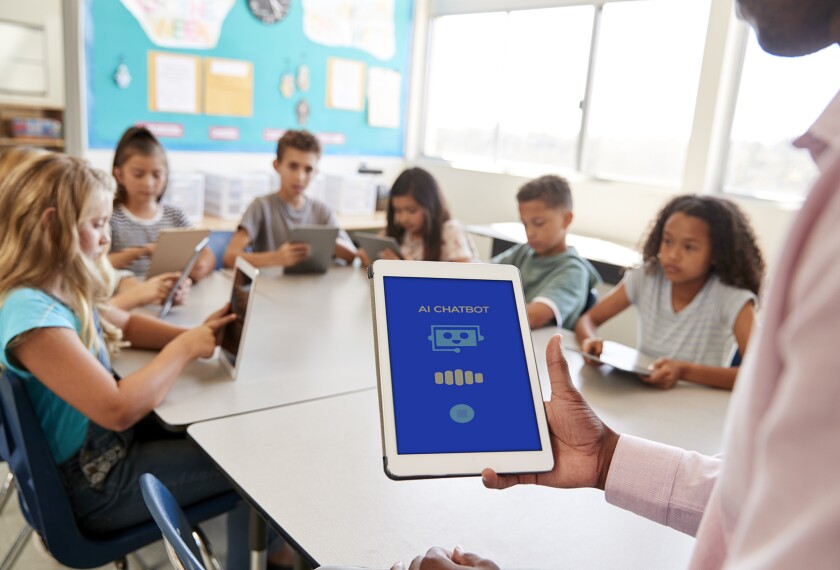

Artificial intelligence is all the rage right now, and it will be for the rest of my lifetime. In this Harvard Business Review article, McAfee, Rock, and Brynjolfsson refer to AI as a “general-purpose technology akin to electricity, the steam engine, and the internet.” Before I go any further, and risk getting comments thrown at me on social media, I do understand that there are IP concerns, among other issues that we still have to work out. However, what we also know is that AI is here to stay, so we as educators can either get on board with it or we can be once again deemed behind the times where our students use the technology at home and come to school to go back a century or two.
Over the past few months, I have used AI more and more. Partly because I wanted to see what all of the fuss was about and also because I needed to play around with it to see if it was something that I should be using in my role as an author, consultant, and owner of a company.
For full disclosure, I am not a techie. I have created a website for the Instructional Leadership Collective, designed courses through Thinkific, and use Mentimeter for all of my virtual and in-person workshops. However, I would never consider myself an expert in using technology, which is why I am trying out AI. I feel that every once in a while, we should feel uncomfortable as we learn, because being uncomfortable during learning (in a psychologically safe environment) can result in deeper, more rigorous learning experiences.
Here’s What I’ve Learned Through AI
As with anything that is new for me, I like to start small. When I began hearing more and more about AI, I decided I would engage in a low-risk activity, which leads me to the first lesson I learned through AI. I used it for cooking. Yes, cooking.
After some major inspiration over the last six months, I began experimenting with gourmet cooking. Please keep in mind that prior to June of this year, I struggled to open a can of tuna fish, so it may surprise you that I now use a sous vide or Big Green Egg to make filet mignon, bleu cheese turkey burgers with pesto, salmon, halibut, or sesame chicken with my own sesame sauce. What does that have to do with AI? I use AI to give me recipes for special sauces, like the one I will make for the pumpkin ravioli I will be serving to guests tonight.
Secondly, I use AI to ask better questions. In a previous blog, I wrote about using AI as a leadership coaching assistant. After sessions are done, I go back and reflect on the questions I asked and have engaged in reading books to help me better learn what questions I could be asking. Additionally, I find that when I ask AI a question and the answers it provides are not always on point, there have been many times that it was my question that encouraged that answer. I needed to go back and rephrase the question so AI understood me better. That’s something we can always do in conversations with humans.
Along with using the AI personal assistant to ask better questions, I also have learned to use AI to see how much I talk during sessions as opposed to the people I coach. Fortunately, I have seen that in most cases, the person being coached does talk more than I do. However, there have been those times where I cut it close, and that matters to me. I strive to listen more than I talk.
The fourth lesson I have learned when using AI is that it helps keep me inspired during moments when I lack inspiration. I have used it to give me a boost when considering keynotes, workshop activities, or topics to cover in this blog. Is it perfect, no. However, I noticed that although it may not give me the exact information I need, it has inspired me to read what it gives and think, “I wonder if I could,” and new ideas come to me during those moments.
Lastly, in reading this outstanding ISTE article, I learned that there are several types of AI, which are:
Reactive - Tools that respond to specific inputs or situations without learning (i.e., Alexa)
Predictive - Tools that analyze historical data and experiences to predict future events or behaviors (i.e., Netflix).
Generative - Tools that generate new content or outputs, often creating something novel from learned patterns (ChatGPT).
In the End
Those who fear AI have probably been using it already when they ask Alexa to play a song or when they get on Netflix and click on the movie that Netflix said they might want to watch. It seems that generative is the one that makes most people nervous because of IP rules or that it may not be able to provide the most accurate information, which is kind of ironic given how many people spread misinformation through gossip.