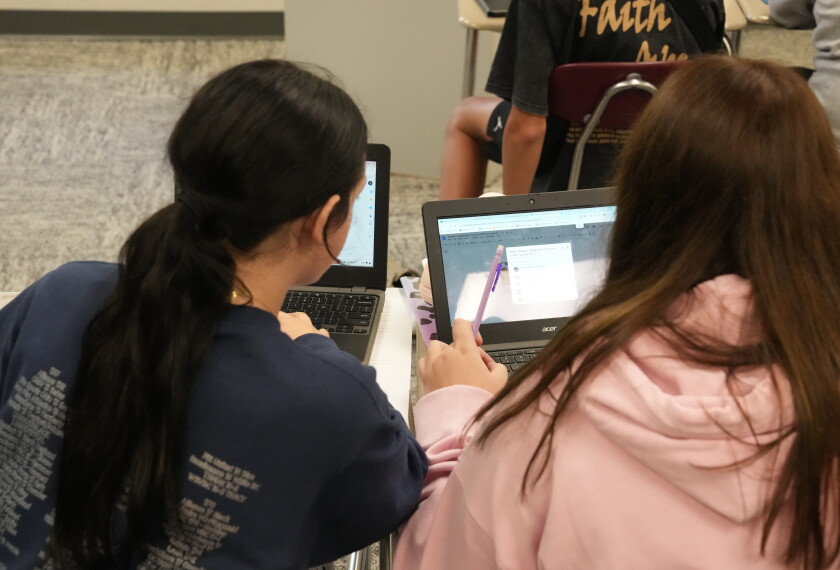
Are schools actually scaling back tech use, amid parental and educator concerns about oversaturation?
A recent Education Week story found that as of earlier this year, about three-quarters of district and school administrators said they had not reduced their investment in technology. But many said that families in their school systems believe too much time is spent on tech.
The article drew a strong reaction when EdWeek posted it on social media. Some of the responses on Facebook were from teachers who shared how they are attempting to pare down tech’s role in their classrooms. Others explained why they’re not able to do so.
Many teachers appear to feel squeezed. Sixty-one percent of educators say that parents/guardians with whom they interact with believe there’s too much technology use for school-related purposes. Thirty-seven percent said families feel the amount of technology in schools is “just right,” according to the survey, conducted of 79 district leaders, 122 school leaders, and 395 teachers by the EdWeek Research Center in February and March.
Parent/guardians are concerned about the negative effects technology could have on students, such as their ability to think critically and perform well in school. Those worries seem to be directed at an array of technologies, from cellphones to social media to artificial intelligence.
Others, however, have encouraged school districts leaders, classroom teachers, and parents to take a more nuanced view of technology. Not all types of “screen time” are the same, they say, and some forms of tech have brought benefits to individual students and instructional strategies.
The responses to the EdWeek article about scaling back tech show strikingly different observations from online commenters. Some who identified themselves as teachers say they’ve pared back digital tools. Others say they haven’t been able to do so.
The responses have been edited lightly for length and clarity.
Some teachers are limiting technology use of their own accord
40+ years as a high school and (in retirement) college English teacher here. If you want to solve the problem, you’re gonna have to go to pen, pencil, and paper. I did it in AP [Language] for years. It works.
11th-grade history teacher here. I eliminated all tech and digital assignments two years ago.
As a teacher, I’m at the bottom of the hierarchy, but for my part, I will no longer be letting my students use laptops in math class.
Others want to pull back on tech, but lack alternative resources
I would love to do more old school stuff, but with budgets shrinking and teachers being told to make less copies, what are we going to do? I can post the same worksheet in Google Classroom and not spend any school resources or my own money making copies for 27 students. At least we still have workbooks.
The issue is that schools fell victim to the tech industries pushing "more tech is better," and in the process, we dismantled all of our analog systems. Now we don’t have the money to rebuild them. We don’t have the hundreds of thousands of dollars to repurchase textbooks that have shifted to online versions. Our teachers have moved past or forgotten all of their analog training and now over-rely on the technology that you shoved down our throats. Now, when the data finally tells you what any veteran teacher was trying to tell you for years, you want to hold us accountable for the shift back or blame us if we cannot or will not do so.
Some teachers are trying to find a balance
Until testing is on pencil and paper, tech has to be a part of instruction. Yes, we need direct instruction, but practice on tech and writing on computers is required.
I had to scale back, as the students were turning in written work created by AI. Students are now handwriting their essays in class.
I am a teacher. I have chosen to no longer give access to the online version of the textbook unless it is addressed in the IEP, they need the Spanish version, or they need it while on vacation.