Are Schools Actually Scaling Back Tech in Response to a Rising Backlash?
Special Report
Special Report
Classroom Technology

Are Schools Actually Scaling Back Tech in Response to a Rising Backlash?

By Sean Cavanagh & Jessica Cuellar — June 29, 2026 2 min read
CEM 2540
  • Save to favorites
  • Print

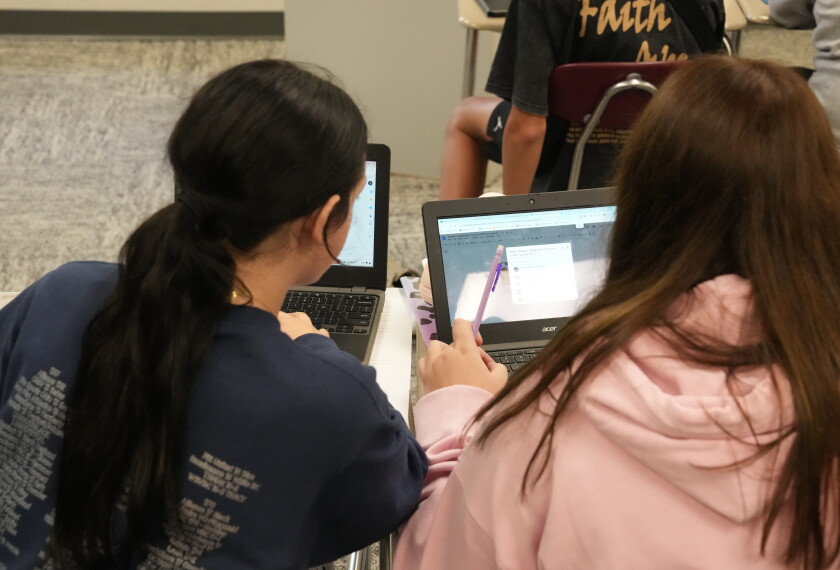
Technology’s role in schools is under tremendous scrutiny.

Education Week’s recently published “Technology Counts” special report examines how districts are weighing the pressure—from parents, teachers, and advocates—to scale back tech use, at the same time they’re trying to protect what they see as its most beneficial applications.

Schools’ reliance on tech soared during the pandemic, a time when many of them by necessity moved to 1-to-1 computing programs. Those decisions, supercharged by billions of dollars in federal stimulus aid, put a device in the hands of nearly all students in most districts. School systems also poured money into myriad other tech tools and platforms designed to engage students and deliver academic content online.

Now, many families and educators are having a tech rethink.

Emerging research on the negative impact of student immersion in social media, and concerns about students becoming overly reliant on AI, have contributed to those anxieties.

A nationally representative online survey conducted in February and March by the EdWeek Research Center captured this sentiment.

It found that strong majorities of teachers and administrators in middle and high schools say that that the parents they’re in touch with believe the amount of time students spend with technology is too high.

The survey was conducted of 79 district leaders, 122 school leaders, and 395 teachers.

But with all the talk of a tech backlash, are schools actually moving aggressively to scale it back?

The answers to another question the EdWeek Research Center put forward on the same survey this year suggests the answer is no.

A strong majority of those surveyed, asked if their district had reduced investments in tech because of parental concerns, said they had not.

Richard Culatta, the CEO of ISTE+ASCD, a professional development organization that supports effective tech use in schools, has argued that educators should avoid falling into extremes, when weighing tech’s role.

Much of the rhetoric being put forward about tech misses the necessary context—namely, how it’s being used in individual schools and classrooms, said Culatta in an interview with Education Week Assistant Editor Alyson Klein.

“A lot of schools handed out devices far faster than they were preparing their teachers [to teach with them],” said Culatta, the former director of the office of ed tech during the Obama administration. (That office was closed by the second Trump administration).

The tech backlash, he said, “is what happens when you [don’t prepare teachers].”

So-called “techlash” is a major undercurrent at this year’ ISTE + ASCD conference, being held in Orlando, Fla.

Added Culatta: “What we don’t want to see is the really impactful, effective ways that technology is helping change students’ lives for the better be thrown out because some schools weren’t able to figure out how to keep kids from watching YouTube all day.”

A version of this article appeared in the June 15, 2026 edition of Education Week as The ed-tech backlash is here. What it means for schools

Events

This content is provided by our sponsor. It is not written by and does not necessarily reflect the views of Education Week's editorial staff.
Sponsor
Recruitment & Retention Webinar
Hiring, Retention, and Fill Rates: A Data-Driven Sub Strategy
Explore what keeps substitutes coming back and hear how one district rebuilt its substitute hiring process and improved its fill rate.
Content provided by Frontline Education
Early Childhood K-12 Essentials Forum Early Childhood Education: Building Essential Skills for Success
Join this free virtual event to examine the biggest challenges in supporting young children, from preschool through elementary school. 
This content is provided by our sponsor. It is not written by and does not necessarily reflect the views of Education Week's editorial staff.
Sponsor
Student Absenteeism Webinar
Attendance Isn't an Attendance Problem
Boost attendance by strengthening relationships, belonging, and support with practical strategies from Doug Fisher & Nancy Frey.
Content provided by Corwin

EdWeek Top School Jobs

Teacher Jobs
Search over ten thousand teaching jobs nationwide — elementary, middle, high school and more.
View Jobs
Principal Jobs
Find hundreds of jobs for principals, assistant principals, and other school leadership roles.
View Jobs
Administrator Jobs
Over a thousand district-level jobs: superintendents, directors, more.
View Jobs
Support Staff Jobs
Search thousands of jobs, from paraprofessionals to counselors and more.
View Jobs

Read Next

Classroom Technology It's About Quality Tech Use, Not Screen Time, Trump's Top K-12 Official Argues
Trump administration's top K-12 official urges educators to focus on whether ed tech is effective.
5 min read
Assistant Secretary for the Office of Elementary and Secondary Education Kirsten Baesler speaks during the National Forum on Education Policy in Washington, DC on Wednesday July 8, 2026.
Assistant Secretary of Elementary and Secondary Education Kirsten Baesler speaks during the National Forum on Education Policy in Washington on Wednesday, July 8, 2026. Baesler urged educators to ensure ed tech is delivering results for students, rather than focus single-mindedly on the amount of time students are spending on screens in class.
Demetrius Freeman for Education Week
Classroom Technology These Kids Are Learning Without Tech in a District That Gives Out Devices to All
Some parents in this city opted their children out of school-issued devices.
Claire Bryan, The Seattle Times
10 min read
Imran, left, confers with his math partner Nataly as the fifth graders solve a problem using base-10 rods at Hawthorne Elementary School, Tuesday, Jan. 24, 2023 , in Seattle .
Imran, left, confers with his math partner Nataly as the 5th graders solve a problem using base-10 rods at Hawthorne Elementary School in Seattle on Jan. 24, 2023. Some parents in the city, which issues devices to all students, have opted their children out of school-issued technology.
Ken Lambert/Seattle Times via TNS
Classroom Technology Q&A Why a 'Blunt Force' Approach to Screen Time May Be Problematic
District and state leaders should avoid one-size-fits-all mandates on screen time, expert argues.
3 min read
Ninth-graders Charley Mays, left, and Grace Coleman work on iPads during an honors physical science class at Minnetonka High School on Oct. 30, 2019 in Minnetonka, Minnesota .
Ninth-graders Charley Mays, left, and Grace Coleman work on iPads during an honors physical science class at Minnetonka High School on Oct. 30, 2019 in Minnetonka, Minn. Some experts caution schools not to go too far in dialing back the use of classroom technologies, a trend called the "techlash" that is driven by concerns about the overuse of technology in schools.
Jerry Holt/The Minnesota Star Tribune via TNS
Classroom Technology Spotlight Spotlight on the Screen Time Reckoning: Educators, Parents, and the Fight for Healthier Classrooms
Screens are reshaping classrooms, but educators are pushing back to restore balance, protect learning, and prioritize human connection.