The anti-technology sentiment that schools around the country are facing isn’t some frivolous criticism that will somehow magically dissipate all on its own, cautioned Richard Culatta, the CEO of ISTE+ASCD.
There are some people who “think it’s just some crunchy parents who have too much time on their hands. They think it’ll blow over,” Culatta said.
Meanwhile, others believe that “‘there is no greater work that I have in this world than making sure all technology is banned in my kids’ lives,’” Culatta added.
Join us at ISTE+ASCD
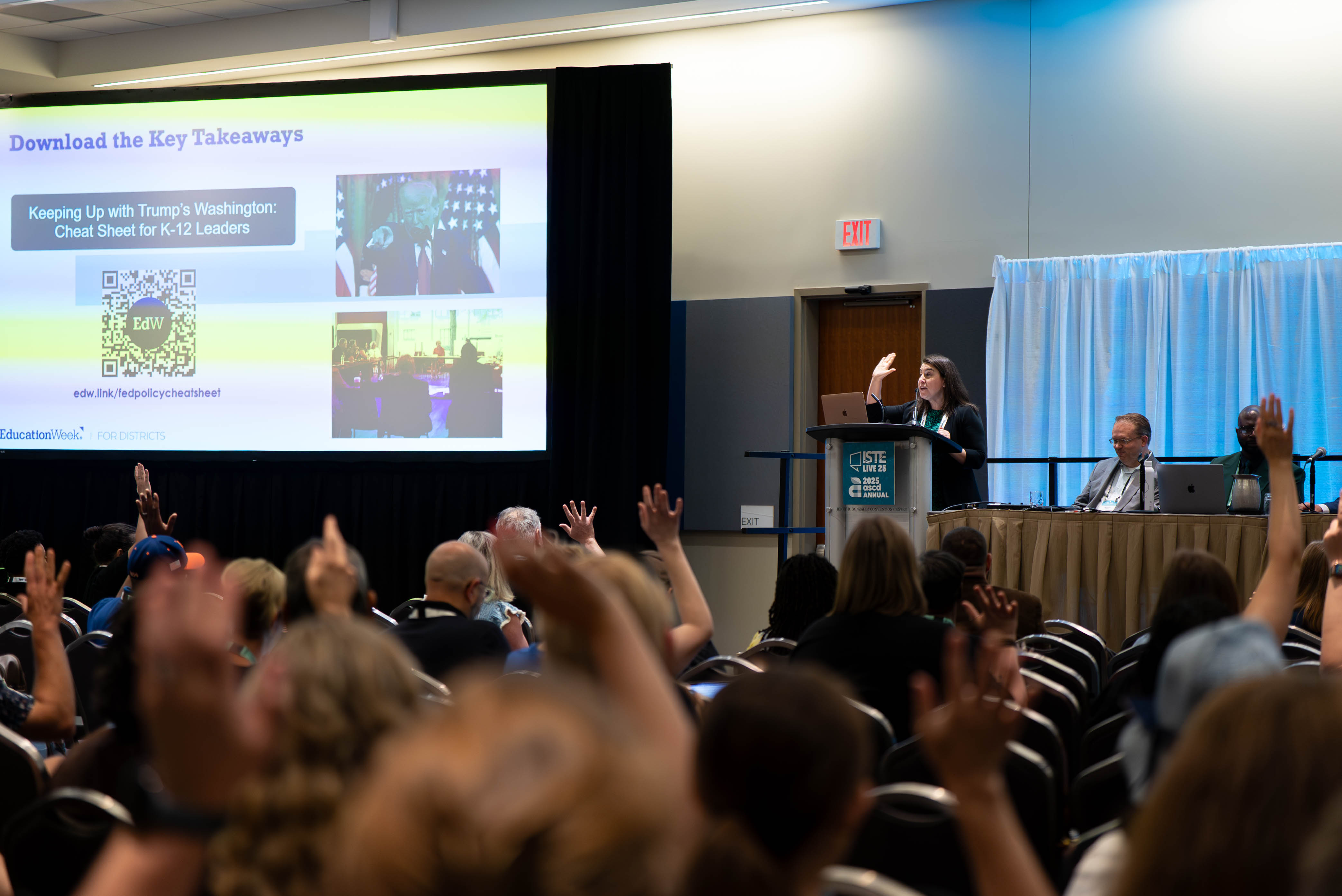
Heading to Orlando for the ISTE/ASCD conference? Be sure to attend The Ed-Tech Backlash Is Here. How Should District Leaders Respond? on Monday, June 29, 1-2 pm ET. Join EdWeek Assistant Editor Alyson Klein, EdWeek Research Center Director Holly Kurtz, and a panel of district leaders to understand what’s fueling the ed-tech pushback, get practical takeaways on how to respond to community concerns about screen time, and more.
Join us >The right answer on technology is somewhere in between, Culatta explained. There’s no research to support the use of all educational technologies, all the time in schools. But there’s also no evidence that getting rid of it entirely is a smart move either, he said.
Helping schools navigate that reality—and rebuilding trust with parents and communities on technology—will be a major theme of ISTE’s 2026 annual conference, set to kick off in Orlando, Fla., on June 28.
The conference will also delve into what graduates need to know in an artificial intelligence dominated world and include sessions on topics like reimagining testing with the aid of AI.
Education Week spoke with Culatta on Zoom to discuss those topics, as well as how educators should respond to the rising ed-tech backlash.
This conversation has been edited for length and clarity.

What are you hearing from educators about the ed-tech backlash, or ‘techlash,’ as some are calling it?
We should not use technology everywhere, all the time in schools. The research supports that. ISTE supports that, right? But limiting technology based on time is also not supported by research, and it’s harmful for kids. Should we have limits? Yes, we should, but it should be limits based on quality, not based on the clock.
But at last count, I think there were 414 bills that are moving through state legislatures [that seek to limit technology use]. When stuff gets passed into law, it isn’t going to just go away, even if public perception changes.
I said after watching just how quickly [some schools] pushed technology out during COVID, that there would be a course correction coming.
A lot of schools handed out devices far faster than they were preparing their teachers [to teach with them]. This is what happens when you do that. What we don’t want to see is the really impactful, effective ways that technology is helping change students’ lives for the better be thrown out because some schools weren’t able to figure out how to keep kids from watching YouTube all day.
What are you worried will happen if schools start ditching ed tech as quickly as they adopted it during the pandemic?
I was in a [school district] recently. They’re one of the school districts that’s very quickly pulling back for a lot of their technologies. They’re thoughtful about it, but they are doing that.
I talked to a student who was a senior, graduating top of his class. I said, “how do you feel about the fact that freshmen are not going to have access to the technology?”
It was an emotional conversation. He said, “I’m severely dyslexic, and I wouldn’t be here, absolutely wouldn’t be here, wouldn’t be in school, I would have dropped out [without the support of technology].”
That’s the sort of stuff that’s really hard to grapple with.
How are you helping schools make the case that high quality ed tech tools—if used appropriately—can be beneficial for student learning?
We have not taken apart piece by piece some of the crazy claims that are out there. What we have done, and we’ll release this at the conference, is our research team looked at 10 years of 100 or maybe more really high-quality evidence, peer-reviewed research studies, answering some of the common questions that are coming up.
So [when] a parent walks into a school and says, “Here’s something I read on the internet, and it says that you have no evidence that technology is making anything better. In fact, it’s making test scores go down. What do you have to say about it?”
A lot of the schools don’t have a great response. So, we’ve compiled [evidence] and we have, I think, a nice guide. The goal of it is to just help make those conversations a little more meaningful.
(For a different perspective on the research behind ed-tech’s effectiveness, check out this EdWeek roundtable discussion featuring Jonathan Haidt, the author of The Anxious Generation, a best-selling book that argued a childhood spent in largely unrestricted screen time has had disastrous consequences for the well-being of children and young adults.)
Any can’t-miss sessions or things to check out at your annual conference this year?
There will be a space at the conference to explore how schools adopt to a shift in the conversation on AI, away from “What is AI? How does it work?” to “how do we practice using it in ways that help support human skills?”
And there will also be a showing of “Multiple Choice,” a documentary that showcases Virginia’s Winchester Public Schools [work on career and technical education].
There’ll also be some really interesting stuff around assessment and reimagining assessment.