Rooftop terraces brimming with gardens. A glamorous school bathroom with lights around the mirrors, like those you’d find in a movie star’s makeup room. An air-conditioned indoor recess room, complete with soft, twinkly lights and a sketching and drawing nook.
Those are some of the architectural features and amenities that 6th graders at Knox Gifted Academy, a public magnet school in Chandler, Ariz., incorporated into their dream school facilities, which they brought to life both in virtual and real-life 3D models.
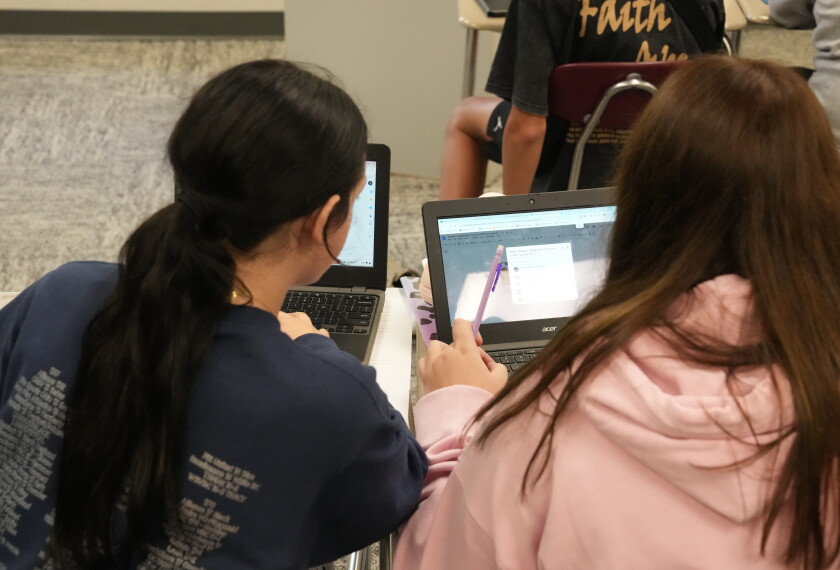
The project was part of a push by technology teachers Tara Menghini and Krista Wilkewitz to prod their students to use digital tools to fuel creativity, not passively consume content.
It also gave students a chance to deploy their coding skills, conduct research, collaborate, and, especially, use their imaginations.
The teachers kicked off the project—which took up about an academic quarter during the students’ twice-weekly technology classes—by asking kids about their school experience.
“It’s a question I don’t think kids get asked enough, or at least are not asked their feedback about: What is the purpose of school? Why are you even here?” Menghini said. “What do you want to get out of school? And then we say, ‘what could school look like?’”
The students then met with experts in school design.
They interviewed an experienced local school architect on Zoom, who could tell from the wall behind the students that their school had been built in the 1970s.
They FaceTimed with the principal of a nearby campus under construction as he walked through the site wearing his hard hat.
The class also researched real-world—but outside-the-box—possibilities. They watched a news video about Alpha Schools, a network of private schools that rely heavily on artificial intelligence to provide instruction for part of each day. They learned about Design 39 in San Diego, a public pre-K-8 school dedicated to project-based learning.
And Menghini talked to the students about her experience teaching in Japan, where students play an active role in running the school—including cleaning the building and serving lunch.
The students then brainstormed their dream school in teams and decided on its nonnegotiable features.
Next, they created digital versions of their schools—or classrooms—that they could explore in virtual reality, specifically using Delightex, a 3D-immersive platform. (Knox Academy has a paid version, but there is also a free version. Minecraft Education is another option, Menghini suggested.)
The digital aspect of the project helped students more completely think through their planning, Wilkewitz said.
It allowed for “modeling and working out the kinks, so that when they got to their physical build, they knew, OK, this might work, this might not work,” she said.
Kids then used their math skills to sketch out blueprints. Next, they made real-life models of their dream schools using decidedly low-tech materials: matboard or cardboard, popsicle sticks, fake foliage, wood cubes, fabric, tissue paper, dowel rods, toothpicks, pompoms, and more. (For this, Wilkewitz and Menghini visited a 4,000-square-foot recycling center and carted away donated junk for free.)
The teachers also prepped students with training on some potentially dangerous tools—including hot glue guns and X-Acto knives.
The project gave the teachers some insight into what their students think and worry about.
One student created a test kitchen where kids could learn about math concepts, like fractions, while baking cupcakes, making pizzas, or decorating cinnamon buns.
“The things that the kids wanted to change have to do with agency,” Menghini said. “They want choice, they want to know that what they’re learning means something.”
And when the principal of the under-construction school showed students classrooms with see-through walls, the kids wondered where students would hide if a shooter attacked, Menghini said.
She encouraged them to ask the principal, who assured the kids the glass was bulletproof.
Menghini was also touched that one group’s model included covered parking spots so teachers’ cars wouldn’t overheat in the Arizona sun, complete with solar panels to power electric vehicle charging stations.
“They thought of us!” she said.
At the project’s conclusion, the school invited parents to visit for a glimpse inside the students’ fantasy facilities.
“I feel like is the most important part, just the empowerment aspect of it, of kids getting to show and be excited about what they did,” Wilkewitz said.