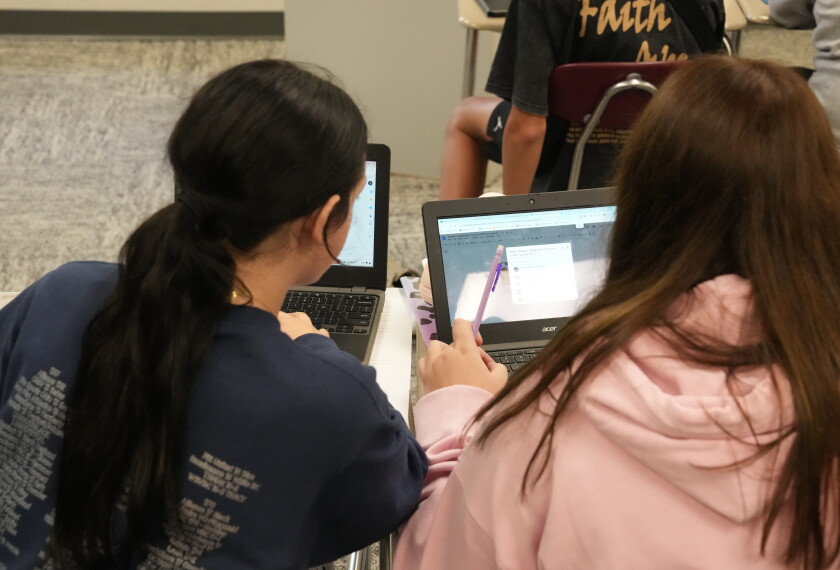

Chromebooks’ “short” lifespans are “saddling schools with additional costs,” concludes a report from the U.S. Public Interest Research Group Education Fund.
“Across the 48.1 million K-12 public school students in the U.S., doubling the lifespan of Chromebooks could result in $1.8 billion dollars in savings for taxpayers, assuming no additional maintenance costs,” according to the report, published April 18.
The report’s findings come from interviews with school IT directors, technicians, journalists, repair shop owners, parts suppliers, and teachers about their experiences using Chromebooks, as well as from analyses of publicly available data.
Many school districts didn’t have a 1-to-1 computing environment at all grade levels until the pandemic led to emergency remote and hybrid learning. To provide laptops for all students, districts looked for devices that fit within their budgets. Chromebooks were the answer for most districts.
“A laptop that we were looking at was going to cost us $800 per student, versus a Chromebook, which was going to cost us $300 per student,” said Louis McDonald, the director of technology for the Fauquier County Public Schools in Virginia. “For every one laptop, I could buy two Chromebooks. And for what we saw as the majority of the operations of our students, which was in the Google ecosystem, a Chromebook made the most sense.”
The PIRG report argues that one of the biggest problems with Chromebooks is that each device comes with “a built-in expiration date,” after which software support ends. That means Chromebooks of a certain age will be denied software updates even if its hardware is still useful. Those with expired Chromebooks might not be able to access certain services, such as online state testing websites, the report found. Districts then have to purchase newer models of Chromebooks. The report argues that a four- or five-year software support isn’t long enough and that Google should extend it to 10 years so students can use the same device for the majority of their K-12 attendance.
These expiration dates can also take schools by surprise. One school official in California told PIRG researchers that “while the expiration date for a given model might be set for seven years, by the time his school buys their laptops, expiration is only four to five years away.”
The short lifespan also makes it difficult for schools to resell their devices, and instead have to pay to recycle them, the report found.

Another challenge that schools face is finding spare parts to repair their Chromebooks, according to the report. Schools need to purchase parts from third parties or use the ones from broken machines, and “the scarcity can contribute to the high price for parts, making repair uneconomical,” the report found. For example, an official from the Oakland, Calif., school district told PIRG researchers that fixing a cracked screen can cost around half the price of a new device.
District technology leaders who spoke with Education Week said that getting spare parts isn’t as difficult now compared to the beginning of the pandemic when there were major supply-chain disruptions.
Some districts work with multiple vendors to ensure there’s no delay in receiving spare parts. But the volume of repairs that districts handle does mean that buying parts can become costly.
“My parts budget originally was designed to support staff fixes, which are very limited,” said McDonald, the Fauquier County district technology director. When the 11,000-student district distributed Chromebooks to all students, “we estimated, worst-case, $70,000 in parts would be needed per year, [but] we are approaching close to $80,000 this year.”
‘Students are very hard on devices’
The PIRG report calls on Google to extend the software expiration dates of Chromebooks and for manufacturers to produce longer-lasting devices with overstock of spare parts for districts to purchase at affordable prices.
Google did not immediately respond to Education Week’s request for comment. But in a statement to The Verge, a Google spokesperson said the company has “worked diligently with our hardware partners to increase the years of guaranteed support Chromebooks receive,” and that since 2020, they provide eight years of software updates compared to five years in 2016.
Sarah Radcliffe, the director of future-ready learning for the School District of Altoona in Wisconsin, agreed with the report’s recommendations.
“If devices could last longer, but fully functional and up to date, allow the operating system upgrades and the hardware was tough enough to withstand more wear and tear, it would be awesome!” she said in an email.
But McDonald isn’t convinced that PIRG’s recommendations would solve school districts’ problems. No matter which laptop brand schools choose, they will still need to repair and replace those devices as often as they do now, he said.
“Students are very hard on devices,” McDonald said. “I don’t care if it’s a Windows laptop or a Chromebook, they’re going to destroy it. Any device after five years of being with a middle school or high schooler is going to be in bad shape.”
The biggest challenge for school districts, he said, is how to get students to take care of the devices as if it was their own personal device.