Mathematics Report Roundup

Teaching Fractions

By Debra Viadero — October 12, 2010 1 min read
  • Save to favorites
  • Print

The latest practice guide from the federal Institute of Education Sciences offers educators research-backed advice on tackling one of the most critical gaps in American students’ mathematical knowledge: how to work with fractions.

Compared with their Asian peers, U.S. students fall short in their understanding of fractions, the report says. On the 2004 National Assessment of Educational Progress mathematics test, for example, half of 8th graders could not place three fractions in order from least to greatest.

To address the problem, the institute recruited top scholars to recommend best practices for teaching fractions.

They called for: building on students’ informal understandings of sharing and proportionality; using number lines to help students understand how fractions expand the number system beyond whole numbers; teaching students why strategies such as the “invert and multiply rule” make sense; focusing on the especially difficult concepts of ratio, rate, and proportions; and emphasizing fractions in teacher education and professional development.

The guide also rates the evidence for each recommendation, gives practical examples, and suggests ways to overcome potential roadblocks to implementation.
Related Tags:

A version of this article appeared in the October 13, 2010 edition of Education Week as Teaching Fractions

Events

Student Well-Being & Movement K-12 Essentials Forum How Schools Are Teaching Students Life Skills
Join this free virtual event to explore creative ways schools have found to seamlessly integrate teaching life skills into the school day.
This content is provided by our sponsor. It is not written by and does not necessarily reflect the views of Education Week's editorial staff.
Sponsor
Special Education Webinar
Bridging the Math Gap: What’s New in Dyscalculia Identification, Instruction & State Action
Discover the latest dyscalculia research insights, state-level policy trends, and classroom strategies to make math more accessible for all.
Content provided by TouchMath
This content is provided by our sponsor. It is not written by and does not necessarily reflect the views of Education Week's editorial staff.
Sponsor
School & District Management Webinar
Too Many Initiatives, Not Enough Alignment: A Change Management Playbook for Leaders
Learn how leadership teams can increase alignment and evaluate every program, practice, and purchase against a clear strategic plan.
Content provided by Otus

EdWeek Top School Jobs

Teacher Jobs
Search over ten thousand teaching jobs nationwide — elementary, middle, high school and more.
View Jobs
Principal Jobs
Find hundreds of jobs for principals, assistant principals, and other school leadership roles.
View Jobs
Administrator Jobs
Over a thousand district-level jobs: superintendents, directors, more.
View Jobs
Support Staff Jobs
Search thousands of jobs, from paraprofessionals to counselors and more.
View Jobs

Read Next

Mathematics Spotlight Spotlight on Creating a Positive Math Culture
This Spotlight explores instructional practices that help build students’ math skills, confidence, and willingness to tackle hard problems.
Mathematics 4 Research-Backed Tips for Mastering Math Facts
A new review of research offers evidence-based recommendations for classroom practice.
5 min read
A classroom at Lafargue Elementary School in Effie, Louisiana, on Friday, August 22. The state has implemented new professional development requirements for math teachers in grades 4-8 to help improve student achievement and address learning gaps.
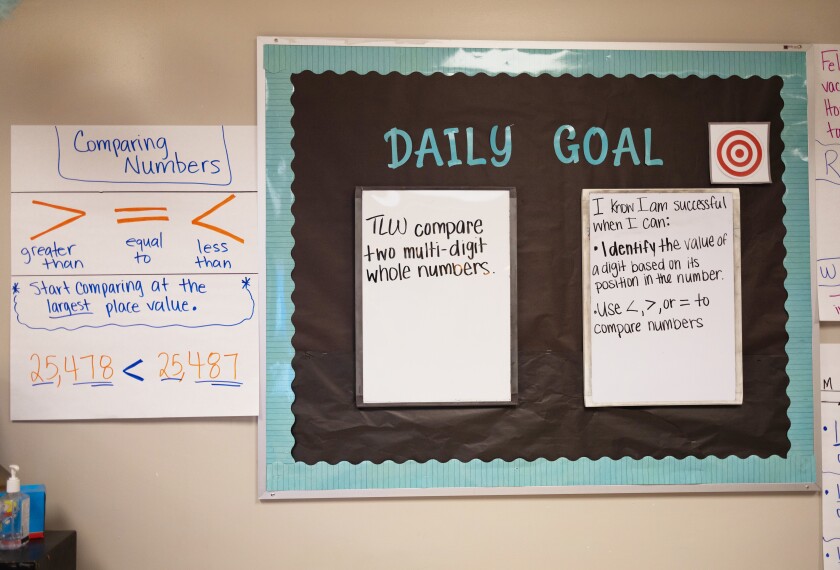
An elementary school classroom in Effie, La., shows how one of the learning goals is to master the ability to compare numbers, on August 22, 2025. New research points out steps teachers can take to memorize facts—through a combination of practice, drills, and playing with numbers.
Kathleen Flynn for Education Week
Mathematics Are Students Prepared for College-Level Math? A Senator Wants to Know
Cassidy has asked 35 institutions about incoming students' math abilities, citing a "crisis" in K-12 math education.
3 min read
Sen. Bill Cassidy, R-La., chairman of the Senate Health, Education, Labor and Pensions (HELP) Committee, strives for a closed-door meeting with fellow Republicans at the Capitol in Washington, Tuesday, Dec. 9, 2025.
Sen. Bill Cassidy, R-La., the chairman of the Senate Health, Education, Labor and Pensions (HELP) Committee, pictured on Capitol Hill on Dec. 9, 2025, has asked for details from colleges and universities about whether matriculants possess adequate math skills.
J. Scott Applewhite/AP
Mathematics Debates Over Math Teaching Are Heating Up. They Could Affect Classrooms
A controversial new movement promoting the "science of math" has come into the math establishment's crosshairs.
9 min read
Casey Dupuis points to class work for a one of her 5th graders during a math class at Lafargue Elementary School in Effie, Louisiana, on Friday, August 22. The state has implemented new professional development requirements for math teachers in grades 4-8 to help improve student achievement and address learning gaps.
A 5th grader works on a problem during a math class at an elementary school in Effie, La., on Aug. 22, 2025. A position paper on teaching math published by the National Council of Supervisors of Mathematics recently kicked off another round of conversations about what practices work best in the classroom—and what the ultimate goals of the subject even are.
Kathleen Flynn for Education Week
