
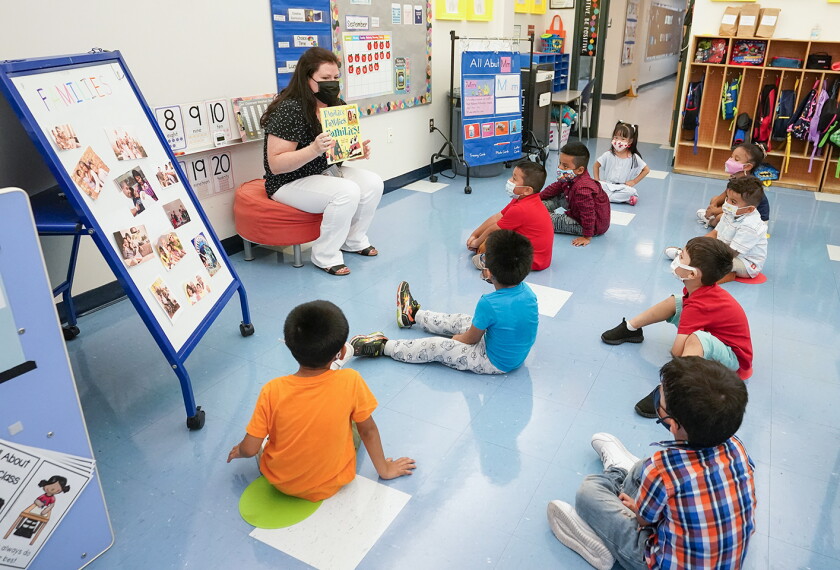
Amid the pandemic, the number of young children attending preschool has dropped to its lowest level in more than a quarter century. The decline threatens to derail decades of improvements in school readiness, particularly for the most-vulnerable children.
New Census data show only 40 percent of 3- and 4-year-olds enrolled in school in 2020, a 14 percentage-point drop from 2019 and the first time since 1996 that fewer than half of U.S. children in that age group attended preschool. (Those data back up Education Week’s own analysis of state enrollment data this summer, which found declines in kindergarten in every state and in preschool in every state that collects preschool data.)
The National Institute for Early Education Research found the top three reasons parents pulled their young children from preschool included fears of health risks, cuts to state and other preschool programs and a dearth of in-school preschool options for working parents.
In fact, the Census data show young children of working moms were particularly hard hit; their preschool enrollment fell 35 percent in 2020, compared to only 10 percent of 3- to 4-year-olds whose mothers did not work.
While most preschool programs have returned to in-person instruction, NIEER also found families continue to be concerned that sending young children to nursery school could expose them—and by extension, other vulnerable family members—to COVID-19. While a vaccine is expected to be approved for 5- to 12-year-olds in days or weeks, there is no timeline yet for COVID-19 vaccines for younger children, and studies have found students in the earliest grades are more likely than older children to infect other family members if they bring home the coronavirus.
Enrollment in preschools fell by 25 percent from 2019 to 2020, from 4.7 million to 3.5 million, significantly worse than the 9 percent drop in kindergarten enrollment, which brought that number down to 3.7 million, Census data show.
School readiness at risk
Elementary schools are already feeling the fallout of incoming kindergartners who missed early education last year. Studies find young children were exposed to significantly more screen time and had fewer opportunities to develop academic routines.
Erika Forti is the public schools superintendent in East Haven, Conn. While children who attended her district’s preschool program last year have kept up in elementary, she said, those who did not attend last year or who are coming into preschool now need more support with both academics and social-emotional development.
“The preschoolers [in 2020] who transitioned into our kindergarten definitely have a stronger foundation for routine and foundational cognitive and academic skills, but also have more regulation around emotions and executive functioning,” Forti said. “Those who have not necessarily attended preschools due to the pandemic may not have had the kindergarten-readiness skills of the kids who attended preschool ... both academics and [school] routines and, in some instances, the socialization skills.”
Moreover, the district has seen that new grades coming up will need more support. “It’s been really challenging [for] some of our 3- and 4-year-olds,” Forti said. “You know, they were 18 months old when the pandemic hit. So they were in their homes; their opportunity to socialize with others wasn’t as readily available. And so they’re coming to us with some different kinds of behaviors and in a very different place than they have in the past.”
One new study by researchers at George Mason University found children’s school-readiness skills at age 4 still predicted their academic achievement and likelihood of receiving discipline by grade 5, and the American Academy of Pediatrics finds students who attended preschool were less likely later on to show signs of anxiety or be at risk of dropping out of school.
Children who attend preschool have been shown to attend school more regularly once they get to K-12, too, according to Hedy Chang, the founder of Attendance Works, a nonprofit that studies the effects and prevention of chronic absenteeism. Better attendance comes in part, she said, because children develop school routines and become comfortable in organized school settings, and because they’ve strengthened their immune systems from having been around other kids.
Because there are few assessments for students before grade 3, Chang noted, “one of the challenges is we may not pick up what the impact of all of this is for a little while. ... We’re already going to see some impacts on 3rd grade now, but it’s going to grow over time unless we figure out some other ways to really support our youngest learners.”
East Haven provided in-person, full-day summer preschool programs for the past two years, with a focus on helping students socialize, develop executive skills, and learn hygiene and safety routines related to the pandemic. Forti said the district is doubling down on socialization and academic routine development for children who have been out of school.
“We focus on social-emotional learning and building kids’ executive functioning skills. That’s really, really important to us—to develop that strong foundation,” she said. “We need to make sure we are welcoming our kids back to safe and nurturing environments and building relationships with them.”


