

“Student data” is a term teachers use and hear about a lot, but which “student data” are actually most useful?
Today’s post begins a series to explore answers to that question.
You might also be interested in The Best Resources Showing Why We Need To Be “Data-Informed” & Not “Data-Driven.”
During my teaching career, I often maintained a running log of student formative-assessment data. More importantly, I was able to easily create visual representations of them and review the charts regularly with students. Students often loved being able to take photos of them to show their parents and/or use them to develop goals for the future.
‘Read the Class’
Rebecca Alber is an instructor in the School of Education at UCLA. She has been a high school English teacher, literacy coach, and consulting editor and writer at Edutopia:
The single best way I collect data is through observation of students. When I say this, what immediately comes to mind is a beautiful quote from educator and researcher Paulo Freire: “A good exercise in the intellectual discipline required for ‘reading’ the class as if it were a text would be for teachers to develop the habit, more out of pleasure than mere obligation, of taking daily notes recording the students’ behavioral reactions, their phrases and their meanings, and their gestures of tenderness or refusal.”
So, there I am in the classroom. My students have a writing prompt to respond to, and more than half the class is not writing or writing very hesitantly. I’m frustrated at first and feel some irritation. I breath and I observe. The students seem to be struggling to understand. This is helpful data! (As a teacher of teachers, I encourage the preservice and first-year teachers I work with to get curious not furious in their observations of students.)
What I may do next is pause my students in their writing and ask for questions to see if the prompt needs further explaining and then I may need to provide further context, or an example, or amplify a concept from the prompt. I may even need to rewrite the prompt there on the spot or add a second prompt, so they have an option. I could even jot on the white board a couple of sentence starters as well.
As I see it, Freire’s advice for “reading the class” challenges us to come from a place of joy and inquiry when observing “the students’ behavioral reactions, their phrases and their meanings, and their gestures of tenderness or refusal.”
Observation provides teachers with so much rich data—data to inform our very next moves in the moment with our students.

‘Not Limited to Test Scores’
Laleh Ghotbi is a national- bard-certified teacher with more than 30 years of experience in education. She is the 2025–26 Salt Lake City school district teacher of the year and currently teaches 4th grade at Mountain View Elementary in Salt Lake City :
To me, any information that helps me understand my students better and teach them more effectively is considered data. Data are not limited to test scores; they include students’ academic performance, social-emotional needs, interests, and the lived experiences they bring into the classroom.
I begin gathering data even before the school year starts by connecting with administrators, previous teachers, and school counselors. These conversations provide valuable insight into students’ strengths, needs, and any social-emotional considerations. This early understanding helps me create a supportive and responsive learning environment from the very first day.
At the start of the school year, I continue collecting data through intentional community-building activities. I facilitate classroom circles and ask students to complete a “Get to Know Me” page, where they share their interests, strengths, areas for growth, and what they feel confident teaching others. Since I incorporate a great deal of peer teaching, this information helps me structure meaningful collaboration. I also learn about students’ home lives and family structures, which allows me to communicate more effectively with families and honor them as essential partners in their children’s education.
Academic data are another important component of my practice. I use formal assessments to understand where students are performing relative to standards. Equally important are the informal and ongoing assessments I use daily, including classroom observations, partner discussions, thumbs-up/-sideways/-down checks, journals, and student work samples. These formative assessments give me immediate feedback on student understanding and allow me to adjust instruction in real time.
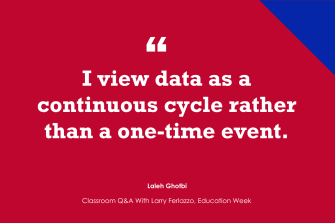
I view data as a continuous cycle rather than a one-time event. I regularly analyze both formal and informal data to identify patterns, monitor growth, and make instructional decisions. For example, I use this information to form flexible groups, differentiate instruction, and provide targeted support or enrichment. I also share relevant insights with families to keep them informed and involved in their child’s progress.
Ultimately, data guide not only my instruction but also my relationships with students. They help me meet students where they are, build on their strengths, and support their growth academically and emotionally. By using a wide range of data sources, I can create a classroom environment where all students feel seen, supported, and empowered to succeed.
‘Awash in a Sea of Student Data’
Michele Caracappa, Ed.D., is a former teacher, principal, chief academic officer, and nonprofit leader. As the founder of Lead Learning, she partners with school and system leaders to enhance and transform instructional systems so that all students thrive.
Teachers today are awash in a sea of student data. From spreadsheets to dashboards to assessment reports, there’s no shortage of stats that seek to quantify student performance. Yet researchers find that most data study initiatives have little impact on student learning—and it’s not hard to see why: Few of these data points are designed to give teachers the kind of actionable insights that actually change what happens in a classroom the next day. As a teacher and school leader, too often data study felt like participating in an autopsy, aiming to uncover what went wrong after it was too late. But years of practice have shown me there’s another way, one that facilitates action in real time, not after the fact.
The Data That Haves Been in Front of Us All Along
The most meaningful use of student data that I’ve encountered doesn’t rely on a tech platform, dashboard, or app. Rather, it involves consistently engaging in the practice of studying student work as a vehicle to improve instruction. When teachers view the work their students produce as a mirror that provides insights into their own teaching practice, they gain the opportunity to change their practice to better meet students’ needs.
Data stop being about sorting and ranking and start being about adapting instruction in ways that increase learning. And when teachers put their eyes on student work consistently, they begin to see direct evidence of how student learning improves over time: as a direct result of improvements to instruction.
Try This With Your Team
At your next team meeting, after delivering a lesson, agree to bring the work your students produced in class. Examine the work using the following questions:
- What does the work tell me about how well students learned what was taught?
- Based on my answer to question 1, how does the work reflect a strength in my teaching practice, as well as an opportunity for improvement?
- What’s a concrete shift I can make to my instruction to build on strengths and address an area of opportunity?
When reviewing student writing produced in response to literature, teachers might notice that student responses are overly formulaic. For example, students may show mastery of writing that follows a particular format (i.e., claim, evidence, explanation), but the ideas in their claims might lack originality or nuance. This insight from studying student work might help teachers see that though they’ve clearly set expectations for what a response should include, they may need to spend more time supporting students in developing ideas about a text that goes beyond the surface and more deeply plumb the meaning of what they’re reading.
This works even better as a team practice than in isolation. When teachers study student work together, they start to see patterns across classrooms—where their students’ responses are similar to or different from others'— and they learn from one another in ways that lead to increased success schoolwide.
Data That Enable Action in Real Time
This week, try it: Pick one piece of student work from a recent lesson and run it through the three questions above with a colleague. See what it tells you that a dashboard couldn’t and use the work to make shifts that improve your practice—not at the end of the unit or at the start of a new semester but in your very next class period. And then collect the work from tomorrow’s lesson and try it again!

Thanks to Rebecca, Laleh, and Michele for contributing their thoughts.
Responses today answered this question:
How do you use student data in your teaching, and what counts as data?
Consider contributing a question to be answered in a future post. You can send one to me at lferlazzo@epe.org. When you send it in, let me know if I can use your real name if it’s selected or if you’d prefer remaining anonymous and have a pseudonym in mind.
You can also contact me on X at @Larryferlazzo or on Bluesky at @larryferlazzo.bsky.social
Just a reminder; you can subscribe and receive updates from this blog via email. And if you missed any of the highlights from the first 13 years of this blog, you can see a categorized list here.


