

Today’s post wraps up a series on classroom strategies for supporting students’ identity.
Creating ‘Safe Environments’
Altagracia H. Delgado, also known as Grace, has been in the education field for 28 years. She is currently the executive director of multilingual services for Aldine ISD, in the Houston area. She is also an elected board member of the Texas Association for Bilingual Education:
Culturally responsive teaching is a research-based approach to teaching. It connects students’ cultures, languages, and life experiences with what they learn in school. These connections help students access rigorous curriculum and develop higher-level academic skills.
In addition, these classrooms are safe environments that provide space for students to take risks, make mistakes, and learn new content and language. The goal for teachers should be to intentionally plan for experiences that are enriching to students and validate them as well as expose them to other experiences.
One way to do this is through the use of culturally responsive literature. Sharing stories that have similarities in linguistic and cultural experiences of our students is a great way to begin these academic connections. By having books accessible that have a multitude of cultures and experiences, and integrating them into daily lessons, teachers can provide students with access to cultures and experiences that are similar to theirs as well as others’. This is important because students need to view characters in stories that look like them and come from backgrounds similar to theirs, doing activities that are representative of their cultures and backgrounds.
We often hear that “one cannot become what one cannot see,” and books offer potential futures to our students. Using picture books with culturally relevant stories and open-ended questions can provide opportunities for structured conversations that are engaging and can still provide rigorous learning of standards, while also developing new languages.
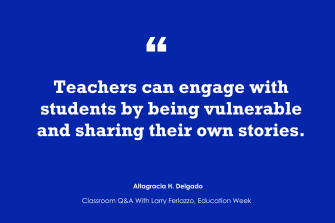
Teachers can engage with students by being vulnerable and sharing their own stories in these open conversations. Additionally, by analyzing these stories with students and helping them journal their own stories, teachers provide additional access to writing standards in scaffolded ways.
Lastly, another way to help teachers make classrooms culturally responsive is through the integrated use of visual arts activities. Since the idea of expressive language can be more than just speaking and writing, allowing students to use visual arts media like illustrations or collages can help students communicate their learning in ways to promote creative thinking and problem-solving, while amplifying students’ voice.
‘Writer’s Workshop’
Alethea Maldonado Cavin is a secondary ESL teacher in Texas. She is entering her 9th year in education and she works alongside multilingual learners:
The first year I implemented the writer’s workshop into my classroom, our writer’s workshop unit was children’s books. I began by asking students: Why is writing hard (sometimes)? What do you like (sometimes) about writing? We then discussed our own existing (multi)literacies, noting ways in which we speak, listen, read, write, and create. We were able to make that distinction among formal and informal writing and writing in the virtual world! We carried those literacies in our writer’s notebook.
We also explored what other writers do through examining children’s books and exploring notebook writing by authors themselves (like Frida Kahlo, Tupac Shakir, and Gloria Anzaldua) to past students’ notebooks. Students began to see that writing in a notebook was a world without restriction where we can honor our own language(s) and also play with language(s). I feel building this foundation before actual collecting in the writer’s notebook is key. This sort of practice builds on the funds of knowledge that our students bring to us when they enter our classrooms.
From there, we talk through what we need as writers to write our best: naming materials we need (pen, pencil, mentor text?), the space we can thrive in (Where do I need to be? Do I need to be alone or have a writing peer near?), and the environment (lighting, music, sustenance?) that sets the mood for the act of writing.
With all this in place, the writers are ready to immerse themselves in the genre of study. In this particular case, we immerse ourselves in children’s books of all types, identifying the books’ themes, literary practices, images, languages, and details. We reflect on these together and we always come back to them as we collect in our writer’s notebook.
When students begin collecting in their writer’s notebook, I always begin with teaching “writing territories” as a writing strategy. Beginning with this strategy, students can always come back to what they created as a bank of writing themes when getting started is harder on some days.
From there, as their writing teacher, you rotate each day, teaching a new writing strategy (creating lists, web map, memory, writing a letter, creating questions, creating a comic, starting with a drawing, etc.). The key is reiterating throughout the mini-writing lesson that the strategy you teach is an “invitation” and that students can choose whatever strategy they want for that specific day.
Collecting in the writer’s notebook is fundamental because here students are exploring their writing and language repertoire. Here, they are building their writing fluency and exercising their ability to write. Students collect for some time and then transition into writing around a topic they keep coming back to in their notebook. From there, students begin designing their “text” for an audience. The text can be a classroom anthology collection, stapled together to be showcased to a specific audience. The audience can be a neighboring classroom or a younger/older grade level.
I think it’s important to really think about the community of which you are a part and begin to have your students design their writing piece with that audience in mind. In our classroom, our students have written children’s books to be later displayed on a classroom altar at an annual Dia de Los Muertos event, where hundreds of “passerbyers” will interact with their writing. Planting the seed that a real audience will be reading their book sets off alarms in their brains as writers, and you will quickly see that they will take extra care crafting their masterpieces.
Strategically, when students are designing and drafting their writing piece, you can teach a few revising and editing teaching points, but it’s important not to overload your students. Even in the writer’s workshop process, writing is not perfect, and that is OK. And finally, always reflect, reflect, reflect. This is an excellent opportunity for your students to practice metacognition and understand themselves as living writers and authors.
NOTE: When I teach writing, my foundational teacher-mentor texts are the following: Randy Bomer’s Building Adolescent Literacy in Today’s English Classroom, Katherine Bomer and Corrine Arens’ A Teacher’s Guide to Writing Workshop Essentials: Time, Choice, Response, and Carla España and Luz Yadira Herrera’s En Comunidad.

‘We as Educators Must Be Open’
Darius Phelps is the assistant director of programs under the Center for Publishing & Applied Liberal Arts (PALA) department at NYU and is a manager at Brooklyn Poets:
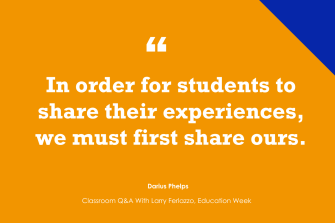
In order for students to share their experiences, we must first share ours, as well. We as educators must be open and honest about our trauma, struggles, grief, joy, and successes in order for students to write and formulate their own personal narratives through whatever method speaks to them. Our vulnerability will lead toward liberation of their own respective experiences.
Thanks to Altagracia, Alethea, and Darius for contributing to today’s post.
Guests answered this question:
What are ways to encourage students to tell their own stories; to explore, write about, share about who they are and what is important to them? And how do you develop a classroom environment to ensure that student identities are supported?
In Part One, Crystal Watson, Kwame Sarfo-Mensah, Courtney Rose, and Erica Silva contributed their responses.
In Part Two, Jacquelyn Fabian, Michele Myers, and Angela M. Ward shared their answers.
In Part Three, Jessica Wood, Kristin Hoins, and Becky Corr wrote their answers.
Consider contributing a question to be answered in a future post. You can send one to me at lferlazzo@epe.org. When you send it in, let me know if I can use your real name if it’s selected or if you’d prefer remaining anonymous and have a pseudonym in mind.
You can also contact me on Twitter at @Larryferlazzo.
Just a reminder; you can subscribe and receive updates from this blog via email. And if you missed any of the highlights from the first 12 years of this blog, you can see a categorized list here.


