Reading & Literacy News in Brief

Novel Reading Could Be Good for Brain, Study Says

By Anthony Rebora — January 22, 2014 1 min read
  • Save to favorites
  • Print

A new study out of Emory University offers evidence that reading novels is more than just high-level entertainment. It also appears to be good for the brain.

The study, published in the journal Brain Connectivity, involved giving regular MRI brain scans to college students who were in the midst of reading Pompeii, a thriller by Robert Harris.

The results showed heightened connectivity (compared with baseline scans) in the areas of the brain associated with language receptivity and representative understanding—that is, grasping or sensing things the reader isn’t literally experiencing.

The heightened activity in those areas of the brain was apparent even days after the students had been actively reading the book, suggesting that something akin to muscle memory was activated.

Related Tags:

A version of this article appeared in the January 22, 2014 edition of Education Week as Novel Reading Could Be Good for Brain, Study Says

Events

Artificial Intelligence Webinar AI and 'Techlash' Are on a Collision Course. How Should Schools Respond?
Learn what strategies and tactics schools can develop to encourage smart and responsible AI use, while also enforcing tech guardrails.
This content is provided by our sponsor. It is not written by and does not necessarily reflect the views of Education Week's editorial staff.
Sponsor
Special Education Webinar
Special Education Disputes & Rising Costs: Protecting Your District
Special education costs and risks are rising. Learn how stronger IEP and Medicaid processes help districts protect funding and compliance.
Content provided by Relay
This content is provided by our sponsor. It is not written by and does not necessarily reflect the views of Education Week's editorial staff.
Sponsor
Personalized Learning Webinar
Differentiation That Delivers: Proven Practices From High-Growth Districts
Make every minute count. Proven strategies from educators and leaders driving real student growth. Save your seat!
Content provided by i-Ready, Curriculum Associates

EdWeek Top School Jobs

Teacher Jobs
Search over ten thousand teaching jobs nationwide — elementary, middle, high school and more.
View Jobs
Principal Jobs
Find hundreds of jobs for principals, assistant principals, and other school leadership roles.
View Jobs
Administrator Jobs
Over a thousand district-level jobs: superintendents, directors, more.
View Jobs
Support Staff Jobs
Search thousands of jobs, from paraprofessionals to counselors and more.
View Jobs

Read Next

Reading & Literacy Q&A Why This Under-the-Radar Piece of Literacy Reform Is One of the Most Important
Parent notification is a central piece of reading reform, this advocate says.
5 min read
Collage of a Black female reading a book with her young daughter on her lap. Other pieces of the collage show an open book with non-legible text, speech bubbles, the letter "A" and a butterfly.
Collage by Gina Tomko/Education Week + Canva
Reading & Literacy 'Long Form' vs. 'Short' Reading: What's Going on Inside A Student's Brain?
Reading a novel and reading short text messages work the brain differently. Here's what that means.
3 min read
Pieces of a book page and a cellphone.
Collage by Laura Baker/Education Week + Getty
Reading & Literacy Creating a Culture of Reading for Pleasure Amid a Focus on Basics
School librarians at Missouri's Clayton school district bring a culture of reading to all students.
9 min read
Tom Bober
Students read books in the library at Captain Elementary School in Clayton, Mo., on Tuesday, Sept. 29, 2026. School Librarian Tom Bober works with teachers at the school to help instill a culture of reading early in students' lives.
Neeta Satam for Education Week
Reading & Literacy Getting Middle Schoolers to Do the Reading Is Hard. Can Communal Reading Help?
New classroom methods aim to help kids internalize the message that engaging in print is worth it.
11 min read
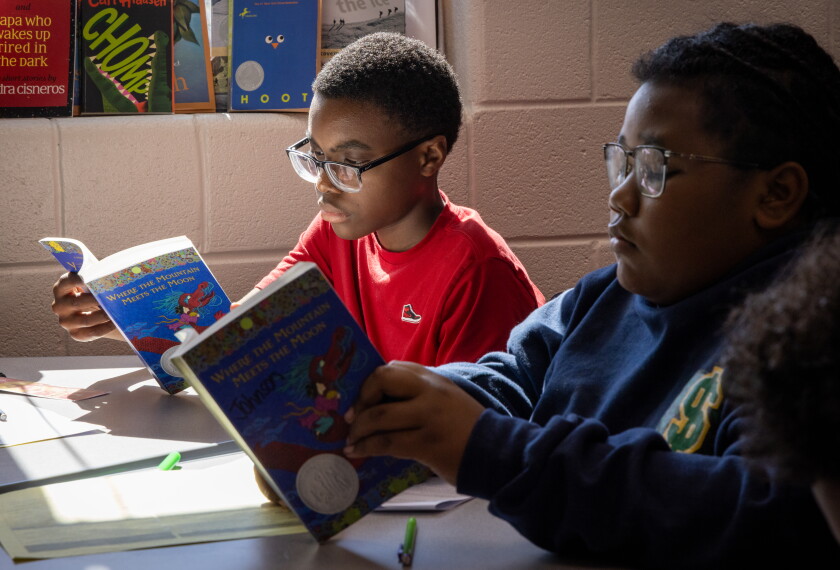
Students read Where the Mountain Meets the Moon in Jaime Johnson’s 6th grade language arts class at Murphy Middle School in Dacula, Georgia on September 22, 2026.
Students read <i>Where the Mountain Meets the Moon</i> in teacher Jaime Johnson’s 6th grade language arts class at Murphy Middle School in Dacula, Georgia on September 22, 2026. Johnson has students do most of the reading in class—to improve fluency, created a shared culture of engagement in books, and above all make sure every student completes the text.
Dustin Chambers for Education Week