
The teenager walks into the empty classroom and crams his lanky frame into a desk. Three teachers, the high school psychologist, and the principal sit in a circle around him. This 17-year-old 10th grader knows he’s been summoned here because his classwork has been slipping.
What he doesn’t know is that he’s part of an expanding national effort to keep students like him—who are overage for their grades—from slipping away from school altogether. The creation of this Cleveland program five years ago reflects a growing national awareness that overage students are far more likely to drop out than those who progress with their peers.
“We want you to pass. We want you to do better,” says Karen Scebbi, the psychologist. “I believe you want that, too.”
Silent, the young man fidgets. He can’t explain why he raps and jokes in class more often than he completes his work. Nearly grown and only a sophomore, he had fallen so far behind at his neighborhood school that he came here to the Options Complex at Margaret A. Ireland School to catch up. But his teachers are worried.
“We’re losing you,” says English teacher Dan Timko. “We need to know what we can do to keep you.”
Hanging onto kids who might otherwise leave school is the mission of the Options Complex, a program for students in grades 6-12 who are behind in school by two or more years. Much of the concern about dropout rates has focused on improving high schools. But experts say that struggling middle schoolers, a too-often-overlooked group, are likely to flounder in 9th grade and stop attending school.
“The best way to improve high schools is to salvage the middle school experience,” said John M. Beam, the executive director of the National Center for Schools and Communities at Fordham University. “Something’s happening in middle school. That’s ultimately where the policy fix may need to be.”
Intervening Early
The Alliance for Excellent Education, a Washington advocacy organization, released figures this month showing that 28 percent of the nation’s 8th graders are at risk of dropping out of high school because of poor reading skills. Students who enter high school reading poorly are 20 times more likely to drop out than their highest-achieving classmates, the group said.
The Philadelphia Education Fund and Johns Hopkins University reported in a recent study that four risk factors among 6th graders make dropping out likely: failing either English or mathematics, attending school less than 80 percent of the time, or receiving poor marks for behavior.
“The field is definitely starting to look at younger kids,” said Robert Balfanz, a Johns Hopkins research scientist and a co-author of the report. “The idea is, if we can identify the kids who might fall off the graduation track earlier on, we might be able to intervene more effectively.”
Accordingly, some school districts are making a special effort to reach middle schoolers who are overage for their grade. Recognizing that they can teeter on dropping out for varying reasons—frequent moves, a need to work after school, difficulty learning English, academic troubles, family crises, chronic misbehavior—districts are offering a portfolio of approaches rather than a fixed route.
The New York City department of education is working with community groups to expand options for overage students as part of an approach it calls “multiple pathways to graduation.”
Some of the New York City programs are geared to teenagers who fell behind in high school, and others to older students with more serious life issues who need to complete their credits in the evening. Both kinds provide personalized, intensive support.
Educators are also stepping up literacy instruction for struggling readers in middle schools. New York also is opening many small high schools that are intended to provide better learning environments for adolescents, said Michele Cahill, a senior adviser on education to Schools Chancellor Joel I. Klein.
“The thinking used to be, ‘We have a large, comprehensive high school on this schedule, and you have to fit into it,’ ” Ms. Cahill said. “Now, we start with where the kids are, set demanding standards, and plan what we need in the system to get them there.”
Cincinnati’s 9-year-old program for overage middle schoolers features classes of 15 to 18 students, an accelerated curriculum, and after-school tutors. Seeing 95 percent of each 8th grade group complete the program and move on to high school has convinced Principal Joseph Porter of the program’s value.
“If kids are held back a year or two, [and] they’re sitting in a 5th grade class and they’re 13, their self-esteem goes down. They’re frustrated. There are going to be behavior problems,” said Mr. Porter, the principal of Lafayette Bloom Back on Track Middle School. “They need to be with kids their own age.”
Doing Things Differently
Dallas has expanded its “reconnection centers” for overage high school students downward to serve middle schoolers after officials noticed that many middle school students were too old for their grades.
“I looked at the data and knew we had to do something differently,” said H.B. Bell, Dallas’ associate superintendent for dropout prevention. “The numbers were astounding.”
Philadelphia has opened three new high schools for overage students with too few credits, and has begun an accelerated pilot program for about 170 overage middle school students.
Cleveland’s program, which also includes two other schools for overage middle school students, began when the district’s chief executive officer, Barbara Byrd-Bennett, noticed that the 9th grade had the largest group of children too old for their grade.
The district also offers programs for high school students who are overage, or have returned after dropping out. Most end in a regular high school diploma rather than an equivalency credential.
“We need to give these kids the instruction and the diploma they need to compete in society,” Ms. Byrd-Bennett said. “If in fact you create what have been traditionally called ‘alternative schools,’ you’re essentially tracking a subculture.”
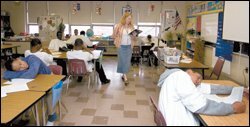
The Options Complex’s 175 students have fallen behind at their regular schools because they’ve failed grades. Once they transfer, they work on an accelerated curriculum designed to catch them up with their peers. Then they can return to their former schools or stay on to graduate. Most stay. Some still fall off the radar screen.
The teaching approach is informal and emphasizes active engagement—a recognition that many students have had difficulty connecting with their schoolwork.
A recent day in Algebra 1, for example, finds middle schoolers working with plastic pieces to fit equations together. A high school social studies teacher downstairs ignores students’ legs draped over their desks, and lets them speak out as they wish in a lively discussion about the jury system.
Students with behavior problems—a sizable portion of those at the Complex—have adult mentors in the building. Teachers draw up customized plans for getting students on track that require daily monitoring and teacher feedback. The school has one full-time psychologist for the middle school students, and another for the high school students.
With a pupil-teacher ratio of 25-to-1, the classes are smaller than those districtwide, but have grown from an average of 15 because of budget-driven staff cuts.
With 500 of the district’s nearly 16,000 middle schoolers overage this school year, the Options Complex has a waiting list. Though the district spends an average of $2,000 more on each Options student, the school was spared from a round of school closures this spring forced by a budget shortfall.
Seeing Results
Ms. Byrd-Bennett views the program as effective. According to district figures, less than 3 percent of its 6,500 9th graders are overage this year, compared with 8.5 percent in 2002-03.
Its state test scores vary—fewer than a third of the school’s 9th graders scored at the proficient level in mathematics or science last year, while more than 80 percent hit that mark in writing. The school’s scores lag behind district averages, and the proportion of students who receive disciplinary action is higher than in regular middle schools.
But it isn’t hard to find Options students who believe the program has turned their lives around. They cite as crucial the smaller classes, individualized attention, and the never-give-up attitude of their teachers.
“At my old school, there were 40 kids in my classes, and I was just getting into fights, coming back, getting behind on my work, and getting into trouble again,” said Shannon Bell, 18, who made it to 12th grade this year after being two years behind.
“Here, they break it down and make sure you understand,” he said. “You feel you belong. It’s a second chance to do something with your life instead of just act a fool.”
Some activists worry that such programs can let schools push out borderline students by “counseling” them out of regular schools.
Anne Wheelock, an independent researcher in Boston, contends that it’s best to provide overage children with customized academic and emotional support in their regular schools. Too often, she says, separate programs use a one-size-fits-all approach that doesn’t work with children of widely varying needs.
“It also gives the mainstream school an escape hatch,” she said. “They always have in the back of their mind, ‘Oh, we can refer our overage kids to the school for overage kids,’ and they never have to do anything to stop the production of overage kids to begin with.”
But Ephraim Weisstein, a vice president of Boston’s Commonwealth Corp., a nonprofit group that designed the Diploma Plus model used in that city for students considered at risk of dropping out, said such teenagers often need separate programs because most traditional schools cannot offer enough support. He rejects the criticism that separate schools create a subclass of students who can’t successfully re-enter the mainstream.
“Don’t we have that kind of system right now?” he said, noting that large percentages of students fall out of the school system or finish without sufficient skills for college or work. “The issue isn’t, are we creating a second-class set of schools? We have one. The issue is, what are we going to do about it?”


