

When a group of Wyoming school districts explored why the students who could benefit the most from internships weren’t doing them, they quickly identified a common barrier—and a creative solution.
Embedding with local employers can help disengaged students find a new purpose for learning and identify future jobs in their own communities, the Wyoming leaders said. But struggling students too often passed those opportunities up. The reason? They needed the time to take additional English classes to fulfill the state’s graduation requirements.
An industrious team of English teachers, community college professors, and district administrators designed a way for students participating in a work-based learning experience to earn an English credit concurrently by completing a series of professional writing assignments related to their internships. Even better: Students who complete the course also earn an introductory college credit that they can put toward their future degrees.
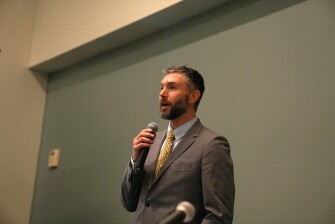
It’s all part of an evolving strategy conceived by four districts clustered in and around Sheridan, Wyo., which have partnered with Sheridan College and local employers to help students identify career pathways early and experience them before they graduate. Two superintendents discussed the collaboration, known as the Northern Wyoming Career Pathways Partnership, at the National Conference on Education, hosted by AASA, the School Superintendents Association, in Nashville on Thursday.
“There are all kinds of reasons students leave our communities after graduation,” said Chase Christensen, superintendent of the rural Sheridan County District #3. “The one reason we don’t want to see is that they don’t see the opportunity to stay.”
The districts’ work comes as school systems around the country aim to build their relevance for students and families by partnering with local employers to design new student learning experiences, a key focus of the AASA conference.
Knocking down barriers to career-based learning
In small towns, that work is particularly relevant, Christensen said. Connecting students to local jobs can be a key strategy for economic development, improving graduation rates, and even maintaining school enrollment levels, as more students opt to return to their communities and start families after college or career training, he said.
The three districts in Sheridan County and one in neighboring Johnson County use a multi-phase strategy to introduce students to possible career fields early, explore whether their aptitude aligns with their interests, and engage in job shadowing and internships to get hands-on experiences.
“We need to ask ourselves, ‘Why do our kids keep coming back? And more importantly, why don’t they?’” said Scott Stults, superintendent of Sheridan County District #2.
Stults’ district eliminated valedictorian and salutatorian titles when educators discovered that many high-achieving students bypassed internships they might have otherwise pursued, favoring additional Advanced Placement courses weighted more in calculating GPAs.
For struggling students, they offered additional credit-recovery options and eased GPA requirements that were often barriers for interested students.
The English/language arts credit helps address the needs of students across the academic spectrum by giving them an early start to a college degree. For students interested in the trades, it may incentivize them to pursue a more lucrative associate degree, rather than a professional certificate, Christensen said.
Work for the course, overseen by a Sheridan College professor, includes a writing assignment that stretches students’ problem-solving and relationship skills. Students must identify an area for improvement in their internship employers’ policies or processes and propose a solution in a written essay that they discuss with their supervisor at an exit interview.
Some employers have actually adopted students’ suggestions, which helped them cut costs and improve products, Stults said. In one case, a local rifle manufacturer changed a metal-finishing process after a student shared a skill he’d developed in shop class. Supervisors later offered to pay for the student to complete gunsmith training so he could return as a full-time employee after graduation.
“We tell employers, ‘You’re going to have a valuable employee there on day one,’” said Christensen. “‘They can think outside the box because they haven’t had the lid shut yet.’”
A phased approach to career exploration
The ELA credit, and high school internships, build on a phased approach.
All four districts employ career coaches, who work with students to identify learning experiences and coordinate with local employers to identify new opportunities.
They also take students on field trips and hold career fairs to show the range of jobs at local companies. For example: While Sheridan County doesn’t have a big tech employer, a student could become a computer programmer at a nearby hospital.
In 8th or 9th grade, students complete ungraded assessments developed by YouScience, an education company, that identify overlaps in their career-related interests and aptitudes. Those results can help drive conversations with parents and identify needed coursework, Stults said.
If students have a high aptitude in a given career field and no interest, they may benefit from hearing from an adult who does that work. If they have high interest but low aptitude, they may select courses that can help build those necessary skills, leaders said.
Career coaches also share the aggregate results with employers and the local Chamber of Commerce, which may use the data for economic development. If data show that hundreds of high school students have both high aptitude and interest in technology jobs, that might become a selling point for a tech company interested in expanding in the area.
Districts also use the results to sort students into advisories based on aptitude and interest so they can hold regular conversations with like-minded peers about what’s next, leaders said.
The approach has been so successful that leaders are searching for ways to evolve and expand it. One possibility: Identifying additional college credits like math and geometry that overlap with students’ internships.
“If we don’t ensure our students see a future for themselves in the community where they graduated and grew up, of course they are going to leave,” Christensen said.


