
Science

How to Build Girls’ Interest and Confidence in STEM Learning

By Lauraine Langreo — December 12, 2022 2 min read
Black girl wearing face mask and protective glasses using microscope in laboratory
  • Save to favorites
  • Print

Female representation in science, technology, engineering, and math (or STEM) jobs is increasing, especially in health-care-related jobs. But women are still largely underrepresented in other STEM careers, such as computer science and engineering, according to data from the U.S. Census Bureau.

The reason? Girls still have to break through barriers, such as gender stereotypes, in order to gain interest in STEM fields and feel confident that they can be successful in them.

Experts say that it’s vital for girls to be introduced to STEM career opportunities as early as elementary school and have role models throughout their K-12 education who will encourage them to pursue study in these fields.

This is where schools come into the picture. Too often, students aren’t introduced to STEM career opportunities until they’re in high school, but that is often too late for many kids, according to experts. STEM engagement could be done through hands-on activities, after-school clubs, and career day events that start in elementary school and extend into middle and high school.

Education Week has extensive coverage that addresses the question of how to get more girls to pursue STEM careers. Here is a collection of articles and videos Education Week has published on this topic that you could use to tackle this challenge.

What the research says

Photo of teacher with students working on STEM project.

Boys and girls start out on the same biological footing when it comes to math, based on the first neuroimaging study of math gender differences in children, according to an article published in the journal Science of Learning.

Girls persevere longer and are more engaged in science tasks when they are asked to “do science,” rather than “be scientists,” according to a study published in the journal Psychological Science.

Gender gaps in the most male-dominated science fields don’t come from men outperforming women academically in those subjects, but from the fact that overwhelmingly more low-achieving boys opt for STEM careers more than most girls do, according to a study by New York University researchers.


Girls’ STEM teachers are influential

Ninth graders Angela Alexy, Zoe Doyle, and Sarah Retallick use Instamorph to mold a custom phone cord holder at Pennsbury High School in Falls Township, Pa., on March 19, 2018. Bucks County schools are involving girls in STEM programs.

One of the most influential factors that determines whether girls will pursue a career in the technology industry is having a parent or teacher who encouraged them to study computer science, according to a survey from Girls Who Code and Logitech.


How to make STEM more inclusive
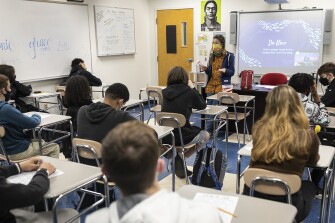
Megan Bowen walks through the lesson plan for the day during class at Salem Academy Charter School in Salem, Mass., on April 25, 2022.

Three Latina teachers discuss how they’re pushing the boundaries of computer science education, by expanding the K-12 sector’s notions of what counts as “real” computer science.


Using video games to spark girls’ interest in STEM

A screenshot from the game, Minecraft Dungeon.

To get girls interested in STEM careers, two teachers in a Louisiana school district decided to start their own after-school club called Girls Who Game. The students play Minecraft, a 3D game where you can create just about anything, to learn skills such as communication, collaboration, critical thinking, problem solving, and creativity.


What women in STEM careers have to say

Former Southwest Airlines pilot Tammie Jo Shults talked about school anxiety, STEM career preparation programs, and what problem-solving skills students should be learning in school.

In an article, female NASA scientists talked about what educators can do to ensure they are engaging girls and other underrepresented students in STEM.

Events

School & District Management Webinar Squeeze More Learning Time Out of the School Day
Learn how to increase learning time for your students by identifying and minimizing classroom disruptions.
This content is provided by our sponsor. It is not written by and does not necessarily reflect the views of Education Week's editorial staff.
Sponsor
Reading & Literacy Webinar
Improve Reading Comprehension: Three Tools for Working Memory Challenges
Discover three working memory workarounds to help your students improve reading comprehension and empower them on their reading journey.
Content provided by Solution Tree
Recruitment & Retention Webinar EdRecruiter 2026 Survey Results: How School Districts are Finding and Keeping Talent
Discover the latest K-12 hiring trends from EdWeek’s nationwide survey of job seekers and district HR professionals.

EdWeek Top School Jobs

Teacher Jobs
Search over ten thousand teaching jobs nationwide — elementary, middle, high school and more.
View Jobs
Principal Jobs
Find hundreds of jobs for principals, assistant principals, and other school leadership roles.
View Jobs
Administrator Jobs
Over a thousand district-level jobs: superintendents, directors, more.
View Jobs
Support Staff Jobs
Search thousands of jobs, from paraprofessionals to counselors and more.
View Jobs

Read Next

Science Want Students to Be Better in Science? Bolster Their Math Skills
Teachers share how they model problem-solving, build conceptual understanding of equations, and collaborate with math educators.
5 min read
Seniors at Thurgood Marshall Academic High School in San Francisco practice the use of a pipette as part of a STEM initiative on April 29, 2024.
Seniors at Thurgood Marshall Academic High School in San Francisco practice the use of a pipette as part of a STEM initiative on April 29, 2024. Science teachers say they often have to shore up students' math skills in their lessons.
Peter Prato for Education Week
Science From Our Research Center Nearly Half of Teens Can’t Identify What Causes Climate Change. Why That Matters
Climate change is affecting many industries and students need a basic understanding of the concept to succeed in those fields, experts say.
7 min read
Scientists say that climate change makes storms like hurricanes more destructive. This 2022 aerial view of Fort Myers Beach, Fla. shows the aftermath of Hurricane Ian which made landfall as a Category 4 hurricane.
In this aerial view, heavily damaged mobile homes are seen in Fort Myers Beach, Fla., a month after Hurricane Ian made landfall as a Category 4 hurricane in 2022, causing an estimated $67 billion in insured losses. Experts say climate change is leading to more hurricanes and floods.
Paul Hennessy/Sipa via AP
Science Making Time for Science in Kindergarten Could Have a Big Payoff
When teachers in grades P-1 received high-quality curriculum and PD in science, students' scores rose, a new meta-analysis finds.
4 min read
First graders take a closer look at bees during a class lesson.
First graders take a closer look at bees during a class lesson. Science is often neglected in the early grades, but new research suggests that young students who are exposed early to science instruction do better on science exams—potentially setting them up for later success in the discipline.
Allison Shelley for All4Ed
Science Download How Teachers Are Motivating Students To Learn STEM (DOWNLOADABLE)
Teachers asked students what motivates them to work harder in STEM. Here's what they found.
1 min read
Diverse school children students build robotic cars using computers and coding.
iStock / Getty
