Science

Digital Competition Links Technology, Basketball, and Learning

By Kathleen Kennedy Manzo — September 16, 2009 2 min read
  • Save to favorites
  • Print

Students applauded politely for the dignitaries who were visiting Jefferson Junior High School in Washington yesterday for the launch of a new grant program to promote technology-based learning. But most had never heard of John Holdren (from the White House technology office), William Wilhoyte (the instructional superintendent for D.C. public schools), or Don Knezek (executive director of the International Society for Technology in Education).

The students waited patiently, however, for each introduction, and listened quietly to remarks about the initiative, called HP Digital Assist. But they broke into wild clapping and cheering for the real celebrity, professional basketball player Antawn Jamison.
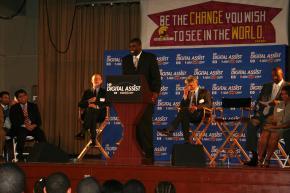
Jamison, who plays for the Washington Wizards, was there to represent the NBA, which is partnering with ISTE and Hewlett Packard to encourage students in D.C., Chicago, Dallas, Houston, Miami, and the San Francisco Bay Area to create multimedia, sports-themed projects that demonstrate their math, science, and technology skills.

The best presentations from each region will be selected in December, with the winners earning HP products for their classrooms and NBA tickets and merchandise.

Once they hone their technology skills, students at Jefferson are planning on creating photo essays and Web sites, as well as producing videos, all of which will require them to build their math and technology proficiency, according to teacher Taiwanna Anthony.

“We want them to get a broad ranger of technology skills and utilize math and science concepts and see how they relate to each other across content areas,” said Anthony.

I’m not sure the students see those kinds of content-area lessons as the real benefits of the program. It was clear that the basketball connection was the exciting part for them. A cynic might question whether the HP and NBA sponsorships are all about the potential for learning, given the inherent public relations potential of such a program, but Anthony and others say that linking learning to something that students are passionate about can engage them more deeply in the subject matter.

Holdren pointed to President Obama’s combined passions for education, technology, and basketball as evidence of the president’s support for such approaches.

“I can’t think of a better way for students to learn math and science by engaging them, by making it fun, linking it to technology, and linking it to basketball,” said Holdren.

Photo: Antawn Jamison, center, at the launch of HP Digital Assist program at Jefferson Junior High School in Washington. Photo by Kathleen Kennedy Manzo/Education Week

Related Tags:

A version of this news article first appeared in the Digital Education blog.

Events

This content is provided by our sponsor. It is not written by and does not necessarily reflect the views of Education Week's editorial staff.
Sponsor
Special Education Webinar
Integrating and Interpreting MTSS Data: How Districts Are Designing Systems That Identify Student Needs
Discover practical ways to organize MTSS data that enable timely, confident MTSS decisions, ensuring every student is seen and supported.
Content provided by Panorama Education
Artificial Intelligence Live Online Discussion A Seat at the Table: AI Could Be Your Thought Partner
How can educators prepare young people for an AI-powered workplace? Join our discussion on using AI as a cognitive companion.
Student Well-Being & Movement K-12 Essentials Forum How Schools Are Teaching Students Life Skills
Join this free virtual event to explore creative ways schools have found to seamlessly integrate teaching life skills into the school day.

EdWeek Top School Jobs

Teacher Jobs
Search over ten thousand teaching jobs nationwide — elementary, middle, high school and more.
View Jobs
Principal Jobs
Find hundreds of jobs for principals, assistant principals, and other school leadership roles.
View Jobs
Administrator Jobs
Over a thousand district-level jobs: superintendents, directors, more.
View Jobs
Support Staff Jobs
Search thousands of jobs, from paraprofessionals to counselors and more.
View Jobs

Read Next

Science Opinion Science Is Losing the Battle for America’s Trust. How Schools Can Help
I grew up a creationist and became a science educator. Here’s what I know about building trust in science.
Amanda L. Townley
8 min read
A diverse group of people building a hall of science using scientific tools, blocks, and symbols.
Islenia Mil for Education Week
Science Want Students to Be Better in Science? Bolster Their Math Skills
Teachers share how they model problem-solving, build conceptual understanding of equations, and collaborate with math educators.
5 min read
Seniors at Thurgood Marshall Academic High School in San Francisco practice the use of a pipette as part of a STEM initiative on April 29, 2024.
Seniors at Thurgood Marshall Academic High School in San Francisco practice the use of a pipette as part of a STEM initiative on April 29, 2024. Science teachers say they often have to shore up students' math skills in their lessons.
Peter Prato for Education Week
Science From Our Research Center Nearly Half of Teens Can’t Identify What Causes Climate Change. Why That Matters
Climate change is affecting many industries and students need a basic understanding of the concept to succeed in those fields, experts say.
7 min read
Scientists say that climate change makes storms like hurricanes more destructive. This 2022 aerial view of Fort Myers Beach, Fla. shows the aftermath of Hurricane Ian which made landfall as a Category 4 hurricane.
In this aerial view, heavily damaged mobile homes are seen in Fort Myers Beach, Fla., a month after Hurricane Ian made landfall as a Category 4 hurricane in 2022, causing an estimated $67 billion in insured losses. Experts say climate change is leading to more hurricanes and floods.
Paul Hennessy/Sipa via AP
Science Making Time for Science in Kindergarten Could Have a Big Payoff
When teachers in grades P-1 received high-quality curriculum and PD in science, students' scores rose, a new meta-analysis finds.
4 min read
First graders take a closer look at bees during a class lesson.
First graders take a closer look at bees during a class lesson. Science is often neglected in the early grades, but new research suggests that young students who are exposed early to science instruction do better on science exams—potentially setting them up for later success in the discipline.
Allison Shelley for All4Ed
