College & Workforce Readiness

Demand Still Growing for Online Credit-Recovery Classes

By Mary Ann Zehr — October 15, 2010 1 min read
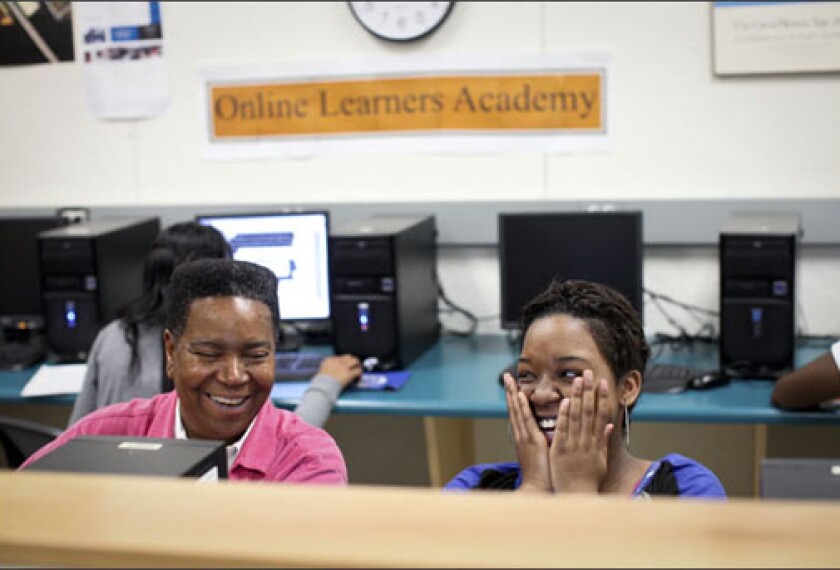
Headmaster Julie Coles, left, works with Dequisha Hill, 19, on strategies for reading comprehension during the Online Learners Academy, a credit-recovery course at the Greater Egleston Community High School in Boston.
  • Save to favorites
  • Print

Interest in online credit-recovery courses continues to surge, prompting some policy experts and educators to consider whether traditional rules requiring students to spend a certain number of hours in the classroom, rather than simply demonstrate their proficiency in the subject matter, are increasingly outdated.

At least three major urban school districts—New York City, Chicago, and Boston—have recently rolled out or soon will roll out programs for online credit recovery. That means that students who have failed courses in high school can earn credits for those courses by making them up through online coursework. District policies vary in whether the students take the classes at an actual school or can do the coursework at home or in another setting.

See Also

Read a more in depth version of this article: “Districts Embracing Online Credit-Recovery Options”

Sales in the credit-recovery line of courses created by Portland, Ore.-based Aventa Learning, one of several companies or nonprofit organizations typically tapped by schools to provide online courses, increased eightfold from 2008 to 2010, according to company officials.

Representatives from the Florida Virtual School, a statewide public school based in Orlando, and the Seattle-based Apex Learning Inc. say they’re noticing increasingly high demand for the use of their regular online courses for credit-recovery purposes.

A version of this article appeared in the October 20, 2010 edition of Digital Directions as E-Credit Recovery Surges

Events

Jobs Regional K-12 Virtual Career Fair: DMV
Find teaching jobs and K-12 education jubs at the EdWeek Top School Jobs virtual career fair.
This content is provided by our sponsor. It is not written by and does not necessarily reflect the views of Education Week's editorial staff.
Sponsor
School Climate & Safety Webinar
Cardiac Emergency Response Plans: What Schools Need Now
Sudden cardiac arrest can happen at school. Learn why CERPs matter, what’srequired, and how districts can prepare to save lives.
Content provided by American Heart Association
Teaching Profession Webinar Effective Strategies to Lift and Sustain Teacher Morale: Lessons from Texas
Learn about the state of teacher morale in Texas and strategies that could lift educators' satisfaction there and around the country.

EdWeek Top School Jobs

Teacher Jobs
Search over ten thousand teaching jobs nationwide — elementary, middle, high school and more.
View Jobs
Principal Jobs
Find hundreds of jobs for principals, assistant principals, and other school leadership roles.
View Jobs
Administrator Jobs
Over a thousand district-level jobs: superintendents, directors, more.
View Jobs
Support Staff Jobs
Search thousands of jobs, from paraprofessionals to counselors and more.
View Jobs

Read Next

College & Workforce Readiness How to Bring More Value to Career-Tech Education Programs
Aligning academic goals to the labor market is critical, according to the Education Commission of the States.
5 min read
Keaton Turner, a junior at Warren County High School, welds a during an advanced manufacturing class in McMinnville.
Keaton Turner, a junior at Warren County High School, welds a during an advanced manufacturing class in McMinnville, Tenn., in May of 2017. States and districts need to do a better job connecting career-focused academic lessons with industry goals, speakers at a recent Education Commission of the States forum said.
Joe Buglewicz for Education Week
College & Workforce Readiness Inside One District’s Experiment to Anchor Learning Around Career-Ready Skills
Employers identify skills like creativity and collaboration as key to success in careers.
8 min read
An 8-year-old girl in a purple t-shirt leans over a butcher block counter inside a retrofitted school bus to glue together a map. Behind her, two classmates glue their projects.
Aiden Montanez Castro, 8, Zayne Mendez, 8, and Violet Ward, 8, work on a lesson in making a topographical map of their hometown at Fulton Elementary School in Ephrata, Pa. The Ephrata district refashioned a school bus into a Maker Bus, which parks at each of the district’s elementary schools for hands-on projects. The district has oriented its teaching around projects that allow students to demonstrate skills like empathy and creativity alongside content knowledge.
Scott Lewis for Education Week
College & Workforce Readiness Reports Work-Based Learning in Postsecondary Education: Results of a National Survey
Based on a 2025 survey, this report examines key questions about educator perspectives on work-based learning in postsecondary education.
College & Workforce Readiness Spotlight Spotlight on College and Career Pathways Designed to Serve All Students
CTE is transforming career prep: AI, high-tech training, and real-world learning connect students to in-demand jobs and future-ready skills.
