Federal Obituary

Rod Paige, Nation’s First African American Secretary of Education, Dies at 92

The Ed. Dept. rolled out the landmark No Child Left Behind Act during his tenure
By The Associated Press — December 10, 2025 4 min read
Education Secretary Rod Paige talks to reporters during a hastily called news conference at the Department of Education in Washington Wednesday, April 9, 2003, regarding his comments favoring schools that appreciate "the values of the Christian community." Paige said he wasn't trying to impose his religious views on others and said "I don't think I have anything to apologize for. What I'm doing is clarifying my remarks."
  • Save to favorites
  • Print

Rod Paige, an educator, coach, and administrator who rolled out the nation’s landmark No Child Left Behind law as the first African American to serve as U.S. secretary of education, died Tuesday.

Former President George W. Bush, who tapped Paige for the nation’s top federal education post, announced the death in a statement but did not provide further details. Paige was 92.

Under Paige’s leadership, the Department of Education implemented the No Child Left Behind law that in 2002 became Bush’s signature education law and was modeled on Paige’s previous work as a schools superintendent in Houston. The law required states to test students annually in grades 3-8 and to intervene if groups of students, like those learning English or those from low-income families, failed to make steady progress.

See Also

President Bush's Secretary of Education Rod Paige, 67, smiles after his swearing in ceremony at the Department of Education in Washington, Wednesday, Jan. 24, 2001.
J. Scott Applewhite/AP
Federal Explainer Rod Paige, Seventh U.S. Education Secretary: Biography and Achievements
Education Week Library Staff, August 18, 2017
3 min read

“Rod was a leader and a friend,” Bush said in his statement. “Unsatisfied with the status quo, he challenged what we called ‘the soft bigotry of low expectations.’ Rod worked hard to make sure that where a child was born didn’t determine whether they could succeed in school and beyond.”

Roderick R. Paige was born to two teachers in the small Mississippi town of Monticello of roughly 1,400 inhabitants. The oldest of five siblings, Paige served a two-year stint in the U.S. Navy before becoming a football coach at the high school, and then junior college levels. Within years, Paige rose to head coach of Jackson State University, his alma mater and a historically black college in the Mississippi capital city.

There, his team became the first—with a 1967 football game—to integrate Mississippi Veterans Memorial Stadium, once an all-white venue.

After moving to Houston in the mid-1970s to become head coach of Texas Southern University, Paige pivoted from the playing field to the classroom and education—first as a teacher, and then as administrator and eventually the dean of its college of education from 1984 to 1994.

Amid growing public recognition of his pursuit of educational excellence, Paige rose to become superintendent of the Houston Independent School District, one of the largest school districts in the country.

He quickly drew the attention of Texas’ most powerful politicians for his sweeping educational reforms in the diverse Texas city. Most notably, he moved to implement stricter metrics for student outcomes, something that became a central point for Bush’s 2000 bid for president. Bush—who later would dub himself the “Education President"—frequently praised Paige on the campaign trail for the Houston reforms he called the “Texas Miracle.”

And once Bush won election, he tapped Paige to be the nation’s top education official.

President Bush is joined by Secretary of Education Rod Paige and students at East Literature Magnet School during the Pledge of Allegiance at a Pledge Across America event, at the East Literature Magnet School in Nashville, Tuesday, Sept. 17, 2002.

As education secretary from 2001 to 2005, Paige emphasized his belief that high expectations were essential for childhood development.

“The easiest thing to do is assign them a nice little menial task and pat them on the head,” he told the Washington Post at the time. “And that is precisely what we don’t need. We need to assign high expectations to those people, too. In fact, that may be our greatest gift: expecting them to achieve, and then supporting them in their efforts to achieve.”

Though widely praised when assuming leadership of the agency, Paige faced pressure from education groups to lessen the impact of the prescriptive law. The National Education Association, which had opposed its passage, called for his resignation after he referred to the teachers’ union as a “terrorist organization.”

And while some educators applauded the law for standardizing expectations regardless of student race or income, others complained for years about what they considered a maze of redundant and unnecessary tests and too much “teaching to the test” by educators.

Paige’s successor at the Education Department under Bush, Margaret Spellings, would offer limited flexibility from aspects of the law’s requirements.

In 2015, House and Senate lawmakers agreed to pull back many provisions from “No Child Left Behind,” shrinking the Education Department’s role in setting school improvement interventions. That year, then-President Barack Obama signed the sweeping education law overhaul, called the Every Student Succeeds Act, ushering in a new approach to accountability, teacher quality, and the way the most poorly performing schools are pushed to improve.
See Also

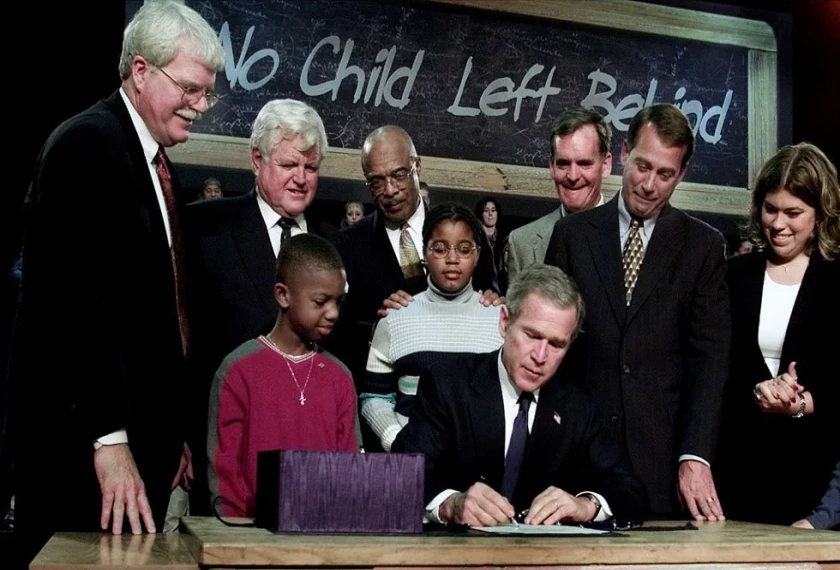
President George W. Bush signs the No Child Left Behind Act at Hamilton High School in Hamilton, Ohio, on Jan. 8, 2002. The NCLB law updated the Elementary and Secondary Education Act and significantly ratcheted up the federal role in education.
Ron Edmonds/AP-File
Every Student Succeeds Act Explainer No Child Left Behind: An Overview
Alyson Klein, April 10, 2015
12 min read

After serving as education secretary, Paige returned to Jackson State University a half century after he was a student there, serving as the interim president in 2016 at the age of 83.

Into his 90s, Paige still publicly expressed deep concern, and optimism, about the future of U.S. education. In an opinion piece appearing in the Houston Chronicle in 2024, Paige lifted up the city that helped propel him to national prominence, urging readers to “look to Houston not just for inspiration, but for hard-won lessons about what works, what doesn’t and what it takes to shake up a stagnant system.”

Copyright 2025 The Associated Press. All rights reserved. This material may not be published, broadcast, rewritten or redistributed without permission.

Events

School & District Management Webinar Squeeze More Learning Time Out of the School Day
Learn how to increase learning time for your students by identifying and minimizing classroom disruptions.
This content is provided by our sponsor. It is not written by and does not necessarily reflect the views of Education Week's editorial staff.
Sponsor
Reading & Literacy Webinar
Improve Reading Comprehension: Three Tools for Working Memory Challenges
Discover three working memory workarounds to help your students improve reading comprehension and empower them on their reading journey.
Content provided by Solution Tree
Recruitment & Retention Webinar EdRecruiter 2026 Survey Results: How School Districts are Finding and Keeping Talent
Discover the latest K-12 hiring trends from EdWeek’s nationwide survey of job seekers and district HR professionals.

EdWeek Top School Jobs

Teacher Jobs
Search over ten thousand teaching jobs nationwide — elementary, middle, high school and more.
View Jobs
Principal Jobs
Find hundreds of jobs for principals, assistant principals, and other school leadership roles.
View Jobs
Administrator Jobs
Over a thousand district-level jobs: superintendents, directors, more.
View Jobs
Support Staff Jobs
Search thousands of jobs, from paraprofessionals to counselors and more.
View Jobs

Read Next

Federal Opinion Can School Reform Be Bipartisan Again?
In a world dominated by social media, is there room for a more serious education debate?
8 min read
The United States Capitol building as a bookcase filled with red, white, and blue policy books in a Washington DC landscape.
Luca D'Urbino for Education Week
Federal Judge Tells Ed. Dept. to Remove Language Blaming Democrats From Staff Emails
The agency added language blaming "Democrat Senators" for the federal shutdown to staffers' out-of-office messages
3 min read
Screenshot of a portion of a response email blaming Democrat Senators for the government shutdown.
Vanessa Solis/Education Week + Getty
Federal Trump’s Ed. Dept. Slashed Civil Rights Enforcement. How States Are Responding
Could a shift in civil rights enforcement be the next example of "returning education to the states?"
6 min read
Pennsylvania Sen. Lindsey Williams, D-Allegheny, is pictured during a confirmation hearing for acting
Pennsylvania state Sen. Lindsey Williams, a Democrat, is pictured during an education committee hearing on Aug. 12, 2025. Williams is preparing legislation that would create a state-level office of civil rights to investigate potential civil rights violations in schools. Williams is introducing the measure in response to the U.S. Department of Education's slashing of its own office for civil rights.
Courtesy of Pennsylvania Senate Democratic Caucus
Federal Fired NCES Chief: Ed. Dept. Cuts Mean 'Fewer Eyes on the Condition of Schools'
Experts discuss how federal actions have impacted equity and research in the field of education.
3 min read
Peggy Carr, Commissioner of the National Center for Education, speaks during an interview about the National Assessment of Education Process (NAEP), on Oct. 21, 2022, in Washington.
Peggy Carr, the former commissioner of the National Center for Education Statistics, speaks during an interview about the National Assessment of Education Process, on Oct. 21, 2022, in Washington. Carr shared her thoughts about the Trump administration's massive staff cuts to the Education Department in a recent webinar.
Alex Brandon/AP
