Blog

Your Education Road Map

Politics K-12

Politics K-12 kept watch on education policy and politics in the nation’s capital and in the states. This blog is no longer being updated, but you can continue to explore these issues on edweek.org by visiting our related topic pages: Federal, States.

Federal

Patty Murray Set to Lead Senate Education Committee After Democratic Wins in Georgia

By Andrew Ujifusa — January 07, 2021 3 min read
Sen. Patty Murray, D-Wash., speaks about the coronavirus during a media availability on Capitol Hill, Tuesday, March 3, 2020 in Washington.
  • Save to favorites
  • Print

Sen. Patty Murray, D-Wash., who helped write the Every Student Succeeds Act, is set to become the chairwoman of the Senate education committee following Democrats’ victory in two U.S. Senate runoff elections in Georgia on Tuesday.

Murray, a former preschool teacher, has served as the ranking Democrat on the committee since 2015. She will replace Sen. Lamar Alexander, R-Tenn., who retired at the end of the last Congress and worked with Murray on writing ESSA as the committee chair.

As the leader of the committee, Murray will have oversight over a variety of education issues, although her top priority will be addressing policy issues related to the coronavirus pandemic’s impact on schools.

In an interview with Education Week last month in which she said she planned on becoming the committee chairwoman if Democrats took control of the Senate, Murray stressed the need for schools to administer assessments to help determine students’ academic needs as a result of school closures and other disruptions.

“I just think we have a moral responsibility to understand how all of our students are doing, where we are falling short, and we have to use data to make sure that we are doing the right thing and sending the dollars to where they are needed the most,” Murray said in that December interview. “That’s called education equity.”

She also said she wants Congress to pass a new COVID-19 relief package that would include more money for K-12 schools once President-elect Joe Biden takes office on Jan. 20.

See Also

Sen. Patty Murray, D-Wash., gives an opening statement during a Senate Health, Education, Labor and Pensions Committee hearing to discuss vaccines and protecting public health during the coronavirus pandemic on Capitol Hill, Wednesday, Sept. 9, 2020, in Washington.
Greg Nash/Pool via AP

Murray is an advocate for robust assessment and accountability measures for schools, and has said this approach is necessary to ensure that disadvantaged students and struggling schools get additional support and resources.

“We put in guardrails to make sure that students didn’t fall through the cracks,” Murray said in a 2019 interview four years after ESSA became law. “We didn’t want to be five or 10 years out from passing that bill and be back in the same place as before we passed the No Child Left Behind bill.”

She is also an advocate for early-childhood education, and helped create federal Preschool Development Grants when President Barack Obama signed ESSA into law in 2015.

One of U.S. Secretary of Education Betsy DeVos’ primary antagonists on Capitol Hill during the Trump administration, Murray is a vocal opponent of using federal dollars to support private school choice. She’s also criticized DeVos’ approach to federal spending on education and the Title IX regulations adopted by the U.S. Department of Education last year.

“We’ve seen her repeatedly turn her back on students and educators and families because she was focused on privatizing our education system, which would drain the resources from our public schools even in a pandemic,” Murray said of DeVos.

Although Murray often enjoyed a productive working relationship with Alexander, with ESSA being the most prominent example in K-12 education policy, the relationship between the two senators frayed during the Trump administration.

Murray will be the second woman to lead the Senate committee that oversees education policy. Former Kansas senator Nancy Kassebaum, a Republican, led the committee from 1995 to 1997, when it went by a different name; its full name now is the Senate Committee on Health, Education, Labor, and Pensions.

Murray was first elected to the Senate in 1992. She has also been a member of Democratic leadership in the Senate. Assuming Murray continues to serve on the powerful Senate appropriations committee that determines funding for the Education Department among other federal agencies, she will also exert more influence over K-12 spending as well as policy in the new Congress.

With the victories by Democrats Jon Ossoff and Raphael Warnock in the Georgia Senate runoff races Tuesday, Senate control would be split 50-50 between Democrats and Republicans, but Vice President-elect Kamala Harris would act as a tie-breaking vote and effectively give Democrats control of the chamber once she and Biden take office. (Like many other news outlets, Education Week relies on the Associated Press to call election results.)

Related Tags:

A version of this news article first appeared in the Politics K-12 blog.

Events

This content is provided by our sponsor. It is not written by and does not necessarily reflect the views of Education Week's editorial staff.
Sponsor
School Climate & Safety Webinar
Belonging as a Leadership Strategy for Today’s Schools
Belonging isn’t a slogan—it’s a leadership strategy. Learn what research shows actually works to improve attendance, culture, and learning.
Content provided by Harmony Academy
This content is provided by our sponsor. It is not written by and does not necessarily reflect the views of Education Week's editorial staff.
Sponsor
School & District Management Webinar
Too Many Initiatives, Not Enough Alignment: A Change Management Playbook for Leaders
Learn how leadership teams can increase alignment and evaluate every program, practice, and purchase against a clear strategic plan.
Content provided by Otus
This content is provided by our sponsor. It is not written by and does not necessarily reflect the views of Education Week's editorial staff.
Sponsor
Artificial Intelligence Webinar
Beyond Teacher Tools: Exploring AI for Student Success
Teacher AI tools only show assigned work. See how TrekAi's student-facing approach reveals authentic learning needs and drives real success.
Content provided by TrekAi

EdWeek Top School Jobs

Teacher Jobs
Search over ten thousand teaching jobs nationwide — elementary, middle, high school and more.
View Jobs
Principal Jobs
Find hundreds of jobs for principals, assistant principals, and other school leadership roles.
View Jobs
Administrator Jobs
Over a thousand district-level jobs: superintendents, directors, more.
View Jobs
Support Staff Jobs
Search thousands of jobs, from paraprofessionals to counselors and more.
View Jobs

Read Next

Federal Ed. Dept. Hangs Banner of Charlie Kirk Alongside MLK Jr., Ben Franklin
It's part of a celebration of the nation's 250th anniversary.
1 min read
New banners of Booker T. Washington, Catharine Beecher and Charlie Kirk hang from the Department of Education, Sunday, March 1, 2026, in Washington.
New banners of Booker T. Washington, Catharine Beecher, and Charlie Kirk hang from the U.S. Department of Education on March 1, 2026, in Washington.
Allison Robbert/AP
Federal Ed. Dept. Wants to Revamp Assistance Program It Calls 'Duplicative,' 'Confusing'
The department's Comprehensive Centers have already been through a year of shakeups.
3 min read
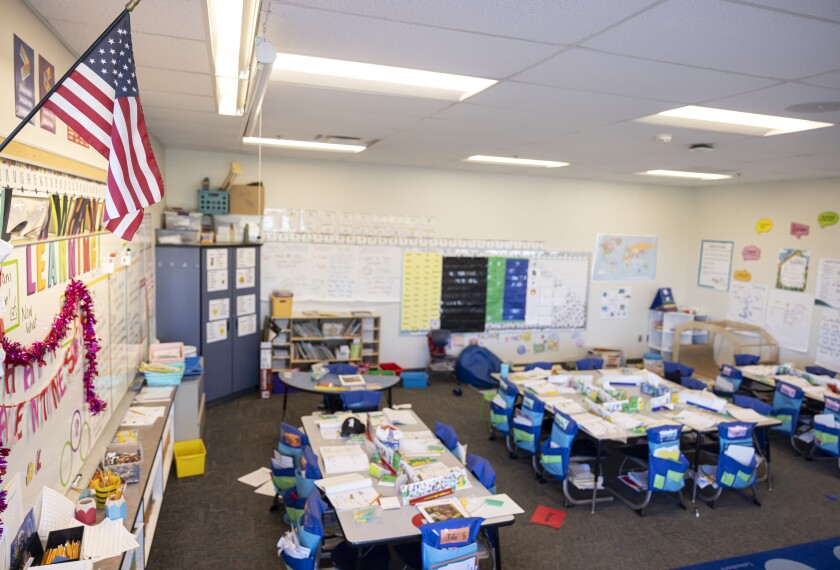
A first grade classroom at a school in Colorado Springs, on Feb. 12, 2026.
A 1st grade classroom at a school in Colorado Springs, Colo., on Feb. 12, 2026. The U.S. Department of Education released a proposal to rework a decades-old program charged with helping states and school districts problem-solve and deploy new initiatives, calling the current structure “duplicative” and “confusing.”
Kevin Mohatt for Education Week
Federal Will the Ed. Dept. Act on Recommendations to Overhaul Its Research Arm?
An adviser's report called for more coherence and sped-up research awards at the Institute of Education Sciences.
6 min read
The U.S. Department of Education building is pictured on Oct. 24, 2025, in Washington, D.C.
The U.S. Department of Education building in Washington is pictured on Oct. 24, 2025. A new report from a department adviser calls for major overhauls to the agency's research arm to facilitate timely research and easier-to-use guides for educators and state leaders.
Maansi Srivastava for Education Week
Federal Trump Talks Up AI in State of the Union, But Not Much Else About Education
The president didn't mention two of his cornerstone education policies from the past year.
4 min read
President Donald Trump enters to deliver the State of the Union address to a joint session of Congress in the House chamber at the U.S. Capitol in Washington, Tuesday, Feb. 24, 2026.
President Donald Trump enters to deliver the State of the Union address to a joint session of Congress in the House chamber at the U.S. Capitol in Washington, Tuesday, Feb. 24, 2026. The president devoted little time in the speech to discussing his education policies.
Kenny Holston/The New York Times via AP, Pool

