
Opinion Blog


Rick Hess Straight Up

Education policy maven Rick Hess of the American Enterprise Institute think tank offers straight talk on matters of policy, politics, research, and reform. Read more from this blog.

Policy & Politics Opinion

Remembering Harvard’s Richard Elmore

By Rick Hess — February 16, 2021 3 min read
Image shows a multi-tailed arrow hitting the bullseye of a target.
  • Save to favorites
  • Print

Last week, the field of education policy lost an icon. Richard Elmore, a longtime professor at the Harvard Graduate School of Education, played an outsized role in helping the profession better understand the realities of policy when it came to improving schools. He was also an influential mentor of mine, serving on my dissertation committee and helping me get launched in this profession.

And he was one hell of a teacher. I first met Elmore in 1992, when I was a wide-eyed doctoral student who enrolled in his class on education policy. He’d only been at Harvard for two years at that point, and I was just months removed from teaching. So I didn’t really know who he was or what I was in for. I left that first class humbled. There must’ve been 50 or 100 students arrayed in the lecture hall, and yet Elmore managed to run a dynamic, provocative, coherent conversation about the ins and outs of policymaking.

He had the ability to invite one thought, then another, and then a third, and then briskly weave them into a clear insight. I still find myself flashing back to his gift when I’m leading a class or a conversation and struggling to find the point of the matter. It struck me as especially remarkable because he was teaching classes full of impassioned education grad students who saw policy as a way to do huge, wonderful, progressive things. Elmore nonetheless had a knack for asking hard questions, checking the surety of the self-impressed, and imparting practical wisdom, all without seeming hostile.

He taught me much that shapes my thinking. I recall arguing once that something was a terrible idea, that it was like setting fires so firefighters could learn to put them out. Dick pointed out that this is exactly how firefighters do get trained. Twenty-five years later, his understated critique is still with me. It surfaces every time I look at something I’ve drafted and realize that I’m using a distracting example to make a point or that I’m not actually yet sure I know what I’m talking about.

On another occasion, I recall that we were simulating presentations to a school board, with Dick playing the chair. He toyed with me at great length before finally shooting me down. All these years later, I can still remember what he told me when he pulled me aside after class.

He said, “Rick, you know what your problem was?” I shook my head. “You were going to lose and you didn’t know it. You were so busy trying to win that you didn’t bother asking what it would take to convince me.”

“What would’ve convinced you?” I asked.

“Nothing,” he said. “You were going to lose. And you should’ve known that. That’s a big part of how this works, asking what others are thinking and what might move them. And you were so busy showboating that you never did.”

It’s a lesson I carry to this day.

Elmore was, of course, a profound and hugely influential scholar. His insights on the “problem of going to scale”—why promising pilot efforts are so rarely successfully supersized—are invaluable and color my thinking even now. His notions of “tight-loose” governance led a generation of leaders to be more deliberate about which tasks should be centrally controlled and which should not. I think it’s fair to say he was prescient in arguing that No Child Left Behind-style accountability was hobbled by inattention as to how these mechanisms would drive school improvement.

His passing leaves me both sorrowful and wistful. Despite Dick’s enormous impact on my thinking and career, we didn’t keep in close contact over the years. I mostly saw him when I was back up at Harvard teaching or speaking and we’d bump into one another. Indeed, in his inimitable style, he occasionally let me know that he thought I’d too often misapplied the lessons he’d taught me.

But I was touched a couple years ago, after I penned Letters to a Young Education Reformer, when he reached out with a note of congratulations. It was the first time he’d done that in two decades. He allowed that we might not have seen eye-to-eye at every point of the journey but said he was happy to see I’d absorbed some wisdom along the way. I regarded that as high praise—about the highest I could imagine.

Godspeed, Professor Elmore. You’ll be sorely missed.
Related Tags:

The opinions expressed in Rick Hess Straight Up are strictly those of the author(s) and do not reflect the opinions or endorsement of Editorial Projects in Education, or any of its publications.

Events

This content is provided by our sponsor. It is not written by and does not necessarily reflect the views of Education Week's editorial staff.
Sponsor
Special Education Webinar
Bridging the Math Gap: What’s New in Dyscalculia Identification, Instruction & State Action
Discover the latest dyscalculia research insights, state-level policy trends, and classroom strategies to make math more accessible for all.
Content provided by TouchMath
This content is provided by our sponsor. It is not written by and does not necessarily reflect the views of Education Week's editorial staff.
Sponsor
School Climate & Safety Webinar
Belonging as a Leadership Strategy for Today’s Schools
Belonging isn’t a slogan—it’s a leadership strategy. Learn what research shows actually works to improve attendance, culture, and learning.
Content provided by Harmony Academy
This content is provided by our sponsor. It is not written by and does not necessarily reflect the views of Education Week's editorial staff.
Sponsor
School & District Management Webinar
Too Many Initiatives, Not Enough Alignment: A Change Management Playbook for Leaders
Learn how leadership teams can increase alignment and evaluate every program, practice, and purchase against a clear strategic plan.
Content provided by Otus

EdWeek Top School Jobs

Teacher Jobs
Search over ten thousand teaching jobs nationwide — elementary, middle, high school and more.
View Jobs
Principal Jobs
Find hundreds of jobs for principals, assistant principals, and other school leadership roles.
View Jobs
Administrator Jobs
Over a thousand district-level jobs: superintendents, directors, more.
View Jobs
Support Staff Jobs
Search thousands of jobs, from paraprofessionals to counselors and more.
View Jobs

Read Next

Federal Trump Talks Up AI in State of the Union, But Not Much Else About Education
The president didn't mention two of his cornerstone education policies from the past year.
4 min read
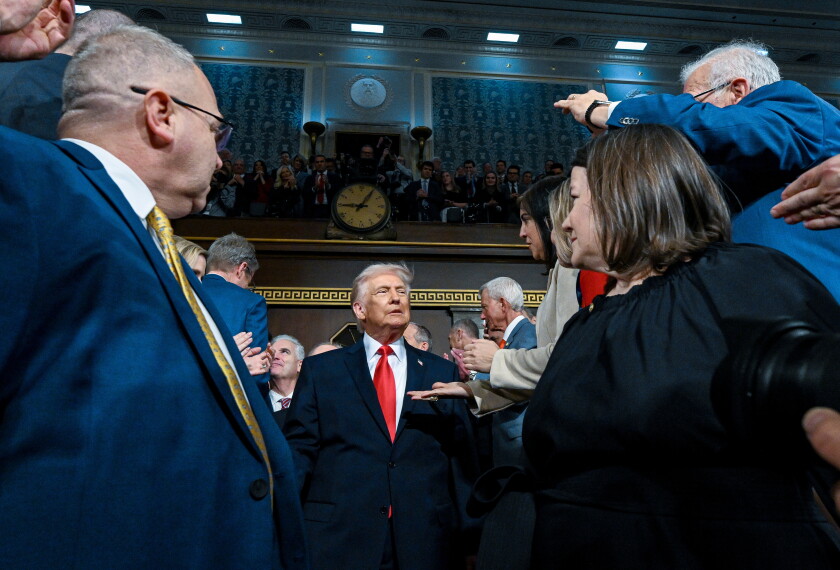
President Donald Trump enters to deliver the State of the Union address to a joint session of Congress in the House chamber at the U.S. Capitol in Washington, Tuesday, Feb. 24, 2026.
President Donald Trump enters to deliver the State of the Union address to a joint session of Congress in the House chamber at the U.S. Capitol in Washington, Tuesday, Feb. 24, 2026. The president devoted little time in the speech to discussing his education policies.
Kenny Holston/The New York Times via AP, Pool
School Choice & Charters Video Private School Choice Is Growing. What Comes Next?
States are investing billions of dollars in public funds for families to use on private schooling.
1 min read
School Choice & Charters The Legal Fight Over Private School Choice: Who Is Suing and Why?
Court battles are underway—or recently wrapped up—for programs in at least nine states.
1 min read
Arkansas Gov. Sarah Huckabee Sanders, left, attends a news conference with Tennessee Gov. Bill Lee, right, Tuesday, Nov. 28, 2023, in Nashville, Tenn. Gov. Lee presented the Education Freedom Scholarship Act of 2024, his administration's legislative proposal to establish statewide universal school choice.
Arkansas Gov. Sarah Huckabee Sanders, left, attends a news conference with Tennessee Gov. Bill Lee in Nashville, Tenn. on Nov. 28, 2023. Both Republican governors have championed new programs that let families in their states use public funds for private education. The programs in both states are facing legal challenges.
George Walker IV/AP
Federal Education Department Will Send More of Its Programs to Other Agencies
Education grants for school safety, community schools, and family engagement will shift to Health and Human Services.
4 min read
Various school representatives and parent liaisons attend a family and community engagement think tank discussion at Lowery Conference Center on March 13, 2024 in Denver. One of the goals of the meeting was to discuss how schools can better integrate new students and families into the district. Denver Public Schools has six community hubs across the district that have serviced 3,000 new students since October 2023. Each community hub has different resources for families and students catering to what the community needs.
A program that helps state education departments and schools improve family engagement policies is among those the Trump administration will transfer from the U.S. Department of Education to the U.S. Department of Health and Human Services. In this photo, school representatives and parent liaisons attend a family and community engagement discussion on March 13, 2024, in Denver to discuss how schools can better integrate new students and families into the district.
Rebecca Slezak For Education Week
