
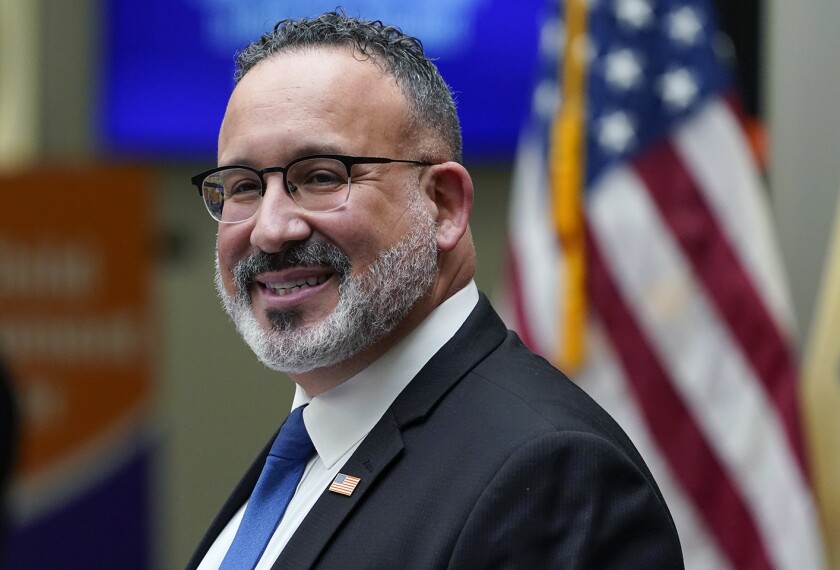
U.S. Secretary of Education Miguel Cardona trumpeted his support for teachers Thursday, while also pushing for more resources and backing for educators and children.
In a speech laying out his vision for education nearly a year after he took office, Cardona named specific goals and challenges for district leaders involving school counselors, reading, and more. Echoing long-standing Biden administration positions, he called for increases in federal funding for Title I programs to support economically disadvantaged students and for special education.
“It’s our moment to finally make education the great equalizer, the force that can help every student thrive” regardless of their backgrounds, Cardona said. He added later that, “our country’s strength is at stake.”
At the same time, he expressed sympathy for educators in the field. Cardona said he could personally relate to their struggles, given the challenges he faced while trying to reopen schools as Connecticut’s education commissioner.
“I know you’re tired. I know you’re stretched,” said Cardona, who called their efforts “heroic” in remarks delivered at the Education Department headquarters in Washington. “While we didn’t sign up to serve during a pandemic, we did sign up to serve students.”
Some teachers have said recently they’re disappointed Cardona does not seem to be consistently championing their interests amid the ongoing push for schools to hold in-person classes.
Cardona reiterated the importance of keeping schools open for in-person learning, which has become the key talking point for President Joe Biden and his administration in recent months. Yet he also said that merely doing so was insufficient.
“We’re either closing educational opportunity gaps, or we’re making them worse” based on the decisions schools make, he said.
While Cardona has repeatedly urged educators and policymakers to alter their expectations and practices in response to COVID-19, he laid out specific goals on Thursday for schools in light of the relief funding they’ve received through federal packages like the American Rescue Plan. Among these:
- Every student who’s fallen behind during the pandemic should have access to a well-trained tutor for 30 minutes a day, three times a week.
- Every high school should have at least one career counselor to support students’ ambitions beyond K-12.
- Every high school student should participate in at least one activity outside of classes, such as athletics or arts programs.
At the federal level, Cardona’s call for schools to get more funding has been anticipated by lawmakers.
Democrats in Congress have introduced funding legislation for the next fiscal year that would provide major increases for programs like Title I for disadvantaged students. However, those bills have stalled, and it remains to be seen whether and when lawmakers enact such increases for fiscal 2022.
Schools have received close to $200 billion in dedicated COVID aid across three federal relief packages dating back to early 2020. And even amid the surge in the omicron variant, the vast majority of school districts have kept their doors open.
Yet ongoing disruptions caused by COVID-19, as well as fatigue and frustrations among parents, school staff, and others, continue to create major challenges for the nation’s schools.
Cardona faces complex tests separate from COVID
Major policy and political tests await Cardona and the Education Department that aren’t directly related to the pandemic.
Within the next several months, the department is due to begin public proceedings as part of its push to overhaul Title IX regulations for K-12 schools and higher education. The White House has indicated that it will toss out the Title IX rule adopted by former education secretary Betsy DeVos in 2020. Last year, the department signaled that it expects school administrators to act aggressively in response to possible incidents of sexual misconduct and that the 2020 rule represented minimum expectations for schools’ approach to the issue.
The new Title IX rule will also likely address controversial issues like transgender students’ rights. The Biden administration has stated it interprets Title IX to cover students’ sexual orientation and gender identity. However, critics of that interpretation, including GOP lawmakers, say it will disrupt school activities such as student athletics. Cardona and congressional Republicans have already publicly sparred about this issue.
The Education Department could also revisit school discipline guidance adopted by the Obama administration but revoked by the Trump White House.
This guidance stated that schools disciplining students of color disproportionately might be in violation of federal civil rights laws. As a 2020 presidential candidate, Biden indicated he would revive this nonbinding directive. But amid ongoing concern about student misbehavior this year and how schools should address race in curriculum and beyond, restarting a debate about that guidance will likely only put a bigger political spotlight on Cardona.
In his speech, the education secretary briefly addressed this issue by declaring that given all the disruption the pandemic has caused students, relying on unfair and “exclusionary” disciplinary policies that push children further away from schools is the wrong approach.


