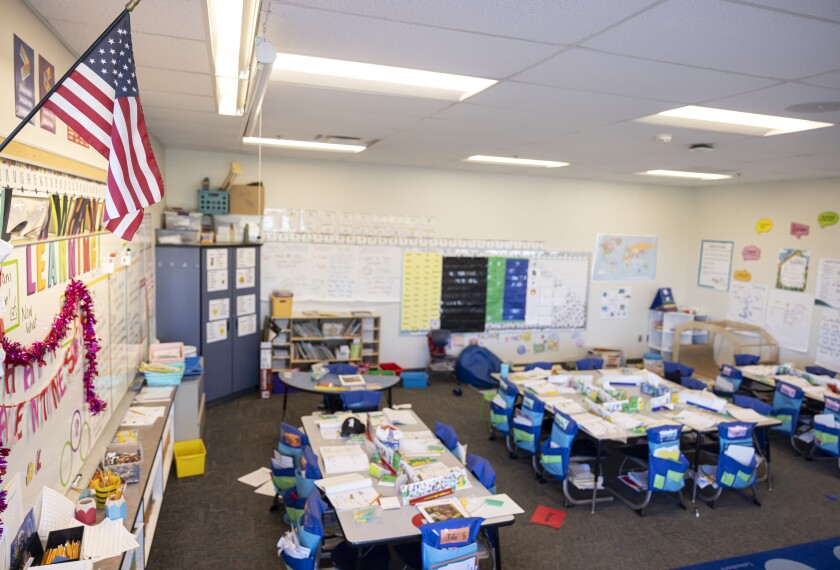
Schools need to work to win the trust of families of color who are reluctant to return their children to in-person instruction during the COVID-19 pandemic, even as educators work to provide strong remote learning options for those who chose to remain at home, U.S. Secretary of Education Miguel Cardona said Friday.
The most recent federal data show that students of color are less likely to return to full-time in-person instruction than their white peers, even when their schools offer the option.
“I do think it’s our responsibility to not only improve remote learning but to better engage with these families,” Cardona said on a call with reporters held to announce the second installment of a U.S. Department of Education guidebook of recommendations on how schools should reopen and recover from the pandemic.
In the brief call, he also addressed reporters’ questions about testing waivers, summer learning, and teacher burnout.
The 52-page guidebook was created after focus groups with educators and feedback from organizations around the country, Cardona said. It includes recommendations about issues like social-emotional learning, addressing lost instructional time, and supporting educators. Many of those recommendations touch on equity concerns; the guidebook encourages schools to monitor issues like gaps in access to technology and how students perceive their learning environments.
The recommendations are part of President Joe Biden’s efforts to encourage a majority of kindergarten through 8th grade schools to open within the first 100 days of his administration, a deadline he will reach on April 30. That strategy also includes new resources provided through the American Rescue Plan, prioritizing teachers for COVID-19 vaccines, and releasing new guidance for schools from the Centers for Disease Control and Prevention.
But, even as nearly 46 percent of public schools offered five days a week of in-person instruction to all students in February, just 34 percent of students were learning full-time in the classroom, according to the most recent federal data, collected through a representative sample of schools around the country.
And many large school districts have reported that families of color are less likely to select in-person options that are offered to them.
Cardona called that “concerning” but “not surprising.”
“Prior to the pandemic, we had a system that served some students better than others, and we have to be bold and unapologetic in addressing that,” he said.
Funds provided through the COVID relief bill can help schools address the disproportionate impact the pandemic has had on students of color, homeless students, English-language learners, students in foster care, and students with disabilities, Cardona said. He encouraged family engagement efforts as schools chart their course in spending the $130 billion in new K-12 aid.
While the guidebook’s recommendations largely draw from strategies that were promoted in schools before the pandemic, Cardona said he hopes educators will find links to best practices and specific examples included in the document to be particularly helpful. The department has also announced plans for a clearinghouse of best practices to help educators learn from existing efforts around the country.
Cardona on state-testing waivers
Education Week asked Cardona on the call about the Education Department’s recent decision to allow the District of Columbia to cancel its year-end state tests on the same day it told Michigan it would not provide similar flexibility.
Officials have stressed that they wants states to make every effort to collect consistent data across districts to monitor student learning, even as the agency provides some flexibility from federal accountability requirements.
In granting the waiver for the District, which is considered a statewide school system, the agency noted it may be difficult for the city’s schools to collect statistically reliable data while most students are still learning remotely. Some testing wonks saw inconsistency in the department’s approach when it didn’t allow Michigan to substitute local assessments for its year-end, summative exam, despite surging rates of the virus there.
The agency has acknowledged to some states that it might not be “viable” for some districts to conduct testing. And it has said states can modify tests or delay their administration until the fall to address logistical concerns.
In his response to Education Week’s question, Cardona did not address the circumstances in Michigan and D.C. specifically.
“Each case is reviewed carefully, case by case,” he said. “And just like reopening schools really required a local context ... the same application of the context that the students are in was taken into account by our team in the Department of Education.”
Cardona on teacher supports, summer learning
Cardona acknowledged concerns about educator burnout as they finish a second year of unprecedented interruption and prepare for the 2021-22 school year, when they will continue to address the aftermath.
Federal aid can be used on strategies that help address educators’ concerns by providing extra support for students, federal officials said. Those strategies can include providing targeted professional development and hiring paraprofessionals and student support staff like school counselors to help address children’s needs.
In response to a reporter’s question about the need for states and districts to design “robust, evidence-based” summer learning programs in a short time frame, Cardona said he thinks such efforts are possible with the help of community partnerships with organizations like Boys and Girls Clubs.
“I will acknowledge the fact that educators, we’re exhausted,” he said. “We’ve been working nonstop since [March 2020] in addressing how to support our students best in a pandemic … But I do think with creative partnerships and that shared sense of urgency that we have in education, it can be done.”