

As the U.S. Supreme Court weighs another case at the intersection of religion and public education, state school boards, legislatures, and other education officials are greenlighting a series of measures that would infuse Christianity into public schools in different ways.
The measures that would directly bring religion into public school buildings include requirements that the Ten Commandments be posted in classrooms, a policy setting aside time for prayer in school, and an order to incorporate the Bible into instruction.
It’s a wave created by advocates who want to see how far they can push the church-state divide with a somewhat pliable U.S. Supreme Court and a favorable executive branch, said Suzanne Rosenblith, a professor of education at the University at Buffalo.

“It seems like there’s definitely a feeling from the Christian right that there’s a warmth to their views, all the way up to the executive branch,” Rosenblith said. “I think strategically they just think that it’s a winning time to do this.”
Courts have decided there’s a clear distinction between teaching religion in a devotional fashion and teaching about different religions’ historical development and influence; schools cannot do the former. While students’ right to pray at school is constitutionally protected, school-sponsored prayer doesn’t fall within that right—particularly when it seems a state is putting “its thumb on the scale” to say it prefers one religion, Rosenblith said.
But that doesn’t mean lawmakers aren’t pushing the boundaries—even as legal challenges arise and courts throw up roadblocks.
Texas has been aggressively charting a more Christian course. In 2023, it allowed districts to use religiously affiliated chaplains to counsel students during the school day. Late last year, the state school board approved a controversial curriculum with Bible-infused lessons for use by elementary schools.
And in the past month, the legislature has passed a bill allowing schools to carve out prayer time, with proponents arguing it was a win for religious liberty, and another bill requiring the display of the Ten Commandments in each public school classroom. Republican Gov. Greg Abbott is expected to sign both measures, according to local reporting.
But Texas is a snapshot of a larger effort fanning out nationally.
Since 2023, there have been at least 38 bills in 20 states seeking to post the Ten Commandments in school classrooms, according to the National Conference of State Legislatures, which tracks legislation nationwide. Ten are still pending this year.
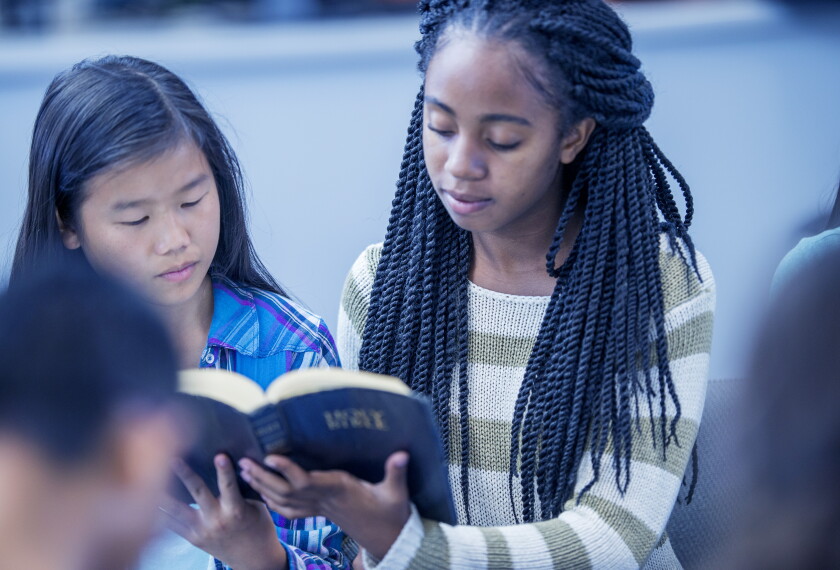
Even as those bills experience more legislative success, the two bills that so far have become law were later met with legal challenges. Louisiana’s measure was blocked by a federal court in 2024 so it hasn’t yet taken effect, and parents sued over the Arkansas law—which was signed into law in April—because it “unconstitutionally pressures students into religious observance,” according to the lawsuit.
The measures come as the U.S. Supreme Court, with a 6-3 conservative majority has, in some cases, backed claims of religious discrimination. The court is expected to rule soon in a Maryland case, where a contingent of parents sued the Montgomery County school system over a rule that prohibits parents from opting their children out of lessons that use LGBTQ+ storybooks.
In April, the justices appeared poised to side with the parents, who are arguing that their religious rights should allow them to pull their children from lessons on sexuality and gender they disagree with, according to Capital News Service. Its decision is expected this month.
It’s surprising the case has even gotten this far, Rosenblith said, “because I can’t imagine a scenario where the court does not find favor with the parents.” Far more liberal courts have also found favor with individual parents’ rights, she said.
“I think it’s really building on the parental rights wave that we’re seeing a lot of, and that the current administration is really encouraging,” she said, noting the president had shown enthusiasm toward school choice and charter schools.

Also this spring, the highest court deadlocked in a case about a religious charter school in Oklahoma. The deadlock leaves an Oklahoma supreme court ruling prohibiting the school in place, making the case a departure from the smooth road the nation’s high court has been paving recently for parties seeking to create more space for religion in the public sphere.
In 2020, the court ruled that a Montana tax-credit scholarship program couldn’t bar families from using the scholarships at religious schools. And two years later, the court said Maine couldn’t exclude religious schools from a public tuition program for towns without public high schools. The same year, the court sided with a Washington state football coach whose district asked him to move his on-the-field, post-game prayers to an alternate location, concerned that the prayer could be viewed as school-sponsored. The court ruled the prayers were private speech protected by the First Amendment.
In the Oklahoma case, in which two Catholic dioceses received state approval to run a religious, virtual charter school, there was no accompanying comment from the justices—just a 4-4 decision. Without that, it’s hard to guess how the court would rule in other cases like it, Rosenblith said.
There’s nuance in these new strategies. While school vouchers that parents can decide to use at religious schools have “won the day,” they’re very different in substance from cases around prayer in schools, Rosenblith said.
Still, it’s been fuel to the fire for the Christian right; Republicans have made school choice a top priority, both at the state level and more recently in major federal legislation.
“Maybe they feel like this is the right moment. If the precedent has been to take more of a separationist view on things, I think that there is more of an appetite right now to entertain some role of religion in the public sphere,” Rosenblith said. “I think people are listening.”

Though the federal government has no say over curriculum, President Donald Trump has previously backed prayer in schools, and he supported the Ten Commandments measure in Louisiana. The more amenable attitude could open the door for the federal government to clearly signal its approval for mixing religion and public education through grant opportunities.
“You could see where they could potentially use money, in a way, as an incentive in this case, not as a cudgel, for these sorts of things, but it’s the degree to which the executive branch right now cares about currying more favor with the religious right,” Rosenblith said. “If that’s an interest, I could see them rolling something out.”


