
School Climate & Safety

Students Feel Less Connected to School. Here’s Why That Matters

There are a number of benefits when students feel close to people at school
By Caitlynn Peetz Stephens — October 08, 2024 3 min read
An illustration of a black broken chain link on a red background.
  • Save to favorites
  • Print

Fewer students feel connected to people at their school now than in 2021, when many districts were still operating on remote or hybrid schedules, according to the recently published results of the U.S. Centers for Disease Control and Prevention’s biennial survey of high school students.

In 2021, about 62 percent of students said they felt close to people at their school. That figure dropped to 55 percent in 2023, according to the Youth Risk Behavior Survey, a nationally representative study of U.S. high school students.

The decrease coincides with districts reporting increases in chronic absenteeism and behavioral challenges, and as schools struggle to help students catch up following pandemic closures. Research has linked strong student connections to school and their teachers with improved mental health, better attendance and grades, less disruptive behavior, and lower dropout rates.
See Also

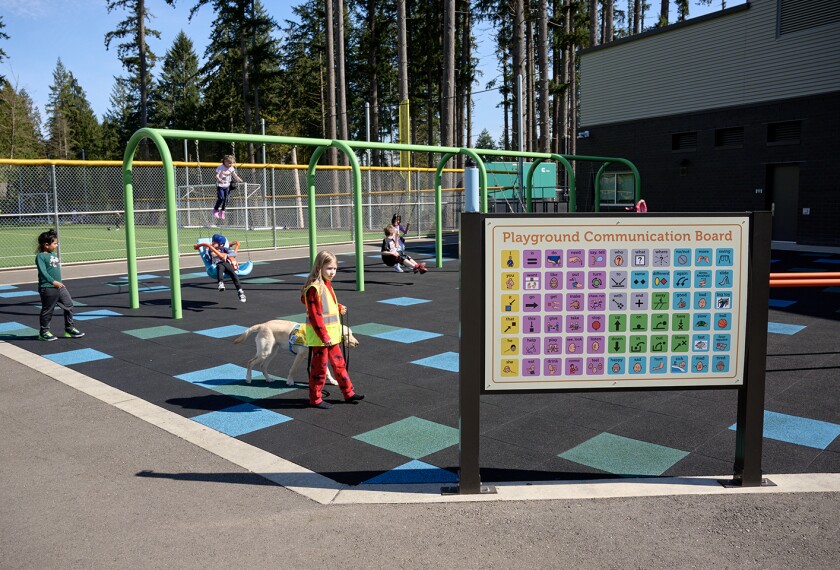
Students at Ruby Bridges Elementary School in Woodinville, Wash., play during recess on April 2, 2024. Students have access to cards with images and words on them so all students, including those who do not speak, can communicate on the playground.
Meron Menghistab for Education Week

“This is all connected and we’re at such a critical time right now in education,” said David Arencibia, a former middle school principal and the 2022 Texas Secondary Principal of the Year who now runs a company focused on strengthening schools’ culture. “We all really need to be all-in on addressing this.”

They’re not a silver bullet to solving all of the problems plaguing students and schools, but relationships with peers and adults give students a reason to attend school, engage in class, and participate in extracurricular activities. Strong relationships can also help teachers detect when students are struggling and need extra support.

These connections have been especially difficult to maintain for girls and students who identify as LGBTQ+.

Girls were more than 10 percentage points less likely than boys to say they felt close to people at school, according to the survey. Fifty percent of girls said they felt close to others at school, compared with 60 percent of boys.

LGBTQ+ students were 13 percentage points less likely than heterosexual and cisgender students to report feeling close to others at school.

Along with some of the well-documented challenges students have faced in recent years—from poor mental health to higher rates of poverty and homelessness—Arencibia said at least some of the problem can be traced back to high levels of teacher and administrator turnover during the pandemic.

When experienced educators and leaders left, they took a lot of valuable experience and, in some cases, important connections with students with them. Teachers and administrators new to their positions should consider additional training on the importance of school culture and how to build a positive and engaging environment, he said.

“There was a wealth of knowledge that basically left the classroom, and we need to be intentional about continuing to build that as we staff schools,” Arencibia said.

The CDC has identified mentoring, service learning, student-led clubs, and classroom-management training for teachers as strategies schools can use to build connectedness, which can in turn reduce unhealthy behaviors and strengthen students’ engagement.

See Also

Principal David Arencibia embraces a student as they make their way to their next class at Colleyville Middle School in Colleyville, Texas on Tuesday, April 18, 2023.
Principal David Arencibia embraces a student as they make their way to their next class at Colleyville Middle School in Colleyville, Texas, on Tuesday, April 18, 2023.
Emil T. Lippe for Education Week

It’s tough work that takes intentionality and dedication, but the payoff can be huge, Arencibia said. Research backs that up.

Studies have shown that building connectedness and a sense of belonging at school can benefit students well into adulthood.

CDC researchers tracked more than 14,000 middle and high school students over 20 years and, in a 2019 study, found that those who reported feeling connected to school as adolescents were half as likely—or even less likely—than those who didn’t to have used illegal drugs or misused prescription drugs, been diagnosed with a sexually transmitted disease, experienced emotional distress and thoughts of suicide, or been the victim of physical violence as adults.

Ultimately, the data showing students feel less connected to people in their school reinforces the conclusion that “old-fashioned” teaching methods won’t work anymore, Arencibia said. Students need more opportunities to collaborate with each other and their teachers.

“The days of passing out a worksheet and then walking away or just standing and delivering a lecture are passed now,” he said. “They need active and collaborative classrooms where they can make these connections.”


Related Tags:

Events

Jobs Regional K-12 Virtual Career Fair: DMV
Find teaching jobs and K-12 education jubs at the EdWeek Top School Jobs virtual career fair.
This content is provided by our sponsor. It is not written by and does not necessarily reflect the views of Education Week's editorial staff.
Sponsor
Artificial Intelligence Webinar
Making AI Work in Schools: From Experimentation to Purposeful Practice
AI use is expanding in schools. Learn how district leaders can move from experimentation to coordinated, systemwide impact.
Content provided by Frontline Education
This content is provided by our sponsor. It is not written by and does not necessarily reflect the views of Education Week's editorial staff.
Sponsor
Student Well-Being & Movement Webinar
Building Resilient Students: Leadership Beyond the Classroom
How can schools build resilient, confident students? Join education leaders to explore new strategies for leadership and well-being.
Content provided by IMG Academy

EdWeek Top School Jobs

Teacher Jobs
Search over ten thousand teaching jobs nationwide — elementary, middle, high school and more.
View Jobs
Principal Jobs
Find hundreds of jobs for principals, assistant principals, and other school leadership roles.
View Jobs
Administrator Jobs
Over a thousand district-level jobs: superintendents, directors, more.
View Jobs
Support Staff Jobs
Search thousands of jobs, from paraprofessionals to counselors and more.
View Jobs

Read Next

School Climate & Safety Steps to Follow for a Smooth, Successful, and Safe Graduation Ceremony
Graduation ceremonies pose unique logistical challenges for school districts. Preparation is key.
5 min read
There was minimal police presence as the Los Angeles County Sheriff's department kept an eye on the Maywood Academy High School graduation ceremony at East Los Angeles College in Monterey Park, CA on Thursday, June 12, 2025.
Law enforcement kept an eye on proceedings at the Maywood Academy High School graduation ceremony at East Los Angeles College in Monterey Park, Calif., on June 12, 2025. Graduation ceremonies pose a unique logistical challenge for school districts, with many considerations to take into account.
Myung J. Chun / Los Angeles Times via Getty
School Climate & Safety Q&A Restorative Practices Aren't Consequence-Free, Says a Student Discipline Expert
Consistent consequences are important to managing student behavior, says the author of a new book on discipline.
6 min read
Students pass a talking piece during a restorative justice exercise at a school in Oakland, Calif., on June 11, 2013.
A student receives the talking piece from another student during a restorative justice session at a school in Oakland, Calif., on June 11, 2013. Nathan Maynard, the author of a newly released book on student discipline, says restorative practices are often misunderstood.
Lea Suzuki/San Francisco Chronicle via AP
School Climate & Safety States Push AI Weapons Detection as Part of School Safety
Three states are considering whether to require weapons-detection systems at school entrances.
5 min read
A display indicating a detected weapon is pictured on an Evolv weapons detection system in New York City.
A display indicating a detected weapon is pictured on an Evolv AI weapons detection system in New York City, on March 28, 2024. Lawmakers in Georgia are weighing a bill that would require all public schools to have weapons-detection systems or metal detectors at building entrances. While supporters say the systems make schools safer, critics say the technology has limitations.
Barry Williams/New York Daily News via TNS
School Climate & Safety What 3 Top Principals Do So Students Feel Like They Belong at School
Principals use belonging, mentorship, and creative incentives to boost attendance.
5 min read
Image of a group of students meeting with their teacher. One student is giving the teacher a high-five.
Laura Baker/Education Week via Canva
