
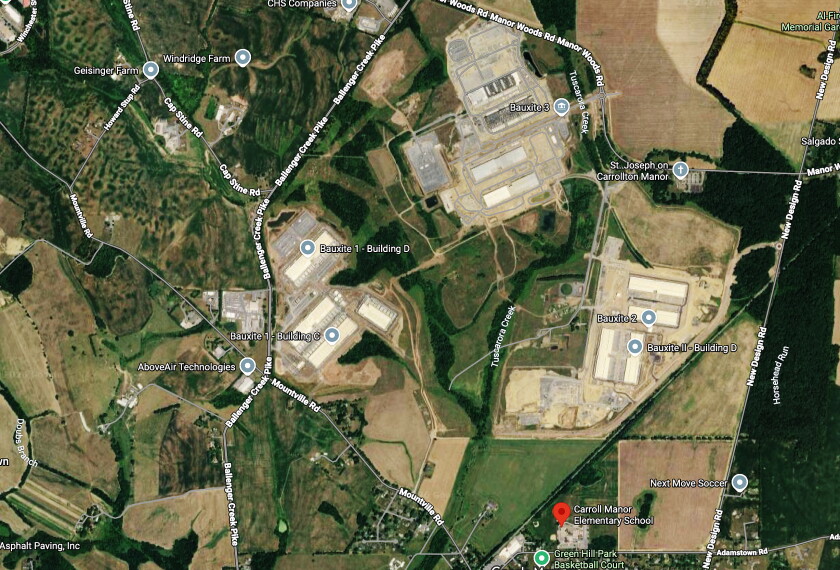
As more data centers are built near schools, concerns are growing about how their proximity could affect students’ health and that of the broader school community.
Education Week recently reported how one data center under construction is on track to be situated 500 feet from an elementary school in Frederick County, Md. Local community members have expressed concerns about the effect on students’ health, the potential for increased noise from a constantly operating data center, and the possibility of higher utility bills in the area as a major power consumer is introduced.
Below are four ways data centers are affecting schools and students.
1. Student health concerns are driving the pushback
Children and educators living and attending or working in schools near data centers are exposed to noise and air pollution, health experts told Education Week.
The construction and operation of data centers can result in carbon emissions, use a lot of water, and produce toxic chemicals. This exposure can lead to problems that affect brain development and lungs of all people, but especially students who are younger and whose bodies are still developing.
Another concern is the impact data centers can have on children’s productivity. The facilities give off a constant low humming noise. Data centers also emit light all day long. Both of these factors can distract students struggling to pay attention in class.
Both the light and noise disrupt sleep, which can lead to poor sleep and worsened academic performance, among other health effects associated with a lack of rest. During the school day, the noise can be distracting as well.
2. Data centers are increasingly being built closer to schools
Research shows that around 1,878 schools are within a mile of at least one data center or future facility. Data centers are intentionally being built closer to the people or systems using data.
But there are at least 15 states considering data center moratoriums, according to the National Conference of State Legislatures—although only New York has passed a one-year ban.
3. Schools and communities are facing economic tradeoffs
Aside from the potential effects on the health and productivity of students, schools are also concerned about tradeoffs associated with these facilities.
In Virginia, the state with the highest number of data centers per capita, there have been more than 100 power outages a month in Fairfax County Public Schools. Teachers in Henrico County were asked to start switching their lights off at the end of the day as electricity rates jumped 25%. Teachers were also told to disconnect appliances or chargers not in use, and limit the use of space heaters.
Dean Rose, the president of Frederick County’s school board, told Education Week a rising electricity bill would be “a big inflationary item.”
Frederick County in September announced a community benefit agreement with Catellus, the developer of the data center in the area, which includes $30 million for renovations at the elementary school closest to the facility, Carroll Manor Elementary. The catch? The county would be barred from applying new zoning rules to the data center campus for eight years.
Members of the community protested this deal, stating the school should be relocated, not renovated, according to local reporting. Eventually, the county executive rejected it. While the school will not receive new funding for renovations, the county executive extended a moratorium on new data center applications to July 2027.
4. Health experts recommend mitigation strategies that schools could implement to help protect students
As data centers are being scoped and built, there are ways schools and families can take action to help with the negative health effects they can have on students.
Carroll Manor Elementary School installed an air-monitoring system to evaluate air quality and is asking the county for a sound and noise monitoring system, too.
Dr. Debra Hendrickson, a physician and clinical professor of pediatrics at the University of Nevada School of Medicine, recommends weatherizing homes, which includes sealing windows and doors, and getting an air purifier to protect children from toxic pollutants in houses near data centers.
If these measures are too costly, there are online resources to learn to make these purifiers out of a box fan and a filter. Additionally, limiting exercise time outdoors if the air quality is poor or having the students wear masks outside is also recommended.


