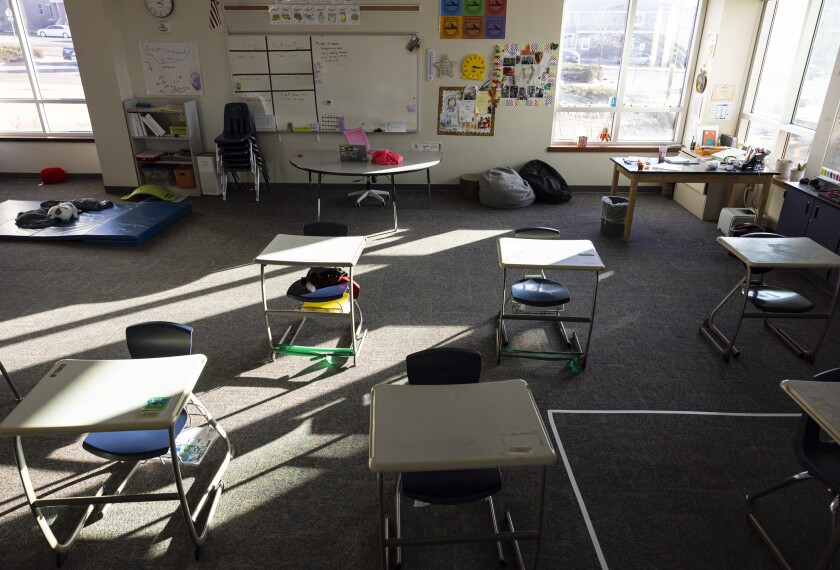
As states face persistently high rates of absenteeism, lawmakers and educators are wrestling with a thorny question: Should parents and caregivers face criminal penalties when their children miss too much school?
California Gov. Gavin Newsom signed a bill Oct. 1 that will eliminate the threat of fines or jail time for parents whose children are “chronically truant.” Advocates for low-income students said the new law, which takes effect Jan. 1, reverses a policy that has disproportionately affected poor families without effectively addressing attendance problems.
“Families and kids need support, not criminal charges and fines, to improve school attendance,” California Assembly Member Patrick Ahrens, a Democrat and the bill’s sponsor, said as Newsom signed it. “Fining or imprisoning parents did nothing to get kids the education and support they need.”
The change comes as states confront high rates of chronic absenteeism that have persisted well beyond interruptions caused by COVID-19. A student is considered chronically absent if they miss 10% or more of school days, even if those absences are excused for reasons like illness or bereavement.
Of the 15 states that have released data from the 2024-25 school year, 14 showed declining rates of chronic absenteeism year-over-year, though absenteeism remains above pre-pandemic levels in all those states, according to the Return to Learn tracker maintained by the American Enterprise Institute. In 2023-24, 23.5% of students nationwide were chronically absent, up from 15% in 2018, the analysis found.
Schools shift gears from punishment to prevention
In the last 15 years, most schools have shifted away from a mindset of punishing students once their unexcused absences meet the statutory definition of truancy. (State definitions of truancy vary, but they all involve limits on only unexcused absences.)
Instead, schools monitor students absences—both excused and unexcused—on an ongoing basis in hopes they can intervene before a student is deemed chronically absent. Those efforts accelerated with the passage of the federal Every Student Succeeds Act in 2015, after which 37 states and the District of Columbia included rates of chronic absenteeism in their revamped school accountability models.
In recent years, state lawmakers and education officials have attempted to shore up those efforts with more support and resources. Twenty-one states have set measurable improvement targets for schools, according to a June report from Attendance Works, a nonprofit organization that promotes research-based attendance strategies.
In Iowa, the state education department launched a data platform that allows districts to track patterns of absences on a more granular level. Georgia passed a law in April that sets stronger data-reporting requirements and requires schools to establish attendance review teams and school climate committees.
Even as they shift to a focus on prevention, 20 states still require schools to alert courts if a student is truant, Attendance Works found.
Attendance researchers have found court intervention to be ineffective at bringing absenteeism down, said Hedy Chang, the founder and executive director of Attendance Works. Schools should intervene well before a student’s absences are considered truancy, she said, and doing so requires building trusting relationships with their families to help address non-academic barriers, like anxiety or a lack of transportation, that contribute to missed school days. The fear that a school might refer a parent for criminal penalties makes it difficult to maintain that trust, Chang said.
“To understand what is causing kids to miss school, you have to start by building a relationship of trust with the kid and the family so that then they can tell you what’s going on and you can engage in problem-solving,” she said. “When we start with threats, it doesn’t support that relationship-building.”
That’s been a complaint for some districts in Kentucky, where a 2024 law requires school districts to report parents and guardians to the county attorney if their child in kindergarten through 5th grade has 15 or more unexcused absences. For truant students in 6th through 12th grade, districts must report the students themselves.
“Something has to be done,” state Rep. Timmy Truett, a Republican and that law’s sponsor, said in a February 2024 education committee meeting. “Since COVID, we’ve conditioned parents that attendance is not the most important thing. … It’s something we’re still fighting each and every day.”
Since the pandemic, researchers have found that parents overestimate how many days it takes to be considered chronically absent and underestimate their own child’s absences. Truett said he hoped a “robe effect,” a phrase referring to the threat of judicial action, would be a wake-up call for Kentucky parents.
But districts warned the change would overwhelm local courts with new cases, making it difficult for them to meaningfully address truancy through diversion programs. After the law took effect, many districts reported dramatic upticks in parents who removed their children from the district for home schooling, some in an apparent effort to avoid legal penalties for poor attendance.
“They’ll go to home school before they’ll go to court,” Harlan County Superintendent Brett Johnson told the Lexington Herald-Leader in July.
California eliminates legal penalties for truancy
California’s new law reverses course on a policy once championed by former Vice President Kamala Harris that criminally penalized parents if their children missed 10% or more of school days without a valid excuse. As the state’s attorney general, Harris said she was “putting parents on notice” that they would “face the full force and consequences of the law” if they didn’t take responsibility for their children’s attendance.
Her position became a flashpoint in the 2020 presidential campaign, when publications like HuffPost ran stories about low-income parents who were arrested, sometimes with news photographers present, as a result of the law. One mother told HuffPost she was arrested after her daughter, who has sickle-cell anemia, repeatedly missed school because of hospitalization or pain from the disease.
Harris later walked back her support for the policy and said that it was never her intent for parents to face heavy-handed punishment.
Neither Newsom nor the new bill’s sponsors mentioned Harris when he recently signed it into law.
“We are long past due to repeal this very punitive approach towards making sure that our kids are going to school,” Ahrens, the bill sponsor, said.
There are no statewide data on how many parents faced criminal penalties under the law, but research suggests truancy laws affect some students more than others.
A March 2023 analysis of California attendance data by researchers from the University of Tennessee; the University of California, Davis; and Attendance Works found that Black, Latino, and Native American students and students from low-income households have a higher percentage of their school absences deemed unexcused than their peers.
Parents may not be aware of what they need to do to have an absence count as excused, like providing a doctor’s note after repeated sick days, the researchers concluded.
Researchers also analyzed handbooks and websites from 40 randomly selected middle and high schools throughout California. When racially segregated and high-poverty schools presented policies related to attendance, they were more likely to use punitive language, like threats of court appearances or detention.
Meanwhile, more diverse schools and schools with fewer students in poverty “tended to adopt communication styles treating parents as partners in promoting attendance and even as valued clients,” the report found. One school’s attendance page even listed contact information for attendance clerks alongside a photo of a smiling hotel concierge waiting to help a customer.
But, even if schools more consistently and equitably classify absences as “excused,” the conversation misses a larger concern, Chang said. Even repeated excused absences can affect students’ academic success, development, and well-being, she said. That’s why schools have shifted away from punitive responses toward a preventative and supportive mindset.
“Courts aren’t where you build that relationship” with students and their families, Chang said. “Schools and communities are where you build that relationship.”