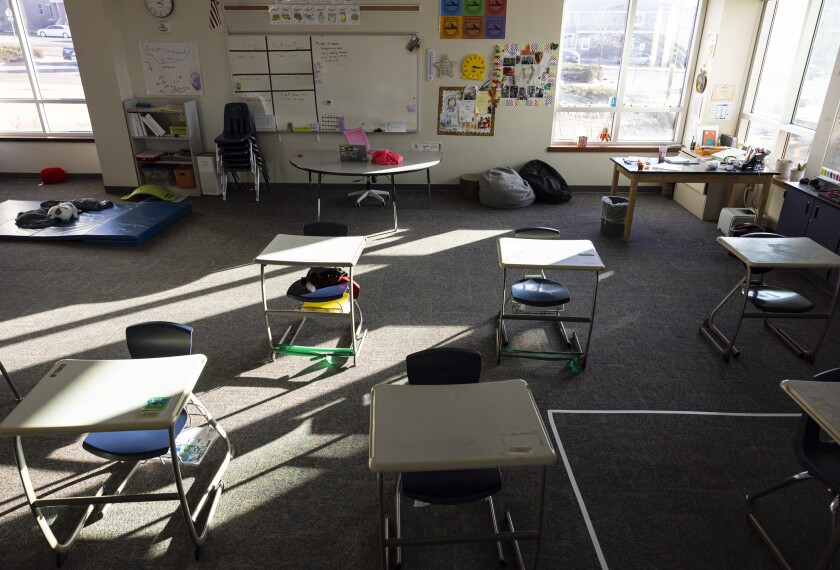
Chronic absenteeism skyrocketed during the pandemic, creating major challenges for teachers and school administrators eager to bring students back to regular classroom routines.
But for many schools, elevated levels of chronic absenteeism have persisted well past the reopening of school buildings, and schools across America are continuing their work to reduce the amount of missed class time and address its far-reaching consequences.
Chronic absenteeism has been associated with a slew of problems, including lower reading achievement and engagement in school, and ultimately a higher risk of dropping out. The students already facing some of the biggest challenges—homeless and foster students, those in poverty, and those with chronic medical conditions like asthma—are also the students most likely to miss school repeatedly.
The research is clear: The more time students spend in school, the better. So, avoiding unnecessary absences is a key piece of academic recovery.
Here are seven things we now know about chronic absenteeism and ways to successfully address it based on a collection of newly published research and surveys of parents, students, and educators.
Absenteeism spiked after pandemic school closures and remains high, but is trending down
Chronic absenteeism was already on the rise before COVID hit. Federal data in 2018 showed nearly 8 million students (16%) nationwide were chronically absent in the 2015-16 school year, and the rate had been slowly but steadily rising beforehand.
In the 2021-22 school year, after the pandemic shuttered school buildings, approximately 30% of students were chronically absent—missing at least 10 percent of the school year—almost double the pre-pandemic figure.
More recently, research suggests that the chronic absenteeism rate is trending downward, but remains well above pre-pandemic norms.

One report in August from the RAND Corp.—among the first to examine absences for the most recent academic year—estimated that about 22% of students across the United States were chronically absent in 2024-25.
Another recent report from FutureEd estimated a similar figure, 23% nationwide, for the 2023-24 school year. That figure also lined up with data from the American Enterprise Institute, which showed a 23.5% rate of chronic absenteeism in 2024, down from 25.4% in 2023 and 28.5% in 2022.
Urban schools struggle more with high absenteeism
In roughly half of urban districts, more than 30% of students were chronically absent in 2024-25—a far higher share than in rural or suburban districts, according to the recent report from RAND.
About 7% of suburban and 9% of rural schools reported that 30% or more of their students were chronically absent in the same time period.
This is not a new phenomenon. Even before the pandemic, urban districts had higher absenteeism.
Absenteeism affects all students, even those who show up. And it hurts teacher morale
Chronic absences affect students who miss classes, hurting their grades, how connected they feel to their peers and school communities, and their chances of completing high school.
Frequent absences by a large segment of the student body also hurt students who attend regularly.
That could be because constant missed school days force teachers into a cycle of remediating and reviewing missed content when absent students return, slowing progress for other students, researchers speculate. It can also be difficult to establish classroom routines and a culture amid a constant churn of students. Some research has found that in classrooms with poorer overall attendance, students exhibited lower reading, math, and executive function skills.
Chronic absenteeism can also be self-perpetuating, as research has shown that students’ absences can make peers more likely to miss school.

The empty desks also affect teachers’ morale: Teacher satisfaction drops steadily as absenteeism increases, according to a study published last November in Education Researcher.
Researchers found teachers whose classes had higher absenteeism in the fall semester rated significantly lower on measures of job satisfaction, feelings of usefulness, and belief in the teaching profession.
Mounting absences can hurt teachers’ ability to feel close to students, and make-up work can add to teachers’ already long to-do lists.
Parents, students, and educators say students are missing more school due to illness
The most common reason kids identified for missing school in the August RAND survey was illness (67%). Other reasons included feeling down or anxious (10%), oversleeping (9%), and being uninterested in attending (7%). About 4% said they missed school to care for a family member, 3% lacked transportation to school, and 1% reported work conflicts.

In an NPR/Ipsos poll released in June 2024, parents were most likely to identify illnesses and concern for student safety as acceptable reasons to miss school. While a growing number of schools stress that children should come to school if they have a noncontagious illness and no fever, 51 percent of parents said that sort of illness was a valid reason to stay home.
Parents know absenteeism is a problem, but often underestimate their kids’ absences
Fifty-eight percent of parents of school-aged children identified chronic absenteeism as a major problem, according to the June 2024 NPR/Ipsos poll.
Though most parents agreed it was a problem, most also failed to correctly define it. Thirty-two percent of parent respondents identified the correct definition: missing 10 percent or more of school days. Fifty-one percent of parents set the bar higher, defining chronic absenteeism as missing at least 20 percent of the school year.
That’s a problem, because a March 2024 study by researchers at the University of Southern California found parents often undercount their own child’s absences. Among those whose children were chronically absent, just 47 percent said they were concerned, that study found.

Some students don’t think high absenteeism is a problem
One-quarter of students do not think missing three or more weeks of school in a single academic year is a problem, according to a new survey administered by the RAND Corp. between March and May.
Students’ perceptions did not depend on gender, ethnicity, or age. However, students whose parents’ highest education level was high school graduate or less were more likely to say that missing three weeks of school is “mostly OK” (33%) than peers whose parents had at least some college education (24%).
Reasons for absences can vary
There are some research-backed approaches to combating chronic absenteeism—like ensuring students have reliable transportation and that they feel a sense of belonging once they get there.
But to really help drive down absences, school and district leaders must first understand the reasons their students are missing class in the first place, researchers say.
To that end, many districts are partnering with families and community organizations to better understand why kids aren’t in class. As part of this work, leaders have learned their communities have unique and unexpected needs that they can often easily address. For example, one district found that some families simply didn’t understand the bus routes and didn’t know whom to ask for help.

Many districts have also found success in creating educational experiences that feel relevant and engaging to students, particularly for high school students. These could include more robust work-based and career and technical education.
Ensuring families understand the importance of in-person class time and incorporating them into absence-fighting strategies can also pay off, research has found.
Schools with stronger, preexisting family engagement—measured in surveys that assessed trust between parents and teachers, parent involvement in schools, and parents’ influence over school decisions—had chronic absenteeism rates after remote learning that were about 6 percentage points lower than similar schools with weaker family engagement, according to one study in 2023 from the organizations Learning Heroes and The New Teacher Project (TNTP).
Schools have also found that it’s best to avoid punitive approaches to absenteeism, like threatening legal action against families or sending students to detention for high numbers of absences, as that has been shown to further damage families’ connections to school and staff members.