Opinion
School Climate & Safety Opinion

Responding to School Shootings Has Become Routine. It’s Anything But

We can’t numb ourselves to the horror of school shootings
By Ann V. Klotz — June 01, 2022 3 min read
conceptual illustration of flowers growing from gun barrels
  • Save to favorites
  • Print

Sometime between the end of a meeting about office space and an investment committee meeting, I learned of another school shooting last week, this time in Uvalde, Texas. Walking home across the parking lot after yet another meeting, I thought about needing to write another letter to my school community about unspeakable horror. I worried that all I do is communicate tragedy.

I hadn’t written to parents about the shooting at a store in Buffalo, N.Y., less than two weeks earlier, but this time it was a school. The children were young.

The almost-cloying scent of French lilacs lining my school’s parking lot filled my nostrils. Though I usually love their fragrance, in the dusk that evening, the scent made me think of funeral homes—and tiny caskets. I thought about mothers who kissed their babies goodbye, never thinking that harm would befall them in school. I wondered how long it would take me to make sense of this latest tragedy and how to take care of the teachers in my school who take care of our children every day.

See Also

The archbishop of San Antonio, Gustavo Garcia-Siller, comforts families outside the Civic Center following a deadly school shooting at Robb Elementary School in Uvalde, Texas, Tuesday, May 24, 2022.
The archbishop of San Antonio, Gustavo Garcia-Siller, comforts families following a deadly school shooting at Robb Elementary School in Uvalde, Texas, on Tuesday, May 24, 2022.
Dario Lopez-Mills/AP
School Climate & Safety Opinion A Devastated Teacher's Plea for Gun Reform
Mary M. McConnaha, May 25, 2022
4 min read

Passing the school buses and heading up our driveway, I thought about how much I hate lockdown drills, the fact that we have to simulate what to do if a gunman ever came into our school and tried to kill us. I hate being the one to rattle the doorknob. The children have been taught not to let me in.

Once, during a lockdown drill some years ago, I saw the fake gunman aim his Nerf gun, and I leapt upon Leighann, the drama teacher in our upper school, whom I have known since she was a girl herself. Her daughter, Olivia, and my son, Atticus, grew up together, had playdates.

“If I cannot save myself,” I thought, “at least I can save Olivia’s mother.” We crashed to the ground, somewhere in between the reality of the drill and the terror of what could be. We laugh about it now, my clumsy impulse to save her life from harmless Nerf darts.

At home, later that night, after the walk across the parking lot, I went about feeding the pets, ordering dinner, logging into a grad school class. I took refuge in routine, in tasks I could complete automatically.

It was 9 p.m. before my crisis-communication partner, Julie, and I opened a Zoom room and faced each other. I did not ask my whole leadership team to log in—it was too late and too familiar—but I was grateful when our two diversity, equity, inclusion, and belonging experts, Candace and Lauren, joined us. Our school psychologist, Ilissa, logged on as well.

We were efficient, tired, numb. Julie had started the letter, and I had edited it during my playwriting graduate class, feeling guilty about my split focus, worrying about a grad school classmate who lives in Texas and whose face looked drawn during our online class.

The letter to families came together quickly. Too quickly. The resources we shared with parents about how to talk to children after a school shooting were easy to locate. Again.

I closed the letter with a benediction I love by the Swiss philosopher Henri-Frédéric Amiel: “Life is short. We don’t have much time to gladden the hearts of those who walk this way with us. So, be swift to love and make haste to be kind.” It was all I could think to offer. I was out of words.

The next morning, I spoke with my schoolteacher daughter. “What I am most afraid of is growing numb,” I told her. “Inured. When we stop feeling, allowing ourselves to be affected—that’s when I fear who we will become.”

On the way back across the parking lot to school, I thought about all the schoolteachers who brushed their teeth, made coffee, buried their fear, and headed to school to be a reassuring presence in the lives of children who rely on them to smile and offer structure and routine. They are a different kind of first responders.

The only way to avoid becoming numb is to keep feeling, to allow horror to wash over us. In college, one of my most inspiring professors, Dorothee Metlitski, a Holocaust survivor, talked to us in every course I took with her about man’s inhumanity to man.

“What does that mean?” one of my 9th graders asked last month during one of our final English classes.

I turned the question back to her. “What do you think it means?”

“It’s about being cruel, one person to another.”

“Right,” I affirm, “And it’s the most important thing to fight against.”

The young person who killed the children in Uvalde, and the young person who killed people in Buffalo—both were 18 years old. They could buy guns but not yet drink alcohol.

Today, I am the opposite of numb; I am stretched taut like a violin string, like a wire vibrating with fury and impotence. I do not want a world in which children murder children.

A version of this article appeared in the June 08, 2022 edition of Education Week as Don’t Numb Yourself To the Horror of School Shootings

Events

Student Well-Being & Movement K-12 Essentials Forum How Schools Are Teaching Students Life Skills
Join this free virtual event to explore creative ways schools have found to seamlessly integrate teaching life skills into the school day.
This content is provided by our sponsor. It is not written by and does not necessarily reflect the views of Education Week's editorial staff.
Sponsor
Special Education Webinar
Bridging the Math Gap: What’s New in Dyscalculia Identification, Instruction & State Action
Discover the latest dyscalculia research insights, state-level policy trends, and classroom strategies to make math more accessible for all.
Content provided by TouchMath
This content is provided by our sponsor. It is not written by and does not necessarily reflect the views of Education Week's editorial staff.
Sponsor
School & District Management Webinar
Too Many Initiatives, Not Enough Alignment: A Change Management Playbook for Leaders
Learn how leadership teams can increase alignment and evaluate every program, practice, and purchase against a clear strategic plan.
Content provided by Otus

EdWeek Top School Jobs

Teacher Jobs
Search over ten thousand teaching jobs nationwide — elementary, middle, high school and more.
View Jobs
Principal Jobs
Find hundreds of jobs for principals, assistant principals, and other school leadership roles.
View Jobs
Administrator Jobs
Over a thousand district-level jobs: superintendents, directors, more.
View Jobs
Support Staff Jobs
Search thousands of jobs, from paraprofessionals to counselors and more.
View Jobs

Read Next

School Climate & Safety 4 Ways Schools Can Build a Stronger, Safer Climate
A principal, a student, and a researcher discuss what makes a positive school climate.
4 min read
A 5th grade math class takes place at Lafargue Elementary School in Effie, Louisiana, on Friday, August 22. The state has implemented new professional development requirements for math teachers in grades 4-8 to help improve student achievement and address learning gaps.
Research shows that a positive school climate serves as a protective factor for young people, improving students’ education outcomes and well-being during their academic careers and beyond. A student raises her hand during a 5th grade class in Effie, La., on Aug. 22, 2025.
Kathleen Flynn for Education Week
School Climate & Safety Schools Flag Safety Incidents As Driverless Cars Enter More Cities
Agencies are examining reports of Waymos illegally passing buses; in another case, one struck a student.
5 min read
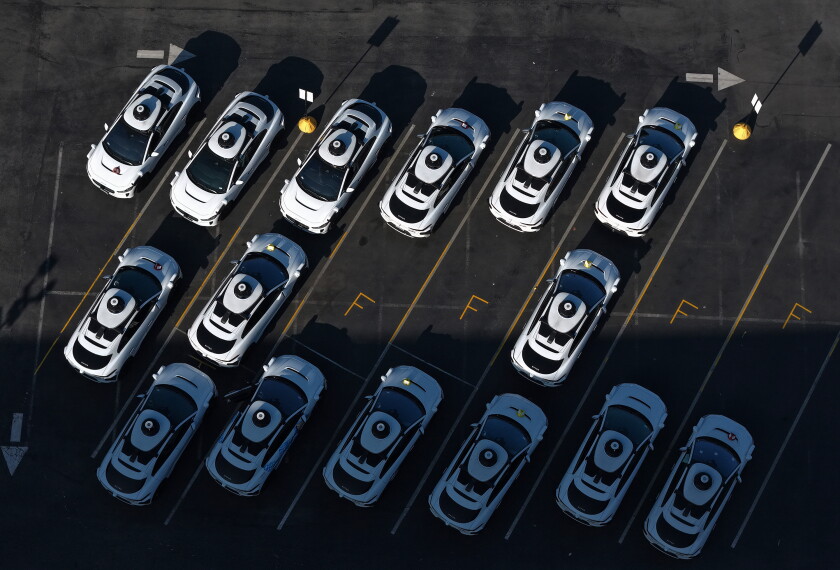
In an aerial view, Waymo robotaxis sit parked at a Waymo facility on Dec. 8, 2025 , in San Francisco . Self-driving taxi company Waymo said it is voluntarily recalling software in its autonomous vehicles after Texas officials documented at least 19 incidents this school year in which the cars illegally passed stopped school buses, including while students were getting on or off.
Waymo self-driving taxis sit parked at a Waymo facility on Dec. 8, 2025, in San Francisco. Federal agencies are investigating after Austin, Texas, schools documented incidents in which the cars illegally passed stopped school buses. In a separate incident, a robotaxi struck a student at low speed as she ran across the street in front of her Santa Monica, Calif., elementary school.
Justin Sullivan/Getty Images via TNS
School Climate & Safety Informal Classroom Discipline Is Hard to Track, Raising Big Equity Concerns
Without adequate support, teachers might resort to these tactics to circumvent prohibitions on suspensions.
5 min read
Image of a student sitting outside of a doorway.
DigitalVision
School Climate & Safety Officer's Acquittal Brings Uvalde Attack's Other Criminal Case to the Forefront
Legal experts say that prosecutors will likely consider changes to how they present evidence and witness testimony.
4 min read
Former Uvalde school district police officer Adrian Gonzales, left, talks to his defense attorney Nico LaHood during a break on the 10th day of his trial at Nueces County Courthouse in Corpus Christi, Texas, Tuesday, Jan. 20, 2026.
Former Uvalde school district police officer Adrian Gonzales, left, talks to his defense attorney Nico LaHood during a break on the 10th day of his trial at Nueces County Courthouse in Corpus Christi, Texas, Tuesday, Jan. 20, 2026. Jurors found Gonzales not guilty.
Sam Owens/Pool
