Student Well-Being & Movement From Our Research Center

How Bad Is Student Absenteeism Right Now? Educators Tell Us

Absence rates rise, on average, 39 percent
By Catherine Gewertz — January 13, 2022 1 min read
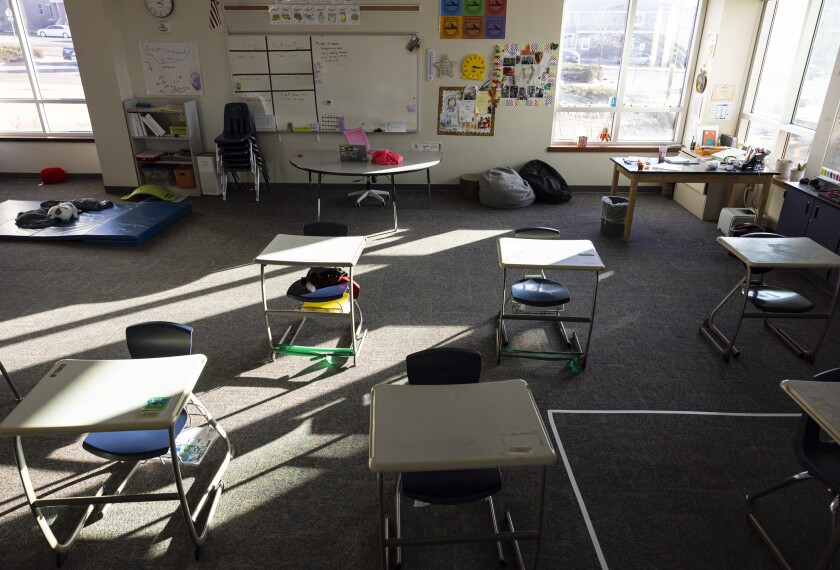
Image of an empty desk.
  • Save to favorites
  • Print

It’s a painful truth already, but new numbers sharpen the picture: 61 percent of educators say that student absenteeism is higher this winter than it was in the fall of 2019, adding new urgency to questions about how to care for students who are struggling with trauma and illness during the pandemic, and how to catch them up academically.

The finding comes from an online survey administered by the EdWeek Research Center during the second half of December. About 1,200 teachers, principals, and district leaders responded.

Where absenteeism is higher, it’s not just a little bit higher: it’s up an average of 39 percent.

Remote instruction appears to play a role in absenteeism. Sixty-four percent of educators at schools that taught mostly in remote mode in 2020-21 said student absenteeism has risen, compared with 51 percent of those in schools that taught mostly face-to-face.

It wasn’t immediately clear how much of the absenteeism was excused, for accepted reasons such as illness or quarantine, and how much was unexcused. But it’s well known that students’ motivation has plummeted during the pandemic, and having to learn alone, at home, on a screen, hasn’t helped.

Experts who study school attendance say one of the biggest reasons students are absent during the pandemic is because they’ve had to quarantine after being exposed to COVID-19. But fear of getting the virus, and struggles with stress, motivation, and mental health have also played roles.

The higher absenteeism echoes statewide drops in attendance that have already been reported in many states and districts. During the pandemic, many districts are also seeing more students become chronic absentees, those who miss more than 10-15 percent—depending on whose definition you use—of school.

Related Tags:

Events

This content is provided by our sponsor. It is not written by and does not necessarily reflect the views of Education Week's editorial staff.
Sponsor
Special Education Webinar
Bridging the Math Gap: What’s New in Dyscalculia Identification, Instruction & State Action
Discover the latest dyscalculia research insights, state-level policy trends, and classroom strategies to make math more accessible for all.
Content provided by TouchMath
This content is provided by our sponsor. It is not written by and does not necessarily reflect the views of Education Week's editorial staff.
Sponsor
School Climate & Safety Webinar
Belonging as a Leadership Strategy for Today’s Schools
Belonging isn’t a slogan—it’s a leadership strategy. Learn what research shows actually works to improve attendance, culture, and learning.
Content provided by Harmony Academy
This content is provided by our sponsor. It is not written by and does not necessarily reflect the views of Education Week's editorial staff.
Sponsor
School & District Management Webinar
Too Many Initiatives, Not Enough Alignment: A Change Management Playbook for Leaders
Learn how leadership teams can increase alignment and evaluate every program, practice, and purchase against a clear strategic plan.
Content provided by Otus

EdWeek Top School Jobs

Teacher Jobs
Search over ten thousand teaching jobs nationwide — elementary, middle, high school and more.
View Jobs
Principal Jobs
Find hundreds of jobs for principals, assistant principals, and other school leadership roles.
View Jobs
Administrator Jobs
Over a thousand district-level jobs: superintendents, directors, more.
View Jobs
Support Staff Jobs
Search thousands of jobs, from paraprofessionals to counselors and more.
View Jobs

Read Next

Student Well-Being & Movement Opinion Why a Good School Needs Both Coaches and Referees
If teachers are forced into being referees, they can't fill that role properly or coach well, either.
6 min read
The United States Capitol building as a bookcase filled with red, white, and blue policy books in a Washington DC landscape.
Luca D'Urbino for Education Week
Student Well-Being & Movement Q&A Cellphones: The 'Most Formidable Adversary' Schools Have Ever Faced
The Spokane schools in Washington paired cellphone restrictions with expanded extracurricular activities.
5 min read
Students at Glover Middle School in Spokane, Wash. make bookmarks and snowflakes during Falcon Time on Dec. 3, 2025.
Students at Glover Middle School in Spokane, Wash. make bookmarks and snowflakes during Falcon Time on Dec. 3, 2025. The district has sought to encourage students to spend less time on devices.
Kaylee Domzalski/Education Week
Student Well-Being & Movement Want Kids to Have Better SEL Skills? Try Using Sports
In a panel discussion, district leaders and an expert discuss why sports is a great place to learn life skills.
3 min read
Students play basketball at Parkway Sports & Health Science Academy on Feb. 21, 2025 in La Mesa, Calif.
Students playing basketball at Parkway Sports & Health Science Academy on Feb. 21, 2025, in La Mesa, Calif. Some schools are using sports as a way to help students develop social-emotional skills.
Ariana Drehsler for Education Week
Student Well-Being & Movement How a District Used Data to Fight Students' Gambling and Vaping
School officials figured out when kids faced the most pressure and worked from there.
3 min read
A panel on risky behaviors and district challenges kicks off at the National Conference on Education in Nashville, Tenn. on Feb. 12, 2026. At the podium is Ashley Dawson, senior project coordinator of children's programs at AASA. At the table, from left: Michael Vuckovich, superintendent of the Windber Area school district; Korie Duryea, the district's special education director; and Jessica Shuster, the director of education.
School officials from Windber, Pa., discussed their fight against student vaping and gambling in a Feb. 12, 2026, panel at the National Conference on Education in Nashville, Tenn. At the table are, from left, Superintendent Michael Vuckovich; Korie Duryea, the district's special education director; and Jessica Shuster, the director of education. Ashley Dawson, senior project coordinator of children's programs at AASA, The School Superintendents Association and conference host, is at the podium.
Kaylee Domzalski/Education Week
