School & District Management

High-School Reforms Found To Bolster Basic Skills

By Linda Chion-Kenney — October 02, 1985 3 min read
  • Save to favorites
  • Print

Recent efforts to improve secondary schools have yielded advances in students’ basic skills, better school attendance, and greater business and community support, according to a survey of officials in the nation’s largest urban districts.

But improvement efforts are having less impact on teacher turnover, the number of students needing remedial courses, and students’ academic performance outside of basic-skills areas.

The survey results were released this month at the Council of the Great City Schools’ fall conference here. The council represents 35 urban districts that enroll 11.4 percent of the nation’s elementary and secondary students.

The “Secondary School Improvement Study,” prepared by Thomas R. Owens of the Northwest Regional Educational Laboratory for the4council, is based on surveys of district superintendents and of principals in three sample high schools from each district.

Twenty-six districts responded to the survey of superintendents, and 71 schools, representing 28 districts, responded to the survey of principals. Improvement efforts were defined as any planned change to improve schools undertaken since 1980.

Findings of Surveys

Among the major findings:

Two-thirds of the superintendents reported that both student homework assignments and time allocated to academic skills have increased significantly in their districts.

Eighty-one percent of the districts reported increases in graduation requirements since 1980. The full effect of these changes, the report said, will probably not be seen for at least several years, but at least one-fourth of the districts reported they had already reduced their elective courses by up to 20 percent. A third of the districts reported losing up to 20 percent of their teachers in electives.

At least a third of the districts reported that the new graduation requirements had led to increased testing and increased support from parents and the community.

Half of the superintendents and nearly half of the principals indicated that their goals of high expectations for student learning, strong instructional quality, and a “curriculum based on clear goals and objectives” had been advanced significantly as a result of school-improvement efforts.

Nearly half of the superintendents reported significant increases in ''clear and focused instruction” and in close monitoring of the learning process.

Although 42 percent of the superintendents and 44 percent of the principals reported that “explicit standards for classroom behavior” had been set more often, only 15 percent of the superintendents and 25 percent of the principals reported great increases in “smooth and efficient classroom routines.”

A third of the superintendents reported lengthening the school day or year in their districts.

“For the most part, we have in place the superstructure--a well-defined and appropriate curriculum,4

appropriate materials related to the goals in the curriculum, and a good testing and accountability program, although it could be in more districts,” commented Walter E. Hathaway, director of research and evaluation for the Portland (Ore.) Public Schools. “What we don’t have is a direct-support system for the teacher.”

‘Bottom-Up Strategy’

According to Samuel E. Husk, executive director of the council, the report shows that it is “time to move on.”

“It’s clear that we’ve done most of the top-down things that we needed to do as far as setting up policy, plans, and procedures,” he said. “Now it’s time to start building a bottom-up strategy.”

Mr. Husk said many of the council’s member districts “will be moving, within the next year or so, into school-site improvement efforts that will allow considerable flexibility for teachers and school-based administrators to come up with individual models” for improvement.

The report includes a list of districts and schools that have “exemplary school-improvement policies” in various areas, as evaluated by the Northwest Regional Educational Laboratory.

Council members will receive a free copy of the report. Others can obtain a copy by sending a purchase order, check, or money order for $7.50 to Mr. Husk at the Council of Great City Schools, 1413 K St., N.W., Washington, D.C. 20005.

Related Tags:

A version of this article appeared in the October 02, 1985 edition of Education Week as High-School Reforms Found To Bolster Basic Skills

Events

Student Well-Being & Movement K-12 Essentials Forum How Schools Are Teaching Students Life Skills
Join this free virtual event to explore creative ways schools have found to seamlessly integrate teaching life skills into the school day.
This content is provided by our sponsor. It is not written by and does not necessarily reflect the views of Education Week's editorial staff.
Sponsor
Special Education Webinar
Bridging the Math Gap: What’s New in Dyscalculia Identification, Instruction & State Action
Discover the latest dyscalculia research insights, state-level policy trends, and classroom strategies to make math more accessible for all.
Content provided by TouchMath
This content is provided by our sponsor. It is not written by and does not necessarily reflect the views of Education Week's editorial staff.
Sponsor
School & District Management Webinar
Too Many Initiatives, Not Enough Alignment: A Change Management Playbook for Leaders
Learn how leadership teams can increase alignment and evaluate every program, practice, and purchase against a clear strategic plan.
Content provided by Otus

EdWeek Top School Jobs

Teacher Jobs
Search over ten thousand teaching jobs nationwide — elementary, middle, high school and more.
View Jobs
Principal Jobs
Find hundreds of jobs for principals, assistant principals, and other school leadership roles.
View Jobs
Administrator Jobs
Over a thousand district-level jobs: superintendents, directors, more.
View Jobs
Support Staff Jobs
Search thousands of jobs, from paraprofessionals to counselors and more.
View Jobs

Read Next

School & District Management On Capitol Hill, Relieved Principals Press for Even More Federal Support
With the fiscal 2026 budget maintaining level K-12 funding, principals look to the future.
7 min read
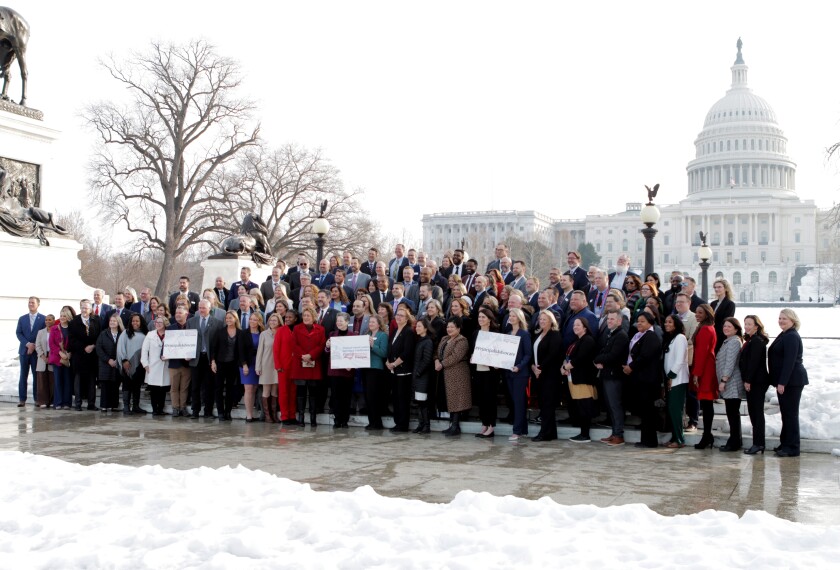
In this image provided by NAESP, elementary school principals gathered on Capitol Hill recently to meet with their state's congressional delegations in Washington
Elementary school principals gathered on Capitol Hill on Feb. 11, 2026,<ins data-user-label="Madeline Will" data-time="02/12/2026 11:53:27 AM" data-user-id="00000175-2522-d295-a175-a7366b840000" data-target-id=""> </ins>to meet with their state's congressional delegations in Washington. They advocated for lawmakers to protect federal K-12 investments.
John Simms/NAESP
School & District Management Q&A Solving Chronic Absenteeism Isn't 'One-Size-Fits-All,' This Leader Says
Proactive, sensitive communication with families can make a big difference.
7 min read
Superintendent Mary Catherine Reljac walks around the exhibition hall of the National Conference on Education in Nashville, on Feb. 12, 2026. Reljac is the superintendent for Fox Chapel Area School District in Pennsylvania.
Mary Catherine Reljac walks around the exhibition hall of the National Conference on Education in Nashville on Feb. 12, 2026. Reljac, the superintendent for Fox Chapel Area school district in Pennsylvania, is working to combat chronic absenteeism through data analysis and tailored student support.
Kaylee Domzalski/Education Week
School & District Management Opinion The News Headlines Are Draining Educators. 5 Things That Can Help
School leaders can take concrete steps to manage the impact of the political upheaval.
5 min read
Screen Shot 2026 02 01 at 8.23.47 AM
Canva
School & District Management Q&A When Should a School District Speak Out on Thorny Issues? One Leader's Approach
A superintendent created a matrix for his district to prevent rash decisions.
5 min read
Matthew Montgomery, the superintendent of Lake Forest schools in Ill., during the AASA conference in Nashville on Feb. 11, 2026.
Matthew Montgomery, the superintendent of Lake Forest schools in Illinois, is pictured at the AASA's 2026 National Conference on Education in Nashville, Tenn., on Feb. 11, 2026. The Lake Forest schools established a decisionmaking matrix that informs when the district speaks out on potentially thorny topics.
Kaylee Domzalski/Education Week
