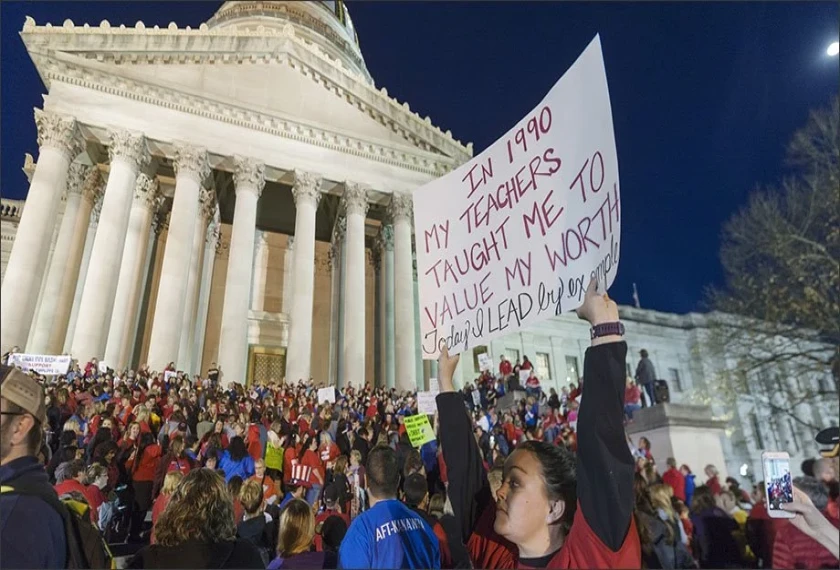
A teacher strike—an organized refusal to work that can cause public schools to close indefinitely—can throw a school, district, or even an entire state into turmoil. While commonplace in decades past, teacher strikes have become rarer, and are generally at the district level and concentrated in a few states, such as Pennsylvania and Illinois.
In 2018, however, there was a remarkable display of teacher activism at the state level. Thousands of teachers in West Virginia, Oklahoma, and Arizona went on strike to fight for higher wages and more school spending, forcing schools across the states to shut down. While the strikes yielded varying results, teachers in each state received a pay raise. There were also shorter statewide protests in Colorado, Kentucky, and North Carolina. Momentum from those labor actions continued into 2019, with teachers in Los Angeles Unified—the nation’s second-largest district—going on strike as the year kicked off.
In states where striking is illegal, sometimes teachers’ unions prefer the word walkout rather than strike. While there does not appear to be an agreed-upon definition to separate a walkout from a strike, some say the latter word implies action against a particular school board policy or a failure to arrive at a collective-bargaining agreement. Often, though, the words are used interchangeably.
Here’s a primer on teacher strikes then and now.
How Common Are Teacher Strikes?
While disruptive to the lives of students and families, teacher strikes are fairly rare. There have been between three and 24 teacher strikes per year since 2010. However, the length of those strikes has varied widely, from just one day to six weeks. Depending on how long a strike lasts, districts have to juggle making up school days; at times, that means shortening scheduled breaks.
Pennsylvania is known to have more strikes than other states–often the same local teachers’ union there will strike multiple times in the same school year. This has happened at least four times since 2010 (the law limits the number of strikes for each district in Pennsylvania to two per school year).
In 2018, notably, there were 14 teacher strikes in Washington state, as teachers fought for double-digit salary increases after a state Supreme Court ruling ordered the state legislature to pour more money into education.
Strikes across an entire state are infrequent, and even when a strike is called “statewide,” it doesn’t always close all school districts. Mississippi’s strike in 1985, Kentucky’s in 2004, and West Virginia’s in 2007 all were called “statewide,” and yet less than half of districts were closed.
Unsurprisingly, statewide strikes tend to be about statewide issues, like public employee health-care plan fees or state education funding.
For media or research inquiries about this data, contact library@educationweek.org.
A Look at Statewide Strikes
While most strikes are organized more locally, every so often organizing efforts reach across all, or much of, an entire state. Here are some influential actions that were viewed as statewide.
- 1968: The first statewide teacher strike was in Florida in 1968 when more than 40 percent of teachers did not come to school. The teachers actually resigned, because the state didn’t allow teachers to strike. At the end of the strike, which lasted for weeks, some teachers were not reinstated. But as a result of the strike, the state boosted education funding and collective bargaining rights for public employees.
- 1985: Over 9,000 of Mississippi’s 25,000 teachers participated in a wildcat strike–one without the union’s authorization—closing schools in 58 of the state’s 154 districts over several weeks.
- 1989: 20,000 Utah teachers staged a one-day strike, closing 38 of the state’s 40 school districts.
- 1990: Teachers in West Virginia went on strike for 12 days.
- 1990: Thousands of Oklahoma teachers engaged in a “protest” organized by the Oklahoma Education Association, which caused more than 120 of the state’s 600-plus school districts to close on different days over one week. The union didn’t officially call it a strike, to avoid diminishing public support for their cause.
- 2001: 16,000 teachers and professors in Hawaii chose to strike, closing nearly all 256 public schools and 10 college campuses in the state for several weeks.
- 2004: 20 of Kentucky’s 176 districts closed briefly because of a teacher strike over health-care plan costs.
- 2007: Nearly 5,000 West Virginia teachers were on strike for one day, closing some or all schools in 14 of the state’s 55 districts.
- 2018: After a nine-day strike, West Virginia teachers struck a deal with the state legislature for a 5 percent pay raise. The state also agreed to look into rising health insurance premiums, and freeze them temporarily.
- 2018: An estimated 30,000 teachers across Oklahoma refused to work for nine days, fighting for a pay raise and more education funding. The state legislature passed the first tax increase in nearly three decades to give teachers an average $6,100 pay raise and put more money into schools. Still, the Oklahoma Education Association ultimately ended the walkout before achieving all of its initial demands.
- 2018: The weeklong Arizona teacher strike ended when the governor signed a plan to provide a 20 percent teacher pay raise over the next three years, along with a restoration of $371 million in recession-era budget cuts to schools. At least 108 of the state’s 184 districts closed for at least one day during the strike.
How Have Strikes Changed Over Time?
The history of teacher strikes dates back to the 1950s and 1960s, when teachers and other public employees started pushing for the collective-bargaining rights held by private-sector employees. Most strikes in those decades—sometimes hundreds per year—focused on getting school boards to recognize teachers’ right to bargain, according to Jon Shelton, an assistant professor of history at University of Wisconsin Green Bay and the author of Teacher Strike! Public Education and the Making of a New American Political Order. Through the 1980s, much of the conflict revolved around staving off budget cuts and defending the gains teachers had made in the previous decades.

“It’s not an exaggeration to say teacher strikes were a part of everyday life,” says Shelton.
But strikes began to taper off in the 1990s, with the number in the early 21st century only a fraction of what schools experienced the decade before. Education Week reported that there were 84 teacher strikes in the 1990-1991 school year, the bulk of them in Pennsylvania. That’s a big difference from these days: Between 2010 and 2017, there weren’t more than 13 strikes in a year. In 2018, a year with significant teacher activism, there were 24 strikes, three of which were statewide.
There are several probable reasons for the decrease in strikes over time, according to Shelton: In the 1990s and early 2000s, the economy was more stable, inflation was down, and teachers’ unions were well-accepted by school districts as the representatives of teachers.
Is Striking Legal?
Whether teachers are legally allowed to strike varies from state-to-state. But in most places, striking is illegal.
As of January 2014, 35 states and the District of Columbia had laws forbidding strikes, according to Milla Sanes and John Schmitt of the Center for Economic and Policy Research. Teacher strikes are legal in 12 states and not covered in statutes or case law in three.
That said, teachers do strike in states where it’s illegal. For instance, strikes are against the law in West Virginia, but that did not stop teachers there in 2018.
Where Are Strikes Most Common?
Pennsylvania, Illinois, Washington state, and California lead the way with the highest number of teacher strikes.
Nationwide, strikes occur in all types of districts, whether urban, rural, or suburban.
Strikes are not teachers’ only bargaining tactics. “Sick-outs”—in which many teachers call in sick on the same day to shut down schools or entire districts—are also a tool used by unions. In Detroit, there have been at least three sickouts between 2016 and 2018 that closed the majority of the city’s schools for at least a day.
A further technique that teachers’ unions use to protest unsatisfactory contracts is “work-to-rule,” also known as “working the contract.” In that case, teachers stop doing any work outside of the hours required by their contract. That may mean teachers stop scheduling field trips, tutoring students after school, advising student clubs, and overseeing after-school activities.


