

Schools need Gen Z teachers. But they’re not quite sure what to do with them.
As hundreds of thousands of veteran educators retire over the next five years, the nation’s most educationally, ethnically, and linguistically diverse group of teachers to date is stepping in to replace them. These young and aspiring teachers are reshaping the K-12 conversation around technology use, mental health, and student engagement in schools.
Many of today’s youngest, newest teachers have been indelibly shaped by doing their training and entering the classroom during the pandemic. “I like to call it B.C. and A.C.—before COVID and after COVID,” said Christian Jovel-Arias, 26, a 5th grade bilingual English/language arts and math teacher at John Quincy Adams Elementary in Dallas.
Jovel-Arias entered classes as a student-teacher in New York City in 2019. But by the time he became a full-time teacher, the expectations of the job had fundamentally changed, he said: “The workload is bigger, the many different hats we wear: a teacher, yes, but a social worker, a nurse, a counselor, a stakeholder in these children’s lives.”
While passionate about their work with students, Gen Z teachers also demand support and flexibility from their schools in ways older generations of teachers haven’t. Gen Z’s expectations, and willingness to look around for a workplace that delivers on them, distinguishes it from earlier generations, say those experienced in teacher hiring.
“My generation and ones before sort of entered the workplace and just bent into whatever expectations were already set,” said Meagan Booth, a former high school principal and current human resources supervisor for the Knox County, Tenn., public schools, who describes herself as an older Millennial. Young teachers hired since the pandemic, Booth said, have raised awareness of student and staff mental health and adapted quickly to changing classroom technology. But they’ve also been “less tied to a given campus or pension plan,” she added.
“They are much more vocal about what they feel they need to be successful—and if you don’t offer it, their loyalty isn’t there,” Booth said. “They are loyal to leaders who they feel support them, not institutions.”

What do Gen Z teachers want out of teaching?
One of the difficulties of any attempt at describing Gen Z teachers’ commonalities is the lack of specific empirical data on them. Most studies look at years of experience rather than age, and it’s hard to directly compare these teachers’ needs and wants to those of older generations like the Baby Boomers (born 1946-1964), who weren’t surveyed when they were the same age as today’s Gen Z youth—between 14 and 29.
When it comes to their morale, the EdWeek Research Center’s annual survey, administered as part of our State of Teaching project, shows that Gen Z teachers reported higher morale than that of older generations in late 2025 when the survey was administered—a shift from the previous year, in which the youngest teachers appeared to have somewhat worse morale than older teachers. (Nationally, the third annual EdWeek Teacher Morale Index stands at +13 on a scale of -100 to 100, suggesting teachers overall feel positive about their jobs, but down from the prior score of +18.)
Some experts say the numbers could mean Gen Z teachers may not be experiencing improvements in school working conditions as much as they are coping with declines in other industries affected by economic and technological disruptions.
“When there’s uncertainty in the economy, more people start thinking about being a teacher,” said Heath Morrison, the chief executive officer of Teachers of Tomorrow, one of the largest alternative-certification programs in the United States. “AI is starting to have a dramatic impact on every single industry, and … when you look at the jobs that are the most secure and least replaceable [by AI], teaching is one of them.”
But to keep Gen Z teachers in the long term, a majority of such teachers in the EdWeek survey and other studies say they need more flexible work structures, such as four-day weeks and more planning time during the workday.
These mirror concerns of Gen Z workers across industries, who regularly prioritize flexibility, career development, meaningful work, and safe workplaces, even above pay and benefits, when deciding where to work.
“There’s a specific focus on the day-to-day function of a teacher and how it has become really unmanageable,” said Weadé James, co-author of a report on early-career educators by the Center for American Progress, a think tank.
Building systems of educator support could help to provide these teachers with more of what they say they need in order to stay, and could potentially have the fringe benefit of stemming more general dissatisfaction among teachers of all ages. And many of them want to have an active role in improving the contours of the job itself.
Dallas teacher Jovel-Arias, for example, discussed assessment and accountability with state senators before the Texas legislature, which just passed sweeping new education policy laws on teacher pay, accountability, and vouchers.
“It’s really been an ‘aha’ moment for me in terms of how state policies affect my colleagues and my students,” Jovel-Arias said.

‘Unprecedented need for support’
Many Gen Z teachers share Jovel-Arias’s desire to shape teaching from the get-go.
Many members of Gen Z have been more involved in family decisionmaking than prior generations, said Amber Chandler, the author of the 2023 book, Everything New Teachers Need to Know But Are Afraid to Ask—and mother of a Gen Z teacher.
This, she said, has meant many Gen Z teachers also expect to have and value a strong voice and autonomy in the workplace, coupled with intense feedback and support from supervisors.
“Anybody under 30, in some ways, may have been put on pedestals where [parents’] lives revolved around their schedules,” Chandler said. “In a lot of ways these new teachers are looking for more than a mentor.”
But few districts have the capacity to support the “almost unprecedented need for continuous support” for larger influxes of new, mostly Gen Z teachers, said Chandler, the director of early career mentoring at New York’s Frontier Central school district in Hamburg, near the shores of Lake Erie where data suggest nearly half of teachers will be new in the next five years.
At least 31 states and the District of Columbia require mentoring for new teachers, but in many cases these programs do not extend beyond the first year, according to the Education Commission of the States, a clearinghouse of state policies.
At least one school district is trying to provide this kind of intensive support for its new teachers, including those in Gen Z. More than 600 of the 3,700 teachers in the Fresno Unified school district in California are in their first two years in charge of a classroom, and the district hires roughly 250 new teachers every year, according to Teresa Morales-Young, Fresno’s director of teacher development.
The district’s formal mentoring program for new teachers lasts two years and centers around developing strong relationships not only between new teachers and veterans in their buildings, but also among new teachers districtwide. (The district also provides separate supports for teachers entering the classroom from other careers.)
Early-career teachers can attend monthly “Saturday Pipeline” meet-ups, in which new teachers socialize and learn together about the most pressing challenges they face: applying the principles of the “science of reading,” engaging students in math discussions, managing student behavior, and understanding individualized education programs for students with disabilities. In the last five years, more first-time teachers also have opted for training on professional habits like formal dress, communication, and social media management, Morales-Young said.

Fresno’s intensive mentoring approach seems to be working. More than 9 in 10 new teachers who participate in the induction program stay in Fresno, according to district data.
Young teachers need a coach—and an advocate
At the heart of the Fresno district’s work on retention is structured, in-class feedback.
Each week, a master teacher observes a new teacher’s lesson, focusing on skills or approaches the teacher wants to improve. The two then meet to discuss what worked and didn’t in the lesson, analyze any new student data from class assignments or benchmarking assessments, and plan future lessons designed to address the teacher’s concerns.
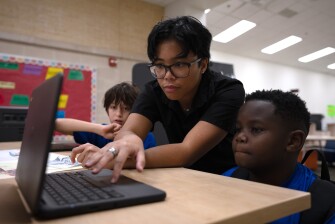
At one such session this November at Thomas Elementary School, mentor Claire Steinbronne watched resource specialist Amanda James walk her small groups of 6th graders during an intervention period through one-step algebraic equations using a number line. Afterwards, the educators work through how to monitor students’ skills to change up the small groups each week and relay the results to their general education teachers.
“I typically write in [students’] progress reports …,” James begins.
“Perfect,” Steinbronne interjects.
“ … but I would like to do more. I would like to go in and meet with grade-level [teachers] when they’re doing their PLCs,” James said, referencing the collaborative “professional learning communities” teachers in Fresno use to guide instruction.
Steinbronne hums. “Maybe make a share doc on Teams for each student and you can share it.”
“Oh, that’s a wonderful idea!” James says.
James also frets about an English learner she sees three days a week but who rarely speaks and recently started holding his breath in class.
“He just kind of started to get red,” she says. “And I noticed that and I asked him if he was OK—he was OK—but I really want to increase communication so that I can figure those things out. Was he just holding his breath for fun? Was he upset about something? What was going on?”
Steinbronne offers to get James a Spanish-speaking tutor to help during small group breakouts.
After discussing her students, Steinbronne asks James about her progress at Fresno State University, where she is taking night classes to work towards turning her provisional teaching license into a full credential under California law.
“I know you have so much on your plate right now. So between school, your personal life, your classes, and the workload, how are you balancing it all right now?” Steinbronne asks.
James huffs out a tight laugh. “I take it day by day—and every day is a month,” she admits, noting that she has been struggling to find enough time to complete some of her assignments and log required class observations. Steinbronne offers to videotape some of James’ classes to help her create the observation logs and reminds James of a peer support group for new teachers that meets online every Tuesday afternoon.
“I just don’t want you to be overwhelmed,” Steinbronne says. “Let me know how I can help.”
Pushing for a better balance
While teachers of all ages continue to show higher rates of stress and anxiety then before the pandemic, Gen Z teachers are more likely than prior generations to speak up when they feel overwhelmed and advocate for a good work-life balance.
Katrina Sacurom takes on a lot of education work beyond being a 5th grade teacher at Shawnee Trail Elementary in Frisco, Texas. Sacurom finds her extra duties—such as advising student activities like a student newspaper and a documentary crew—invigorating rather than exhausting, because they allow her to explore different facets of teaching. Her enthusiasm has building a work-life balance an ongoing learning process.
“Coming into this profession, I have a lot of energy and a lot of drive,” Sacurom said. “It really makes it difficult when you want to give … 100% all the time, but just recognizing that 100% all the time is not exactly the best practice. It’s healthy to set those boundaries.”
Across the board, Gen Z teachers Education Week spoke to said they work hard to maintain their own mental health and keep reasonable boundaries between work and life.
Booth, the Tennessee administrator, and Chandler in New York both have seen a backlash among young teachers against the workaholic tendencies among their parents and mentors. “Gen Z carries a skill set and a language around mental health that I don’t think generations before them have had,” Booth said. “We can learn a lot from them about protecting ourselves from burnout. They watched their mentors burn themselves out and they just aren’t willing to do that.”
Dallas teacher Jovel-Arias prioritizes lesson-planning and differentiation for his students, “and then, everything else will get done when it gets done.”
“My mentality is, I do not work in an emergency room,” he said. “I’m not just a teacher: I’m a human who probably needs to go grocery shopping or take a walk.”
But Gen Z teachers also told Education Week that they needed help from their school leaders to safeguard their work-life boundaries. Sixty percent of Gen Z teachers—about twice as many as Gen X or Boomer teachers—said that having mental wellness days would significantly improve morale, and 65% of Gen Z teachers said getting more dedicated planning time during the school day would be a major morale boost.
Technically, Estefani Robles, a graduate resident at Fresno, gets 45 minutes at the end of the school day for planning. In reality, they’re taken up by calling parents or grading, said Robles, 28. “I think that’s why people really feel burnt out when they have to take work home,” she said. “It would be great to have maybe an hour once a week, guaranteed, just to plan.”
Of course, Jovel-Arias said, that’s easier said than done when administrators, parents, and students often expect round-the-clock access via messaging apps and class websites. “I don’t think people are malicious, but … they just think you’re available at all hours and that’s not the case,” he said.
Fresno’s teacher-coaches have become not just instructional guides, but workplace advocates for their younger colleagues. Robles turned to her coach when she started the year solo teaching 14 students with disabilities in a self-contained class. Her coach helped her secure a permanent substitute teacher as a paraprofessional.
It’s been a huge relief to have another adult in the room, Robles said, to let her take advantage of school planning days.
Having a dedicated paraprofessional also helped Robles limit the amount of time her students spent working practice problems and reading passages on software programs while she taught small groups. “Kids will really gravitate towards technology, so yes, [the software] allowed me to keep them there and focused, but I just felt that like they need that human interaction,” Robles said.

Discipline a challenge
For all the online stereotyping about Gen Z’s traits, like being coddled, teachers in the generation harbor a distinctly old-school attitude to student discipline, favoring a stricter approach to class management than their older colleagues.
A majority of Gen Z teachers in the Education Week survey said their morale would get a major boost if schools limited parents’ ability to appeal their children’s discipline consequences and if parents received instruction on “teaching children how to behave in ways that are appropriate for school.”
Nearly a quarter of Gen Z teachers—more than twice as many as older generations of teachers—also told the EdWeek Research Center they wanted more professional development on managing student behavior.
Demetrius Dove, 23, in his first year as a grade 6-7 grades English/language arts teacher at the Atlanta SMART Academy charter school, said managing student behavior day-to-day required a much bigger learning curve than he’d expected as a student teacher.
“They give us a bunch of strategies, but then you get in the classroom and it’s like, OK, none of this actually works!” he said with a laugh “You really have to build a relationship with your children … to be able to notice, OK, is this a trauma response that I may be reading as, ‘oh, they’re disinterested in the curriculum’?”
“It was a real disconnect,” Dove continued, “because I didn’t necessarily get taught to notice the nuances and the underlying circumstances” behind student misbehavior.
Young teachers often feel their jobs have become more dangerous, and while schools are generally very safe places, overall crime in schools also more than doubled from 2020-2024, according to federal data. The rise in violence wasn’t not just committed by students, but former students, parents, and strangers.
And the smaller age gap between these young teachers and their students can make laying down the law a bit awkward.
“It’s tough to do that because you want to be the cool teacher—everyone wants to be the likeable one,” said Emily Box, the middle school dance teacher in Texas. “I’ve slowly but surely learned that the more discipline and boundaries you set, the more respect you ask for and give in return, the more they’re going to like you.”
Box was in the first graduating class after the pandemic to not have social distancing. She echoes other Gen Z teachers’ concerns that she has to fight for her students’ attention and respect.
“To this day, I hear [from students], ‘You don’t look like a teacher,’ because I get to wear leggings and tennis shoes every day,” Box said. “You know, I’m 26; I’m not super old compared to them. They view me more like an older sister than a mom.”

Willing to walk away
Gen Z teachers, like other workers of their generation, continue to face a rapidly changing and often unstable working environment. It has made more Gen Z workers willing to consider teaching as a job, but also has made them more likely to turn to other careers if a classroom career doesn’t pan out.
More than 60% of Gen Z teachers told the EdWeek Research Center that they planned to switch fields away from K-12 education at least once during their careers. For Gen Z, that could reflect a combination of wider professional interests and less willingness to tough out difficult workplaces.
Administrators can see this disposition as a strength rather than a flaw, said Booth, Knoxville’s human resources director. Gen Z workers “may not go into teaching thinking of it as a forever career, but we can make it a forever career when they feel supported in a way that resonates with them,” Booth said.
Austin dance teacher Box said she gets a bit overwhelmed when considering her long-term career. “I have had those thoughts of, ‘Am I going to do this forever?’” she said. “That’s kind of a scary thing for me to think about, because I’ve always moved on to the next thing, and now that I’m here, I’m like, OK, is this it?”
But then there are those Gen Z teachers whose say they’ve finally landed on career that’s the right fit.
The Frisco, Texas teacher, Katrina Sacurom, had started out wanting a career in international diplomacy, not education. She studied political science and international studies, but her plan, like so many others of her generation, was derailed by the pandemic.
Coming from a family of career educators, Sacurom opted to try a paid teacher residency. Sacurom started in a 3rd grade bilingual class in Dallas in 2021-22 and felt at home.
Now, she says, it’s a lifelong career for her.
“It goes hand in hand with being a lifelong learner,” she said.