Opinion
Student Achievement Letter to the Editor

The Racial Equity Gap

October 30, 2019 1 min read
  • Save to favorites
  • Print

To the Editor:

I find Education Week’s article “Poverty, Not Race, Fuels the Achievement Gap” (Oct. 1, 2019) very troubling.

The article reports the results of a research study that suggest the “racial achievement gap” is more aptly understood as a “poverty gap.” Yet, the first sentence of the second paragraph reads, “Racial segregation tends to concentrate Black and Hispanic children in schools where most of the students come from poor families because of the persistent connection between race and income in the United States.” Doesn’t that make the gap all about race?

Additionally, I believe a more appropriate way to frame the gap might be as an opportunity and access gap rather than an achievement gap, as it is not really an issue of the students themselves but how we are serving them.

Finally, while I have not read this research study, the book Courageous Conversations About Race suggests that, at least on measures such as the SAT, although scores increase for students as income increases, the gap between Black students and their White counterparts persists regardless of income.

Wendy Towle

Wayne, Pa.

A version of this article appeared in the October 30, 2019 edition of Education Week as The Racial Equity Gap

Events

This content is provided by our sponsor. It is not written by and does not necessarily reflect the views of Education Week's editorial staff.
Sponsor
Artificial Intelligence Webinar
Managing AI in Schools: Practical Strategies for Districts
How should districts govern AI in schools? Learn practical strategies for policies, safety, transparency, as well as responsible adoption.
Content provided by Lightspeed Systems
This content is provided by our sponsor. It is not written by and does not necessarily reflect the views of Education Week's editorial staff.
Sponsor
Reading & Literacy Webinar
Unlocking Success for Struggling Adolescent Readers
The Science of Reading transformed K-3 literacy. Now it's time to extend that focus to students in grades 6 through 12.
Content provided by STARI
Jobs Virtual Career Fair for Teachers and K-12 Staff
Find teaching jobs and K-12 education jubs at the EdWeek Top School Jobs virtual career fair.

EdWeek Top School Jobs

Teacher Jobs
Search over ten thousand teaching jobs nationwide — elementary, middle, high school and more.
View Jobs
Principal Jobs
Find hundreds of jobs for principals, assistant principals, and other school leadership roles.
View Jobs
Administrator Jobs
Over a thousand district-level jobs: superintendents, directors, more.
View Jobs
Support Staff Jobs
Search thousands of jobs, from paraprofessionals to counselors and more.
View Jobs

Read Next

Student Achievement Spotlight Tutoring Works…When It’s Done Right
Well-designed high-dosage tutoring boosts reading, math, and STEM interest, proving that targeted support drives real recovery gains.
Student Achievement These Districts Turned Summer School Into an Inviting Destination for Students
Community partnerships helped with scheduling challenges. Themed programs heightened student interest.
6 min read
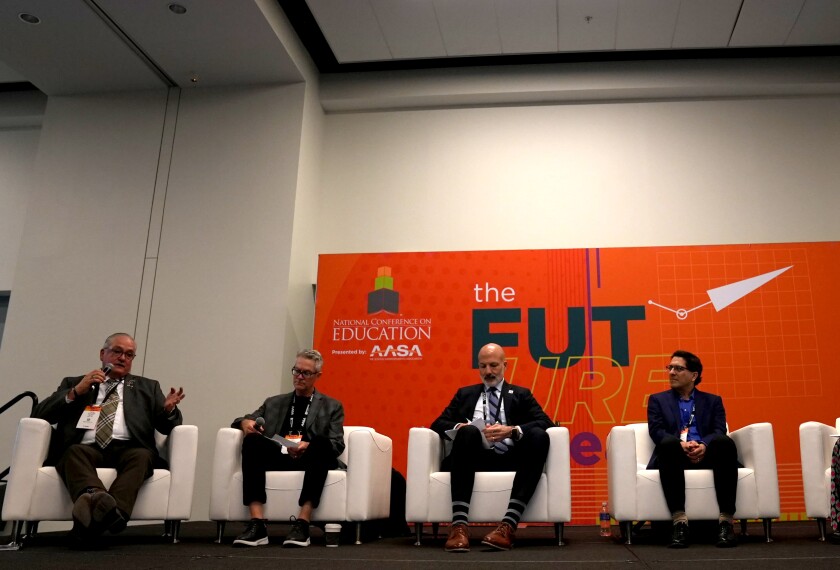
Panelists from left: Carlos Gonzalez, superintendent of the Roma Independent district in Texas; John Skretta, superintendent of Lincoln, Neb., schools; Joe Gothard, superintendent of Madison, Wis., schools; Ben Master, a senior policy researcher at the RAND Corp. speak on summer learning and student success at the National Conference on Education in Nashville, Tenn. on Feb. 13, 2026.
School superintendents, from left, Carlos Gonzalez, of Roma Independent in Texas; John Skretta, of Lincoln, Neb., and Joe Gothard, of Madison, Wis., along with Ben Master, a senior policy researcher at the RAND Corp., discuss summer learning and student success at the National Conference on Education in Nashville, Tenn., on Feb. 13, 2026.
Kaylee Domzalski/Education Week
Student Achievement The Case for Reading Tutoring Before 3rd Grade, Not After
New research suggests virtual tutoring can boost literacy learning before kids begin to struggle.
6 min read
First-graders in Chelsea, Mass. public schools meet with virtual tutors from Ignite Reading in 2025 as part of a study of the program.
First graders in Kelly Elementary School in Chelsea, Mass. meet with virtual tutors from Ignite Reading in 2025 as part of a study of the program. The Chelsea district is now targeting 1st graders for tutoring to make sure all of them meet reading benchmarks by the end of the year.
Courtesy of Chelsea Public Schools
Student Achievement Spotlight Spotlight on Prevention Over Remediation: The Role of Strong Tier 1 Instruction in MTSS
This Spotlight highlights how effective Tier 1 instruction in grades K–5 can improve literacy and math outcomes.