Student Well-Being & Movement Data

Top 3 Barriers to Teaching Social-Emotional Learning. And One Big Takeaway

By Arianna Prothero — December 19, 2022 1 min read
Woman standing on a paper boat with a tsunami wave approaching.
  • Save to favorites
  • Print

This was a conundrum even before the pandemic: Educators say they recognize the importance of developing students’ social and emotional skills, such as managing emotions and setting goals. But they feel that in order to teach academic subjects effectively, there is little time for social-emotional learning lessons.

And the pandemic has only made that problem worse.

A recent EdWeek Research Center survey polled teachers, principals, and district leaders nationally and found not only is this a major barrier, it is by far the most cited challenge to teaching social-emotional skills.

Forty-six percent of respondents said that helping students to catch up academically leaves limited bandwidth for SEL, while 37 percent listed insufficient professional development as a major challenge, and 34 percent cited students’ social-emotional needs being beyond the scope of their ability to handle.

Kendria Jones believes she has a lot to teach her students at Jack Robey Jr. High School in Pine Bluff, Ark., about persistence, resilience, and a willingness to seek help. But time is an enemy.

“We really don’t have a lot of time to do what I would love to do, take way more time than 15 minutes to home in on social-emotional learning,” she told Education Week in a special report about SEL.

See also

Third grade teacher, Stephanie Brugler, works with her class during an SEL lesson at the Jefferson PK-8 school in Warren, Ohio, on Nov. 1, 2022.
Third-grade teacher Stephanie Brugler works with her class during an SEL lesson in November at the Jefferson PK-8 school in Warren, Ohio.
Daniel Lozada for Education Week

Several of the other issues educators say get in the way of teaching SEL are variations on those same three themes of limited bandwidth, lack of investment, and challenges from students. Thirty percent said that an emphasis on standardized exams prep left little time for SEL. Twenty-seven percent cited insufficient curricular materials and instructional resources. And 18 percent said that students don’t want to learn social-emotional skills at school.

Meanwhile, issues that have been much more in the news lately (including in Education Week), such as pushback from parents and communities, are among the least cited challenges. Ten percent of educators said that pushback from parents is a major barrier to social-emotional learning in their school or district, and only 8 percent said the same of pushback from their community.

What is the key takeaway here? While political pushback against social-emotional learning has been grabbing headlines, the biggest barriers remain educators’ usual foes: time is too short, students’ needs are too big, and there are not enough resources.

Events

This content is provided by our sponsor. It is not written by and does not necessarily reflect the views of Education Week's editorial staff.
Sponsor
School Climate & Safety Webinar
Belonging as a Leadership Strategy for Today’s Schools
Belonging isn’t a slogan—it’s a leadership strategy. Learn what research shows actually works to improve attendance, culture, and learning.
Content provided by Harmony Academy
This content is provided by our sponsor. It is not written by and does not necessarily reflect the views of Education Week's editorial staff.
Sponsor
School & District Management Webinar
Too Many Initiatives, Not Enough Alignment: A Change Management Playbook for Leaders
Learn how leadership teams can increase alignment and evaluate every program, practice, and purchase against a clear strategic plan.
Content provided by Otus
This content is provided by our sponsor. It is not written by and does not necessarily reflect the views of Education Week's editorial staff.
Sponsor
Artificial Intelligence Webinar
Beyond Teacher Tools: Exploring AI for Student Success
Teacher AI tools only show assigned work. See how TrekAi's student-facing approach reveals authentic learning needs and drives real success.
Content provided by TrekAi

EdWeek Top School Jobs

Teacher Jobs
Search over ten thousand teaching jobs nationwide — elementary, middle, high school and more.
View Jobs
Principal Jobs
Find hundreds of jobs for principals, assistant principals, and other school leadership roles.
View Jobs
Administrator Jobs
Over a thousand district-level jobs: superintendents, directors, more.
View Jobs
Support Staff Jobs
Search thousands of jobs, from paraprofessionals to counselors and more.
View Jobs

Read Next

Student Well-Being & Movement School Counselors See Rising Trauma Linked to Immigration Enforcement
The school staff whose job it is to support students say they see major signs of emotional distress.
6 min read
Students take a recess break outside of St. Paul district school in St. Paul, MN, February 23, 2026.
Students take recess outside an elementary school in St. Paul, Minn., on Feb. 23, 2026.
Tim Evans for Education Week
Student Well-Being & Movement Looking for SEL's Benefits? Good Implementation Is Key, Experts Say
How well an SEL program is implemented is critical for achieving the outcomes that research promises.
6 min read
Students visit the Alaqua Animal Rescue in Freeport, Fla., for an SEL-based curriculum on Aug. 23, 2025.
Students visit the Alaqua Animal Rescue in Freeport, Fla., for an SEL lesson on Aug. 23, 2025. Social-emotional learning can be a powerful tool for boosting student engagement and improving behavior and academic performance, but experts say it has to be implemented well.
Micah Green for Education Week
Student Well-Being & Movement Millions of Students Attend Schools Near Toxic Sites, a New Study Shows
The study explores schools' proximity to hazardous sites and students' exposure to pollutants.
4 min read
The Fifth Ward Elementary School and residential neighborhoods sit near the Denka Performance Elastomer Plant, back, in Reserve, La., Friday, Sept. 23, 2022. Less than a half mile away from the elementary school, the plant makes synthetic rubber, emitting chloroprene, listed as a carcinogen in California, and a likely one by the Environmental Protection Agency.
The Fifth Ward Elementary School and nearby residential neighborhoods in Reserve, La., pictured here on Sept. 23, 2022, sit near a synthetic rubber plant that has emitted chloroprene, which California lists as a carcinogen. New research finds thousands of schools are located within a quarter mile of such environmental hazard sites.
Gerald Herbert/AP
Student Well-Being & Movement 3 Driving Questions to Create a Sense of Belonging in Schools
Students who feel they belong in their school are more likely to show up and learn.
5 min read
MVCS 1981
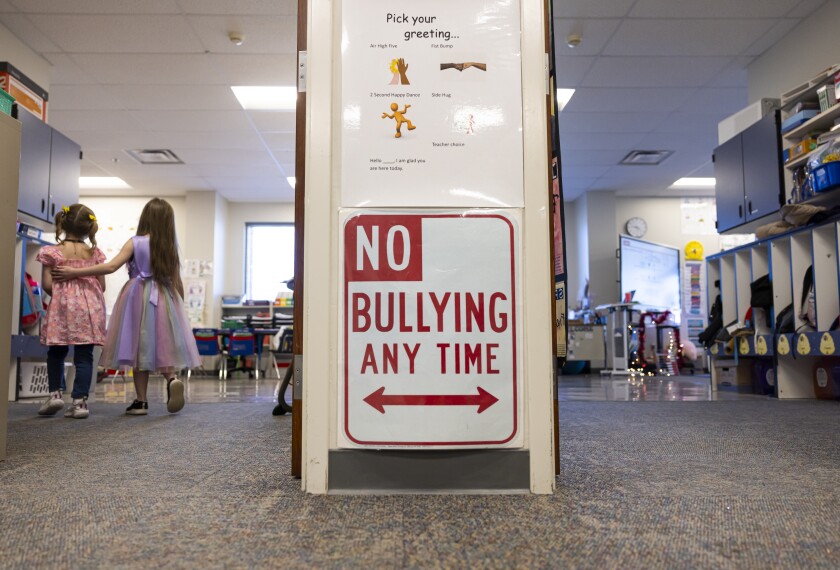
A sign discouraging bullying is seen as two students walk into a classroom at a school in Colorado Springs, Colo., on Feb. 12, 2026. Experts say creating a sense of belonging in school can help curb problems like bullying.
Kevin Mohatt for Education Week