
Jim Crisfield, superintendent of the Wissahickon school district in Ambler, Pa., acknowledges that his district hasn’t exactly been an early adopter of student policies related to personal smart devices and their use on school grounds.
“Until this past school year, we didn’t even have any reference [to cellphone use] in our handbook,” said Crisfield.
Last year, the Pennsylvania district began using “phone hotels” (devices to store cellphones) in the classrooms of its lone high school—students put their cellphones in the devices for class and pick them up once it’s done. The policy has worked well, cut down on distractions, and even earned high marks from students who welcomed a strategy that helped them cut down on their phone use, Crisfield said.
But the policy had an unintended consequence. Banning cellphones during class, but not elsewhere on campus, exacerbated what he refers to as a “catchup” period: students staring at their cellphones in hallways and other areas of the school.
In the ever-evolving technology landscape, students often seem to be at least one step ahead of the adults in the school buildings—especially when it involves the use of personal electronic devices.
Even now, as an increasing number of schools have begun to implement policies restricting cellphone use, it’s likely that students will continue to find ways to evade the rules and continue to connect digitally—with friends, parents, and social media channels—during the school day.
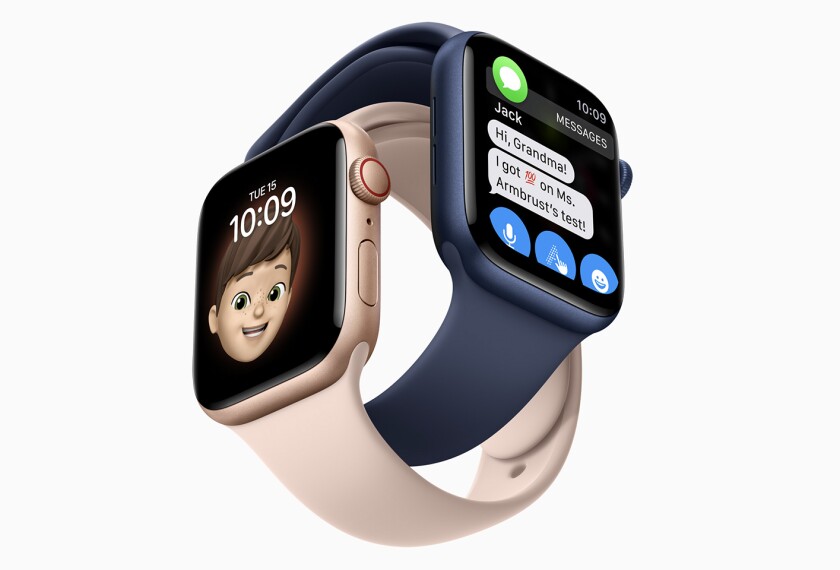
Among the likely candidates for cellphone policy workarounds? Smartwatches: portable devices that look and are worn like a wristwatch but that typically function via mobile apps and can connect to a personal device such as a smartphone. Despite the devices’ increasing popularity among students, many districts’ policies, including Wissahickon’s, do not explicitly mention them.
However, some of the states that are considering or have enacted policies restricting cellphone use in schools have used language that extends to devices beyond cellphones. For instance, Indiana Gov. Eric Holcomb this spring signed into law a ban of “any portable wireless device” during class time.
How popular are smartwatches among students?
When it comes to youths’ choice of personal electronic devices, smartphones continue to dominate. Ninety-five percent of teenagers ages 13 to 17 reported having access to a smartphone in 2023, according to a Pew Research Center survey. Just 13 percent of teens owned a smartwatch in 2021, according to the most recent data available from the Pew Research Center. But the devices seem to be growing in popularity among youth, according to anecdotes from educators as well as companies that track consumer trends on electronic device usage. Counterpoint Research, for instance, predicted recently that the child-targeted smartwatch market will increase by double digits annually—meaning that many more smartwatches will find their way onto the wrists of young consumers.
Yondr is ready. The company produces a popular brand of “pouches” for cellphone storage and has more than doubled its presence in U.S. schools since 2022, with 2,000 schools now using them, according to company spokesperson Evie Solomon. Recently, Yondr began making only XL versions of its pouches—large enough to accommodate both a cellphone and a smartwatch.
Investing in pouches for locking away cellphones—and smartwatches?
It’s unclear exactly how many schools that invested in cellphone pouches purchased ones large enough to store a smartwatch, though Yondr estimated that those currently make up about 5 to 10 percent of its total pouch sales. But for those schools that didn’t get the bigger pouches, the cost of the upgrade likely won’t be feasible.
Yondr pouches, which zip up and lock with a separate magnetic device, cost districts an estimated $25 to $30 per student. Bethlehem School District in Delmar, N.Y., which bought Yondr pouches in 2023, spent $26,773 on the product for the 2023-24 school year, according to its website. The investment included 1,400 pouches, distribution and training, related accessories, replacement pouches, and customer service for one school year.
Last November, U.S. legislators introduced a bill that would create a grant program for schools interested in creating mobile device-free environments that would cover the cost of cellphone pouches. But the legislation is still in early stages, and it’s unclear whether such a grant would pay for phone pouches equipped to contain smartwatches as well as cellphones.
If so, teachers likely would applaud the move—especially those who work in schools where families can afford to buy their kids smartwatches.
One 6th grade teacher, who works at a school in Kansas she described as predominantly affluent, said smartwatches have become an increasingly big problem in her classroom, as students who own them sneak out of class to go to the bathroom and text friends via their smartwatches. Cellphones, stored in students’ backpacks, are less accessible, she said.
The teacher, who asked to remain anonymous for fear of pushback from parents and others in the school community, said that most of her students who own smartwatches do so because their parents want to connect with their children during the school day. Her school’s cellphone policy does not address smartwatches—devices she estimated more than half of her students own and that she feels constitute a major distraction for about a quarter of the students who bring them to school.
By the time more school districts’ personal device policies broaden to include smartwatches, it’s possible that students will be exploring a new—and as of yet, unidentified—form of technology.
“I do know that students are smarter in terms of how they communicate and where they go online,” said Crisfield, Wissahickon’s superintendent. “I’m incredibly curious about technology even though, back in the day, I actually had to call my friends on the phone.”


