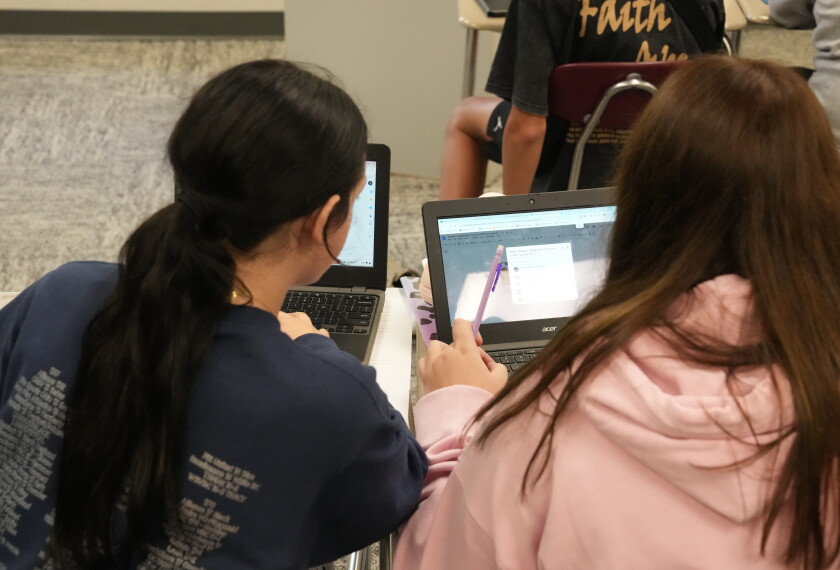
Last fall, Philadelphia’s Kensington High School for Creative and Performing Arts, or KCAPA, a district-managed neighborhood school where 96 percent of the students enrolled live in poverty, had to decide how to use its federal Title I technology aid.
Teachers Andrew A. Biros and Joshua D. Kleiman sensed an opportunity.
“Do we want to keep going in the direction we’ve been going, buy these very expensive pieces of technology and use them the way we’ve always been, or did we want to totally redesign how we’re going to use [technology] in the classroom?” said Mr. Kleiman, a special education teacher and the school’s technology coordinator.
Philadelphia educators experience hope, disappointment when pursuing hands-on, technology-rich school models. Hear what five of these educators had to say about their efforts.
Gianeen C. Powell
Principal, James G. Blaine Elementary School
Daniel E. Ueda
Teacher, Central High School
Lisa J. Nutter & Dana A. Jenkins
President, Philadelphia Academies Inc. & Principal, Roxborough High School
Grace J. Cannon
Executive director, Office of New School Models
Andrew A. Biros & Joshua D. Kleiman
Teachers, Kensington High School for Creative and Performing Arts
Instead of updating its cart of 30 Macbook laptops, the school purchased 128 Chromebooks, the inexpensive notebook computers now used at the city’s Science Leadership Academy.
Beginning next fall, the devices will be KCAPA’s primary instructional resource for English/language arts, in grades 9-12, and social studies, in grades 10-12. Teachers will be expected to develop their own digital curricula, and students will be expected to formulate more of their own questions, conduct more independent research, and create their own content.
It will be the first inquiry-based 1-to-1 computing initiative in a Philadelphia neighborhood high school.
The duo talked to school leaders in Los Angeles and the Philadelphia suburbs, but it was a visit to SLA@Beeber in March that convinced them their vision was possible.
Seeking to spread their optimism, Mr. Biros and Mr. Kleiman brought teams from their school to SLA@Beeberin early May to see the model for themselves. The teachers picked the brains of SLA@Beeber educators and students about everything from creating student assignments in a digital learning management system to encouraging student collaboration via technology.
“The Innovation Gamble” follows a city district resting its hopes on a tech-themed approach. This is the third of three parts.
Part One: Philadelphia Seeks Salvation in Lessons From Model School
Part Two: Innovative Ed. Model Challenges Teachers to Adjust
Part Three: Phila. Funding Crisis Threatens Spread of Innovation
Video: Watch Christopher Lehmann discuss the motivation for Science Leadership Academy’s switch from Mac laptops to Chromebooks.
Video: Watch Karthik Subburam, a teacher at the Science Leadership Academy at Beeber, work to change how he teaches.
Multimedia: Replicating a Model School: The People Behind the Effort
“I think it’s pretty eye-opening for them to see a student population that’s so easy to compare with ours being super-mature in discussing the ideas behind their learning,” Mr. Kleiman said.
Looming over the effort, though, is the district’s ongoing financial crisis. If the budget ax falls again, the teachers who have been developing curricula, planning professional development, and figuring out logistics could be laid off, throwing months of planning out the window.
“We really believe that things will change from a resource standpoint, because they have to,” Mr. Biros said. “If they don’t, we as a city are going to be in a lot of trouble.”