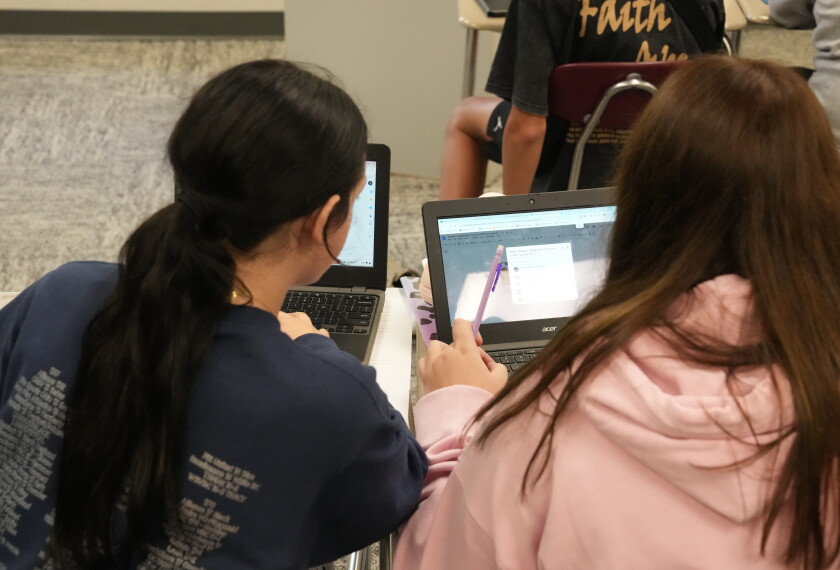
A slew of technology tools have taken root inside public schools during the COVID-19 pandemic. The result is shifts in how educators and administrators conduct meetings, provide mental health supports, and check to see if their students understand new math concepts.
Those findings come from a review of two years’ worth of surveys administered to a nationally representative sample of teachers, principals, and district leaders by the EdWeek Research Center. The surveys began in March 2020 and run through January 2022. By the end of last calendar year, nearly 60 percent of respondents said their experiences using ed tech during remote learning had made them more willing to use technology with their students.
“I think across the country, schools and districts are really looking at what their goals are and how to support students through all the trauma they’ve been through over these last two years,” said Trena Wilkerson, the president of the National Council of Teachers of Mathematics. “They’ve had to grapple with the challenges of doing that in a variety of different kinds of environments.”
Some of the instructional and administrative tools that schools have latched onto are new to K-12. Others are more familiar but are now being used in fresh ways. Interviews with experts suggest that at least some of the tools are part of more long-term and systemic shifts that schools are trying to make.
Such efforts were given a $190 billion boost by Congress, which approved three massive allocations to the Elementary and Secondary School Emergency Relief Fund, or ESSER. The nationwide effort to give all students school-issued computing devices and to improve their internet connectivity at home has also laid the groundwork for new tools to flourish.
Here’s a look at three categories of technology that EdWeek Research Center survey data suggest are likely to stick around.
Videoconferencing platforms have become a key part of how school districts do business
In the weeks after schools shut their doors in response to COVID-19, 43 percent of educators and administrators surveyed by the EdWeek Research Center identified online meeting and conferencing systems as a critical purchase, making such tools their third highest priority behind hand sanitizer and cleaning supplies.
Eighteen months later, schools remained bullish: More than three-fourths of respondents said they were still using the systems to support ongoing remote and hybrid learning. Zoom and Google Hangouts/Meet are by far the most popular platforms, according to survey data from the early months of the pandemic. A much smaller percentage of school districts also use Microsoft Teams for videoconferencing.
It’s no accident that schools are sticking with videoconferencing, said Johann Zimmern, Zoom’s global education marketing lead.
“We were leading the charge in that space,” he said, citing the company’s decision in March 2020 to make its platform available for free to tens of thousands of schools in the United States. That decision was recently extended to June 2022 for existing K-12 customers.
In the months that followed, teaching-via-videoconference emerged as a strategy that significant shares of survey respondents regarded as effective for remotely teaching science (65 percent), English/language arts (63 percent), and math (57 percent). By the summer of 2020, nearly half of teacher respondents said they personally had taught online classes where students interacted with them and other students. Eighty-eight percent said they expected their districts to have synchronous videoconferencing tools available for the 2020-21 school year.
Now, the nation’s schools are largely back to full-time in-person instruction. But Zimmern said Zoom remains in high demand for parent-teacher conferences, guest-speaker programs, school board meetings, teacher professional development, telemedicine appointments, online tutoring programs, and full-time remote learning options that districts have created in record numbers. The company also anticipates that up to 20 percent of K-12 central-office employees will continue to work remotely or both remotely and in person.
To aid the transition from emergency teaching tool to administrative necessity, Zoom has been busy adding new features and integrating its platform with the learning-management and student-information systems that schools are also using. It has also partnered with both hardware companies and third-party developers to make videoconferencing a more user-friendly experience. There’s even a new Zoom phone application for emergency communications that company officials described as one of their fastest-growing K-12 offerings.
Zoom’s K-12 success was aided by the platform’s simplicity. The huge influx of federal funds also helped.
“Videoconferencing was not a tool set that was available to education, because [schools] never had the funding and interest to pay for it,” Zimmern said.
And while some K-12 observers caution that federal stimulus funding won’t remain in place forever and any projections about the future of hybrid work are ultimately guesses, the Zoom official expressed optimism that his product will have a place long-term.
“I think we’re now at the place where the administrative side of school districts will change forever,” he said.
Schools are using federal stimulus funds to invest heavily in social-emotional learning
Educators and administrators were slower to embrace the use of technology to support students’ social and emotional needs. Back in April 2020, about one-third of respondents told the EdWeek Research Center they expected their districts to ramp up spending on SEL in the 2020-21 school year.
A month later, however, that figure had jumped to 45 percent. And by the summer of 2020, 46 percent of respondents were already receiving professional development on how to provide social-emotional support to their remote students, and 49 percent were saying they’d use federal help to pay for additional SEL resources.
That surge of interest wasn’t surprising, said Karen VanAusdal, the senior director of practice for the nonprofit Collaborative for Academic, Social, and Emotional Learning, commonly known as CASEL. Once it became apparent that the pandemic was causing a raft of mental health issues for students and placing extraordinary new stresses on K-12 educators and administrators, addressing the nonacademic aspects of schooling quickly became a priority.
“I think we’ve pulled back and said what does it mean to create a meaningful and successful classroom experience,” VanAusdal said. “Social-emotional learning has to be a key part of that.”
Many districts have added new software tools that are often focused on collecting data on students’ mindsets, feelings, and general well-being. Among the familiar companies that have grown their K-12 footprint is Panorama Education, which provides a range of SEL-related survey instruments and data dashboards. Also making inroads are newer tools such as Rhithm, an app that invites students to report how they’re feeling via emojis, then provides them with customized videos or activities aimed at cultivating traits like mindfulness and focus. VanAusdal also described schools’ growing interest in Along, a platform launched by the Chan Zuckerberg Initiative and Gradient Learning that allows students and teachers to share reflections on how they’re feeling via video, audio, and text.
ESSER funding is greasing the wheels for such purchases. By the fall of 2021, 61 percent of survey respondents said they expected to spend more on SEL during the 2022-23 school year, far more than the share who expected to ramp up spending on curricula in core academic subjects.
CASEL, however, advises districts to go beyond purchasing programs. Instead, the group suggests investing in a “long-term infrastructure” that also includes better data systems, regular curriculum reviews, and ongoing professional development for teachers.
With the nation’s children hurting right now and federal requirements that ESSER money be spent within the next few years, will it really be possible for schools to address students’ short-term social-emotional needs and build up those more permanent systems?
“It’s a great question,” VanAusdal said. “I see folks doing both.”
Educators see digital math tools as a growth area to address academic recovery and deepen instruction
Early in the pandemic, a significant number of EdWeek Research Center survey respondents began reporting that digital instructional resources were reasonably well-suited for math. That was a contrast to reading, which 91 percent of educators said was more difficult to teach remotely and digitally than in person, with print materials.
By spring of 2021, a majority of respondents were saying their school or district planned to use newly approved ESSER funds to buy products aimed at helping elementary students who fell behind in math. Forty-five percent said the online math resource Khan Academy was part of their learning-loss recovery strategy, more than any other product the EdWeek Research Center asked about.
That uptick in adoption is likely to continue even as schools return to more consistent in-person learning, said NCTM’s Wilkerson.
“Teachers have found some of these technology pieces to be very engaging not only online, but in the classroom, because they provide more opportunities for students to engage,” Wilkerson said.
Beyond plug-and-play instructional software, that includes new tools that allow students to work together in pairs or small groups, digitally show their work, and share their problem-solving strategies with classmates and teachers. The pandemic has also created new avenues for collaborative lesson planning online. Sometimes, those efforts involve all-purpose platforms like Google Workspace or Microsoft Teams. Others involve online graphing, spreadsheet, and calculator tools for subjects like algebra and geometry offered by companies like Desmos and GeoGebra. Like CASEL, Wilkerson and NCTM emphasize that making effective use of tools requires a wider ecosystem that includes good data systems and regular professional development, much of which is now virtual.
Survey data support the idea that such products and approaches are likely to stick around: In the summer of 2021, just 10 percent of respondents said they had seen significant declines in the usage of such digital math tools.
“Some of that would possibly be for short-term tutoring-type things,” Wilkerson said. “But what I think are more interesting are the dynamic pieces of software you can use for the long term. I think we will see districts invest more in those.”
Some of the EdWeek Research Center survey data featured in this report was initially published in EdWeek Market Brief, a business intelligence service for senior executives in the education industry.