
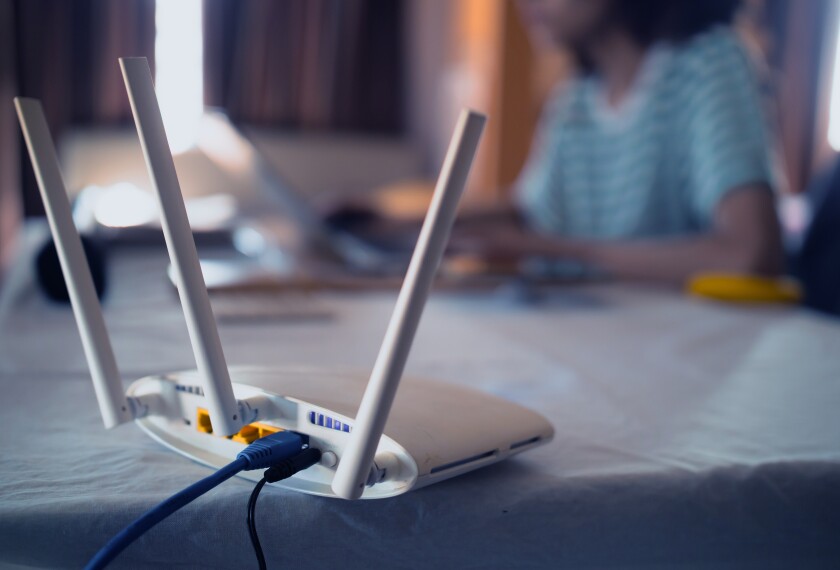
It will now be easier for schools to cover the cost of providing Wi-Fi hotspots to students who don’t have adequate access to internet and broadband services at home.
Under a change approved July 18 by the Federal Communications Commission, schools will now be allowed to use federal E-rate funding to pay for Wi-Fi hotspots.
FCC Chair Jessica Rosenworcel, a Democrat, supported the measure along with the two other Democrats on the five-person commission. Both Republicans on the panel voted against it.
Rosenworcel, during the meeting, recounted the early days of the pandemic when students had to sit outside of fast-food restaurants or libraries or school buildings with their laptops on their knees, using the free Wi-Fi because they lacked home connectivity.
Congress authorized a couple temporary programs to address the need: the Emergency Connectivity Fund and the Affordable Connectivity Program, but both have expired.
The Democratic commissioners said there are still millions of students who don’t have adequate access to the internet and modernizing the E-rate program ensures that students can do their schoolwork wherever they are.
“Today, we have a choice,” Rosenworcel said. “We can go back to those days when people sat in parking lots to get a signal to get online and students struggling with the ‘homework gap’ hung around fast-food places just to get the internet access they needed to do their schoolwork. Or we can go forward and build a digital future that works for everyone.”

The Republican commissioners, however, argued that the change goes beyond the FCC’s authority.
“Congress limited the FCC E-rate authority to enhancing the access of—Congress’s specific terms—classrooms and libraries to telecom services, not any remote location at which people might want to learn,” said Republican Commissioner Brendan Carr.
Commissioner Nathan Simington, another Republican, also argued that off-campus Wi-Fi hotspots could “reduce incentives to physically show up to a classroom” and seemed to doubt that the hotspots would actually be used for learning at home.
Still, Rosenworcel said the FCC has the authority to “update the definition of universal service, which includes E-rate, so that it evolves over time.” Congress also gave the FCC authority to “designate additional services in this program as needed for schools and libraries,” she added.
Schools that use E-rate funding have to comply with the Children’s Internet Protection Act, which requires them to use filters to ensure children are protected from exposure to harmful material while accessing the school-provided internet.

Several K-12 education groups—such as AASA, the School Superintendents Association, the Consortium for School Networking, the Association of School Business Officials International, and the National Rural Education Association—have praised this expansion of how E-rate funds can be used.
“Today’s vote allows the E-rate program to continue its important work in ensuring our nation’s schools and libraries are able to offer our 24-hour learners 24-7 access to broadband,” said David R. Schuler, the executive director of AASA, in a written statement.
Funds for Learning CEO John Harrington called it a “forward-thinking approach” and aligns with “the realities of today’s educational landscape.” Funds For Learning works with schools to help them determine how best to apply for and use E-rate funds.
The recent change to the E-rate to pay for Wi-Fi hotspots is part of Rosenworcel’s broader push to modernize the program and provide technology services she thinks schools need. The E-rate, established in 1996, has helped schools and libraries connect to the internet at discounted rates but hasn’t been used to help students get internet connectivity at home.
Among the other recent changes to the program, which have already been approved, are the expansion of E-rate funding to pay for school bus Wi-Fi and the creation of a cybersecurity pilot program for K-12 schools.
The school bus Wi-Fi initiative has run into legal opposition, however. A lawsuit, filed in December and pending in the 5th U.S. Circuit Court of Appeals, argues that using E-rate funds for Wi-Fi on school buses exceeds the FCC’s authority to provide internet access in schools and libraries. The FCC has filed a motion to dismiss the case.


