Classroom Technology From Our Research Center

‘Techlash’ Is Strongest in Suburban and Rural Schools

By Alyson Klein — October 29, 2026 2 min read
Collage art of a student, clock, and laptop.
  • Save to favorites
  • Print

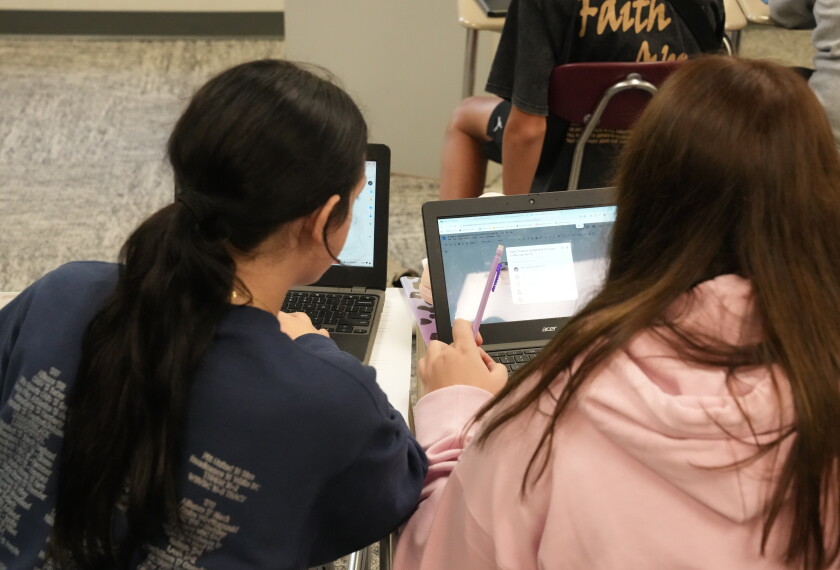
Big-city districts like New York and Los Angeles are grabbing headlines for restricting the time students spend on tech tools.

But educators in suburban and rural areas are more likely to say parents believe students spend too much classroom time on digital devices than those working in urban districts.

More than half of urban educators—57%—report that parents believe the amount of technology in schools is “just right,” according to a survey of 596 teachers, school, and district leaders conducted by the EdWeek Research Center from Feb. 19 to March 13.

That’s compared to 40% of suburban educators and 38% of educators in rural areas or towns who report that parents think the level of tech in schools is “just right.” (Notably, the difference between educators who teach at high-poverty schools compared to those who work at wealthier schools wasn’t statistically significant, unlike the difference between urban, suburban, and rural locations).

Those findings jibe with Cory Montreuil’s experiences in urban schools.

Montreuil, now an instructional coach at low-performing schools in Denver, recalled a sense of jubilation when the urban, high-poverty school he used to work for received a grant for 1-to-1 student devices and hotspots.

“It was seen as this big equity triumph,” said Montreuil. “It was like, ‘now we’re getting something that they also have’” at wealthier schools.

Lila Byock, a Los Angeles parent and the founder of Schools Beyond Screens, a grassroots coalition of families concerned about the impact of technology on student learning and mental health, thinks that parents from a range of demographics worry about screen time.

But wealthier parents get the attention, she said, so their teachers and leaders may be more aware of “techlash.”

“Unfortunately our society is structured in such a way that white affluent parents tend to have the largest, loudest megaphones,” she said.

The picture may be more complicated than the data points make it seem, said Tyler Hunt, a middle school teacher who leads some computer science classes in suburban Chicago.

Parents in her school community don’t see all technology use in the same light.

Some parents take issue with time spent on adaptive learning platforms, which they see as harmful to their child’s mental health, she said.

But parents love the digital projects in Hunt’s class, where students may program robots or construct objects with 3D printers.

“If they’re creating something, then parents are all for it,” Hunt said.

education week logo subbrand logo RC RGB

Data analysis for this article was provided by the EdWeek Research Center. Learn more about the center’s work.

Related Tags:

Maya Riser-Kositsky, Librarian and Data Specialist contributed to this article.

Events

This content is provided by our sponsor. It is not written by and does not necessarily reflect the views of Education Week's editorial staff.
Sponsor
Teaching Profession Webinar
Evaluation Beyond the Checkbox: Turning Ratings Into Teacher Growth
Ratings alone don’t help teachers improve. Join us Nov. 10 to hear what happens after the evaluation: feedback, follow-up, and growth.
Content provided by Frontline Education
This content is provided by our sponsor. It is not written by and does not necessarily reflect the views of Education Week's editorial staff.
Sponsor
Assessment Webinar
The Assessment Trust Crisis: How to Measure Learning in the Age of AI
AI is reshaping learning. Is assessment keeping up? Join this webinar to explore how to measure student thinking, not just right answers.
Content provided by Instructure
This content is provided by our sponsor. It is not written by and does not necessarily reflect the views of Education Week's editorial staff.
Sponsor
College & Workforce Readiness Webinar
From Student Trends to Counselor Action: Turning Insight Into Impact
Find out what is changing in how students approach planning for life after graduation and how schools can help.
Content provided by PowerSchool

EdWeek Top School Jobs

Teacher Jobs
Search over ten thousand teaching jobs nationwide — elementary, middle, high school and more.
View Jobs
Principal Jobs
Find hundreds of jobs for principals, assistant principals, and other school leadership roles.
View Jobs
Administrator Jobs
Over a thousand district-level jobs: superintendents, directors, more.
View Jobs
Support Staff Jobs
Search thousands of jobs, from paraprofessionals to counselors and more.
View Jobs

Read Next

Classroom Technology 3 Ways to Build Elementary Students' Digital Literacy Skills
Teachers suggest age-appropriate ways to talk about computers, the internet, and artificial intelligence.
3 min read
A screen displays guidelines for using artificial intelligence above a portrait of Ernest Hemingway in Casey Cuny's English class at Valencia High School in Santa Clarita, Calif., Wednesday, Aug. 27, 2025.
A screen displays guidelines for using artificial intelligence in Casey Cuny's English class at Valencia High School in Santa Clarita, Calif., Wednesday, Aug. 27, 2025. Tip for educators teaching digital literacy to young learners.
Jae C. Hong/AP
Classroom Technology Are Teens Starting to Accept Cellphone Bans? A New Survey Has Answers
Researchers surveyed teens and adults on how well school cellphone policies were enforced over the course of a school year.
5 min read
Students use their cellphones as they leave for the day the Ramon C. Cortines School of Visual and Performing Arts High School in downtown Los Angeles, Aug. 13, 2024.
Students use their cellphones as they leave the Ramon C. Cortines School of Visual and Performing Arts High School in downtown Los Angeles on Aug. 13, 2024. A new set of surveys of teen attitudes toward school cellphone restrictions shows growing acceptance of the policies by those most directly affected.
Damian Dovarganes/AP
Classroom Technology Opinion The Big Flaw With Ed-Tech Tutoring Isn't Technological
Before focusing on the technology, we need to redesign the learning model, Michael Horn argues.
•
4 min read
The United States Capitol building as a bookcase filled with red, white, and blue policy books in a Washington DC landscape.
Luca D'Urbino for Education Week
Classroom Technology Q&A Students’ Tech Engagement Doesn’t Equal Learning, Psychologists Warn
A panel of psychologists shares recommendations for ensuring technology promotes meaningful learning.
6 min read
DSC03088
Students at a high school in Plymouth, Ohio work on how to properly prompt the Gemini AI app on Aug. 28, 2026. A new report of the American Psychological Association warns that student engagement with tech apps should not be conflated with benefits for learning.
Ruddy Roye for Education Week