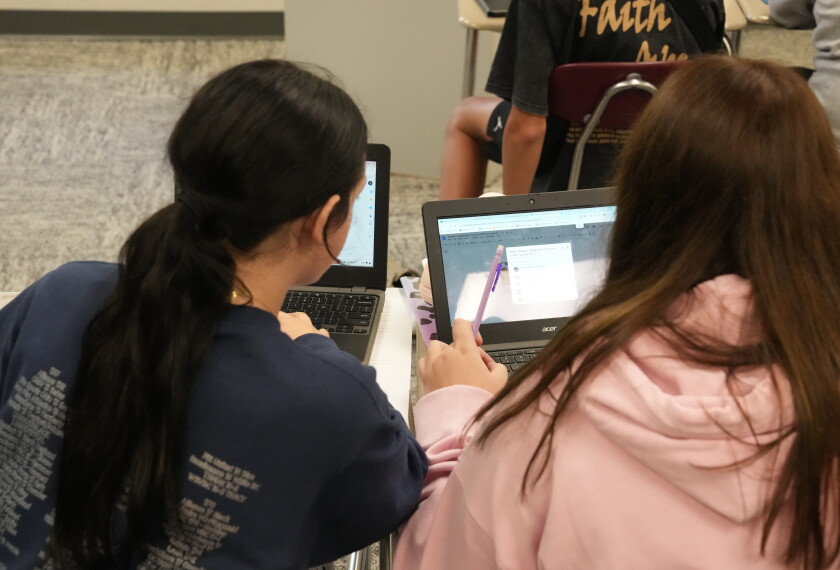

Is technology use in school good or bad for students?
It turns out that the answer to that question—from educators’ perspective—might put the impact of tech on students’ well-being somewhat at odds with how it affects their academic performance.
In an exclusive survey by the EdWeek Research Center, more than half of teachers, principals, and district leaders said the use of technology in school had a negative impact on students’ social-emotional skills development and overall well-being and mental health.
Yet more than half of those surveyed said ed-tech use had a positive impact on engagement in instruction and learning and mastering content and skills.
A high school fine arts teacher from Kentucky said in the survey that effective use of technology in school that addresses students’ well-being and academic development depends largely on the quality of how the tech is used, not just on the digital tool itself.
“Whether student use of technology has a positive or negative impact on learning is mostly dependent on whether the learning experiences are carefully and intentionally designed to be deeply and authentically engaging to the student,” the teacher wrote in an open-ended response to the survey, “and whether students find them meaningful and relevant.”
Staff at the teacher’s school, the educator added, are “highly trained to design instruction that includes meaningful technology use for students.”

Other educators are convinced that the downsides of tech use in school far outweigh the benefits.
“Distraction! Fosters the mindset, “I’ll just Google it,” wrote a high school English language arts teacher from Connecticut.
“A few years ago, I asked students to choose an issue that was important to them personally and write a speech about it. Some students actually had to search Google for ‘good topic for a speech.’”
Another question on the survey asked teachers and administrators if, overall, they believe school-related tech does more to increase or decrease student learning. The respondents were largely divided on that point.
The nationally representative, online survey was conducted in February and March of 79 district leaders, 122 principals, and 395 teachers.