As artificial intelligence continues to reshape the K-12 landscape, educators must be at the center of that evolution, say leaders behind AI-powered educational tools.
Yet many educators remain skeptical. For some, the concern stems from AI’s tendency to produce false or misleading information—so-called “hallucinations.”
Others haven’t received the professional development they need to integrate AI responsibly into instruction.
Still, there are signs of progress. Between spring and fall 2024, the share of teachers who reported receiving at least one AI-related training session increased by 50%, according to the EdWeek Research Center.
The EdWeek 2024 fall survey also showed that 58% of respondents said they received no training on AI, and in open-ended responses to the survey, a teacher said this made them feel at a disadvantage.
“We know that AI is probably the most transformative technology we are going to see in our lifetime,” said Amy Holt, senior director of strategy and operations at Indigitize, a nonprofit working with Indigenous communities to determine AI best practices.
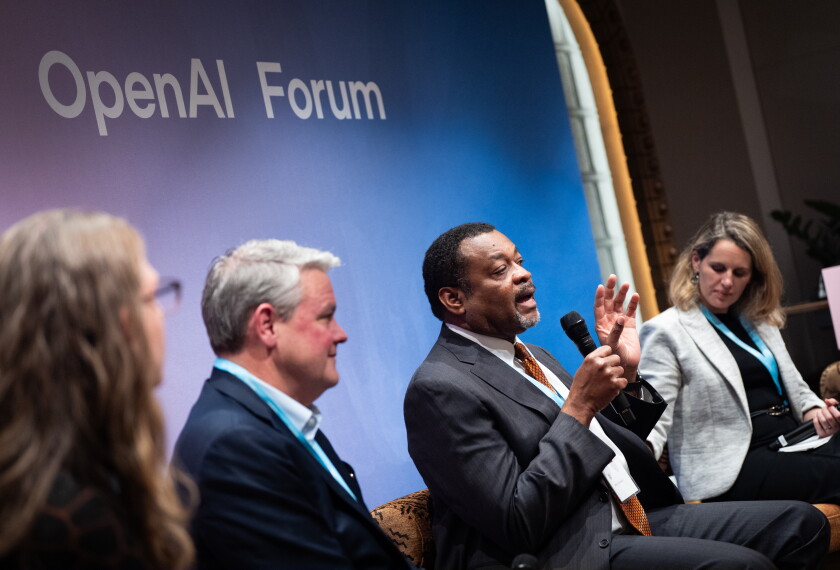
A session at the ISTELive 25 + ASCD Annual Conference 25 held on June 30 and called “Building Equitable AI Pathways Through GenerationAI Partners” had leaders in educational technology discuss how educators can play a bigger role in shaping the future of AI tools, not just using them.
Speakers included Wyman Khuu, head of learning engineering at Playlab.ai, a nonprofit that helps educators create AI-powered apps; Elvira Salazar, director of online learning and technology at Latinos for Education, a nonprofit organization connecting Latinos in the education field; and moderator Jessica Garner, senior director of innovative learning at ISTE+ASCD.
Educators must help build, not just use, AI tools
Khuu highlighted the lack of educator voices in the development of AI-powered education tools.
“Our hope down the road is that ... educators get to shape technology, especially emerging ones, and not just be consumers of it, but creators of it,” said Khuu.
That inclusion is especially crucial when working with historically underrepresented communities, he added. Some of the most widely used tools on Playlab’s platform, Khuu said, weren’t built by software developers, but by teachers themselves.
“We are leveraging your content expertise, you’re sharing your beauty with the world, and you’re getting the acknowledgement and all the love from that world as well,” he said.
Playlab.ai allows educators to create apps and showcase their name to get credit. If another creator remixes off of their app to create a new one, the original creator is still credited. While there is no compensation, Playlab.ai does offer step-by-step instructions for creators to start using the platform.

Professional development around AI needs a reboot
Salazar emphasized that professional development around AI should not focus only on technical skills.
“They are walking away [from professional development] not just with AI literacy,” she said, “but being ready to lead change.”
She and Khuu also said that skepticism among educators shouldn’t be dismissed—instead, it should be welcomed.
Training sessions should start by meeting teachers where they are, Khuu said. If they don’t trust the tool, ask them why, using their answer as a jumping-off point to co-design solutions that address their concerns.
“Eventually, skeptics get to a place where they actually understand AI might lead to some impact,” he said.