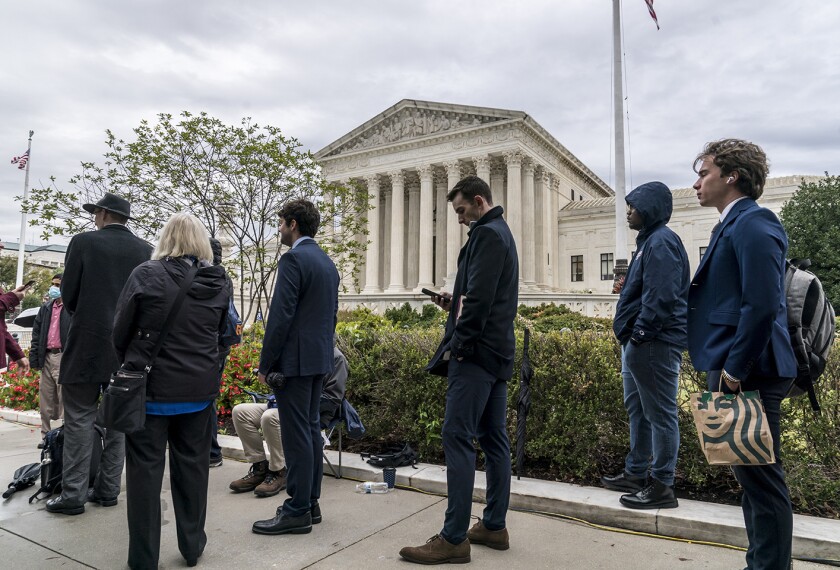
The U.S. Supreme Court on Monday agreed to hear a case stemming from the denial of services to a deaf child that could prove significant for remedies being sought in lawsuits against school districts on behalf of children with disabilities.
The case of Perez v. Sturgis Public Schools (No. 21-887) encompasses two questions involving the tangle of legal procedures families and school officials confront in disputes over the two main federal laws protecting children with disabilities.
The first is whether the Individuals with Disabilities Education Act requires families who have settled their particular IDEA claims with a school district to “exhaust” all administrative proceedings under the that law before filing a claim under the Americans with Disabilities Act of 1990.
The second is whether a family must exhaust IDEA’s own administrative proceedings when it is pursuing a non-IDEA claim for money damages under the ADA or other federal disability laws.
The case centers around a deaf Michigan student who was denied a sign-language interpreter for 12 years while attending school in the Sturgis, Mich. district.
Lawyers for the student told the court that a lower-court decision in favor of the school district “will inflict great harm on students with disabilities and their families,” by requiring them either to forfeit their rights under other disability laws if they accept an IDEA settlement, or undergo lengthy administrative proceedings even when the school district stands ready to remediate anIDEA violation.
The court granted review in the case on the first day of its 2022-23 term. Arguments in the case will likely be held early in 2023, with a decision expected by next June.
A family seeks damages for failure to provide services
The case involves Miguel Luna Perez, who is deaf and communicates through sign language. He attended Sturgis Public Schools from age 9 until 20. His legal papers say that the district assigned a classroom aide to him who did not know sign language and who would sometimes abandon Perez for hours a day. Perez’s parents contend the district led them to believe their son was proceeding toward high school graduation, but they were informed that he only qualified for a certificate of completion.
The Perez family in 2017 filed a due-process complaint with the Michigan Department of Education based on the IDEA, the ADA, and other statutes. The school district soon offered to settle the IDEA complaint, and the family agreed. The district agreed to place Perez in the Michigan School for the Deaf and pay for postsecondary compensatory education and sign-language services.
Perez then sued the district in federal district court under the ADA, seeking unspecified money damages among other relief. The school district argued that Perez could not bring the suit because he had not exhausted all administrative proceedings under the IDEA. The district argued that Perez would have had to reject the settlement and continue pressing his IDEA claims through the full process.
Both a federal district court and a panel of the U.S. Court of Appeals for the 6th Circuit, in Cincinnati, agreed with the district. The appeals court said there was no exception to the key provision of the IDEA requiring administrative exhaustion when such proceedings would futile.
When Perez appealed, the Supreme Court asked the U.S. solicitor general to weigh in on whether to take up the case, and that office recommended the court grant review.
U.S. Solicitor General Elizabeth B. Prelogar told the court that several other federal appeals courts have ruled the opposite way in similar cases on the so-called futility exception, and the high court should resolve the conflict among those courts.
Prelogar, in a brief also signed by U.S. Department of Education lawyers, said the appeals court also erred by holding that the IDEA’s exhaustion requirement applies to legal claims for money damages that are not available under the special education law, such as the ADA claim in Perez’s case.
The Supreme Court had considered that question five years ago in Fry v. Napoleon Community Schools, a case stemming from a school district’s denial of a service dog for a child with cerebral palsy. The court held in Fry that IDEA procedures need not be exhausted when the essence, or “gravamen,” of a lawsuit centers on a violation of other federal disabilities law rather than the special education law’s core guarantee of a “free, appropriate special education.”
The court said it was leaving “for another day” the question of whether exhaustion of IDEA proceedings was necessary when the student was complaining of a denial of a free and appropriate education but seeking a remedy such as money damages that an IDEA hearing officer had no power to award.
In a brief filed with the court, the Sturgis school district urged the justices not to grant review. It said the court’s decision last term in Cummings v. Premier Rehab Keller, which held that money damages for emotional distress were not available under the Rehabilitation Act of 1973, meant that Perez could not recover similar money damages under the ADA, so a review by the high court would be “academic.”
It is “too late” for Perez to amend his suit for emotional-distress damages to another form of compensation, such as for lost income, the district argued.
Perez “disclaimed anything but emotional-distress damages,” the school district said in a supplemental brief.
The Supreme Court was evidently not persuaded and decided to grant review.