Social Studies

The College Board Plans to Change AP African American Studies, Details Unclear

By Ileana Najarro — April 25, 2023 1 min read
Hundreds participate in the National Action Network demonstration in response to Gov. Ron DeSantis's rejection of a high school African American history course, on Feb. 15, 2023 in Tallahassee, Fla.
  • Save to favorites
  • Print

The nonprofit group that runs Advanced Placement classes announced it will make changes to the framework of its new AP African American Studies course, though it has yet to reveal plans.

The April 24 announcement from the College Board comes months after a national debate swirled around the new course. Some scholars criticized the College Board for its exclusion of topics in the course framework, while some state leaders pledged to review the course, with Florida Gov. Ron DeSantis banning the course citing the inclusion of topics that violate state law restricting instruction on race.

“In embarking on this effort, access was our driving principle—both access to a discipline that has not been widely available to high school students, and access for as many of those students as possible,” the College Board said in a statement. “Regrettably, along the way those dual access goals have come into conflict.”

The AP African American Studies course framework was officially released on Feb. 1, the first day of Black History Month, with feedback provided by students and teachers from the first pilot year of the course, which ends this summer. According to the College Board, experts and scholars will work on changes to the existing framework during the second pilot round, which begins this fall. The official course is scheduled to be available for the 2024-25 school year.

“The updated framework, shaped by the development committee and subject matter experts from AP, will ensure that those students who do take this course will get the most holistic possible introduction to African American Studies,” the nonprofit said.

The College Board did not respond to Education Week’s requests for comment. It’s unclear why the organization is making changes and what changes it plans to make, nor what sparked this announcement.

The College Board's Announcement

Here is the College Board’s statement in full.


AP African American Studies Scholars to Make Changes to Course

The Advanced Placement Program has worked for several years alongside scholars, higher education institutions, and secondary schools to create an AP course in African American Studies.


We are committed to providing an unflinching encounter with the facts and evidence of African American history and culture. To achieve that commitment, we must listen to the diversity of voices within the field. The development committee and experts within AP remain engaged in building a course and exam that best reflect this dynamic discipline. Those scholars and experts have decided they will make changes to the latest course framework during this pilot phase. They will determine the details of those changes over the next few months.


Ultimately this work must deliver a representative introductory college-level course, and that imperative will guide its development. Hunger for this course has exploded around the country, growing from 60 schools in the first pilot year to 800 schools and 16,000 students in the school year ahead. Every day, there are more stories about how this course is opening minds and changing lives. Regardless of how many students take this course, each one of those students should have access to the full breadth and beauty of this discipline.


In embarking on this effort, access was our driving principle—both access to a discipline that has not been widely available to high school students, and access for as many of those students as possible. Regrettably, along the way those dual access goals have come into conflict. The updated framework, shaped by the development committee and subject matter experts from AP, will ensure that those students who do take this course will get the most holistic possible introduction to African American Studies.

The journey in developing this new AP course began in the 2000s with major work beginning in 2020. See more about this history in a timeline of events:
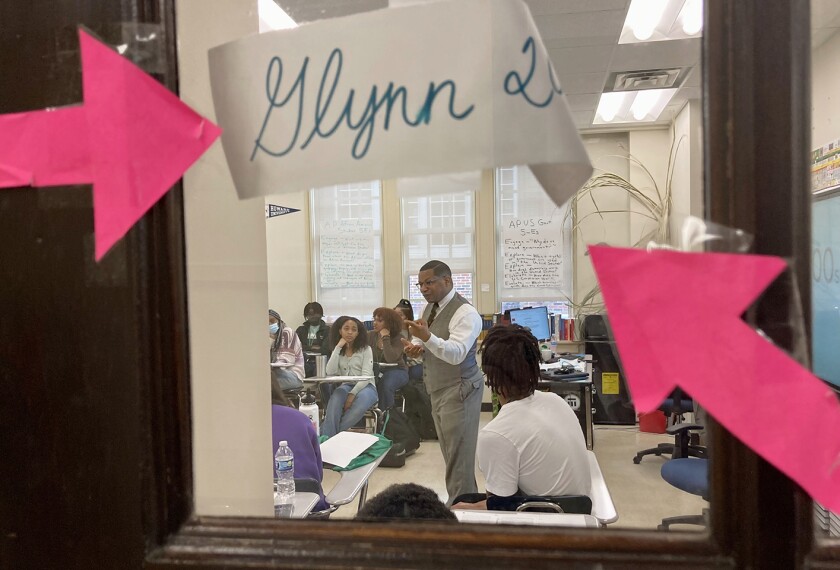
Emmitt Glynn is seen from just outside his classroom at Baton Rouge Magnet High School teaching his second AP African American studies class on Monday, Jan. 30, 2023 in Baton Rouge, La. Baton Rouge Magnet High School in Louisiana is one of 60 schools around the country testing the new course, which has gained national attention since it was banned in Florida.
Stephen Smith/AP
Social Studies How AP African American Studies Came Under Attack: A Timeline
Ileana Najarro, February 10, 2023
16 min read

The course framework as published on Feb. 1 this year covers a lot of ground. Here’s just a sample of what the course currently explores:

Emmitt Glynn teaches AP African American studies to a group of Baton Rouge Magnet High School students on Monday, Jan. 30, 2023 in Baton Rouge, La. Baton Rouge Magnet High School in Louisiana is one of 60 schools around the country testing the new course, which has gained national attention since it was banned in Florida.
Stephen Smith/AP

State officials’ responses to the new course have varied. Here are just a few:

New Jersey Gov. Phil Murphy delivers his State of the State address to a joint session of the Legislature at the statehouse, in Trenton, N.J., Tuesday, Jan. 10, 2023.
New Jersey Gov. Phil Murphy delivering his State of the State address at the statehouse, in Trenton, N.J., on Jan. 10, 2023. Murphy announced the expansion of the AP African American Studies course to 26 schools across the state next school year a few weeks after Florida’s ban.
Matt Rourke/AP

As a new round of schools and classrooms prepare to pilot the new course, hear from educators who have been teaching it in the first pilot round:

Shekinah Hall in her classroom at McLain High School in Tulsa, Okla.
Shekinah Hall, a teacher at McLain High School in Tulsa, Okla., is one of two teachers in Tulsa who are teaching a pilot course of Advanced Placement African American Studies this school year.
Courtesy of Tulsa Public Schools

Events

This content is provided by our sponsor. It is not written by and does not necessarily reflect the views of Education Week's editorial staff.
Sponsor
Artificial Intelligence Webinar
Managing AI in Schools: Practical Strategies for Districts
How should districts govern AI in schools? Learn practical strategies for policies, safety, transparency, as well as responsible adoption.
Content provided by Lightspeed Systems
This content is provided by our sponsor. It is not written by and does not necessarily reflect the views of Education Week's editorial staff.
Sponsor
Reading & Literacy Webinar
Unlocking Success for Struggling Adolescent Readers
The Science of Reading transformed K-3 literacy. Now it's time to extend that focus to students in grades 6 through 12.
Content provided by STARI
Jobs Virtual Career Fair for Teachers and K-12 Staff
Find teaching jobs and K-12 education jubs at the EdWeek Top School Jobs virtual career fair.

EdWeek Top School Jobs

Teacher Jobs
Search over ten thousand teaching jobs nationwide — elementary, middle, high school and more.
View Jobs
Principal Jobs
Find hundreds of jobs for principals, assistant principals, and other school leadership roles.
View Jobs
Administrator Jobs
Over a thousand district-level jobs: superintendents, directors, more.
View Jobs
Support Staff Jobs
Search thousands of jobs, from paraprofessionals to counselors and more.
View Jobs

Read Next

Social Studies Is the Court System Fair? What Students Want to Know About the Justice System
Chicago high schoolers asked a panel of Illinois judges how they decide tough cases.
5 min read
JL357
Illinois Supreme Court Justice Elizabeth M. Rochford, in blue, talks to Lindblom Math and Science Academy student Marianna Haynes during an event at Chicago-Kent College of Law on March 13, 2026 in Chicago. Marianna and other students asked a panel of state judges how they decide cases—and put aside their personal feelings.
Joshua Lott for Education Week
Social Studies Q&A A New Bill Calls for a Model Civics Curriculum at a Polarized Moment
A Democratic senator has introduced bills to boost hands-on civic learning and create a national civics curriculum.
9 min read
Students listen to social studies teacher Ella Pillitteri during a seventh grade civics class at A.D. Henderson School in Boca Raton, Fla., Tuesday, April 16, 2024. When teachers at the K-8 public school, one of the top-performing schools in Florida, are asked how they succeed, one answer is universal: They have autonomy.
Students listen to their social studies teacher during a 7th grade civics class at a school in Boca Raton, Fla., on April 16, 2024. New proposed legislation would create a model national civics curriculum—something that has never successfully been tried.
Rebecca Blackwell/AP
Social Studies Opinion What Is Civic Hope? And Why Should Schools Care About It?
Cynicism and gloom are not a recipe to promote voting and good citizenship.
7 min read
The United States Capitol building as a bookcase filled with red, white, and blue policy books in a Washington DC landscape.
Luca D'Urbino for Education Week
Social Studies A Third of Civics Teachers Have Changed Lessons for Fear of Political Backlash
Teachers still face pressures from the legislative push to ban "divisive concepts" in the classroom.
3 min read
Empty conference room at the National Constitution Center in Philadelphia, Pennsylvania on Feb. 7, 2026.
Trenchant quotes about democracy cover the walls of an empty conference room at the National Constitution Center in Philadelphia on Feb. 7, 2026. New research finds many civics teachers, feeling local political pressure, have altered their lessons.
Matthew Ludak for Education Week
