Opinion
Science Letter to the Editor

In Science, We Need Both Technical Literacy, Ph.D.s

February 20, 2007 1 min read
  • Save to favorites
  • Print

To the Editor:

In his Commentary “The Democratization of Scientific Knowledge” (Feb. 7, 2007), Dennis M. Bartels argues that our national scientific priority should be developing universal technical literacy, not increasing the number of Ph.D.s in science and engineering.

In fact, these are complementary goals, and both are critical to enlarging the pool of technically competent Americans in order to enhance U.S. competitiveness in the 21st-century global economy.

We must expand the pipeline for science, technology, engineering, and math (or STEM) fields to develop a long-term supply of talent. We must encourage students, especially from underrepresented groups, to pursue STEM education at all levels. But we need also to increase both the breadth and depth of Americans’ scientific knowledge.

The issue is not just a numbers race, although the United States until recently produced more Ph.D.s than any other region of the world. It is about having a highly skilled workforce.

Doctoral education trains students to become scientists, engineers, mathematicians, and experts in a wide variety of fields. It is where our nation’s future leaders develop the ability to do original research and to identify and solve complex problems—skills required to advance the limits of knowledge. America’s competitors understand the relationship between human talent, research expertise, and economic leadership, and are expanding their own graduate programs accordingly.

Increasing the number of Ph.D.s in these fields must be a crucial component of our nation’s overall competitiveness strategy. If we are to maintain our global economic strength and national security, we must both develop our domestic talent pool and produce a highly trained workforce able to create and innovate.

Debra W. Stewart

President

Council of Graduate Schools

Washington, D.C.

A version of this article appeared in the February 21, 2007 edition of Education Week as In Science, We Need Both Technical Literacy, Ph.D.s

Events

This content is provided by our sponsor. It is not written by and does not necessarily reflect the views of Education Week's editorial staff.
Sponsor
School & District Management Webinar
The Principal's Role in Collective Efficacy and Student Outcomes
Learn practical strategies that help principals translate their confidence into stronger collective teacher efficacy and student outcomes.
Content provided by Otus
This content is provided by our sponsor. It is not written by and does not necessarily reflect the views of Education Week's editorial staff.
Sponsor
Education Funding Webinar
What Schools Need to Know About the Federal Education Freedom Tax Credit
What schools need to know about the federal Education Freedom Tax Credit: A practical guide from a licensed teacher and policy expert.
Content provided by LearningSpring
This content is provided by our sponsor. It is not written by and does not necessarily reflect the views of Education Week's editorial staff.
Sponsor
School Climate & Safety Webinar
Building Your School Safety Roadmap: Key Priorities for the Upcoming Year
What should be on your school's safety roadmap this year? Join experts to discuss priorities, preparedness, and best practices.
Content provided by Evolv Technology & IdentiSys

EdWeek Top School Jobs

Teacher Jobs
Search over ten thousand teaching jobs nationwide — elementary, middle, high school and more.
View Jobs
Principal Jobs
Find hundreds of jobs for principals, assistant principals, and other school leadership roles.
View Jobs
Administrator Jobs
Over a thousand district-level jobs: superintendents, directors, more.
View Jobs
Support Staff Jobs
Search thousands of jobs, from paraprofessionals to counselors and more.
View Jobs

Read Next

Science Opinion What Should Science Education Look Like 10 Years From Now?
Science instruction has already had some big changes in the past decade. Where is it going next?
8 min read
Conceptual illustration of classroom conversations and fragmented education elements coming together to form a cohesive picture of a book of classroom knowledge.
Sonia Pulido for Education Week
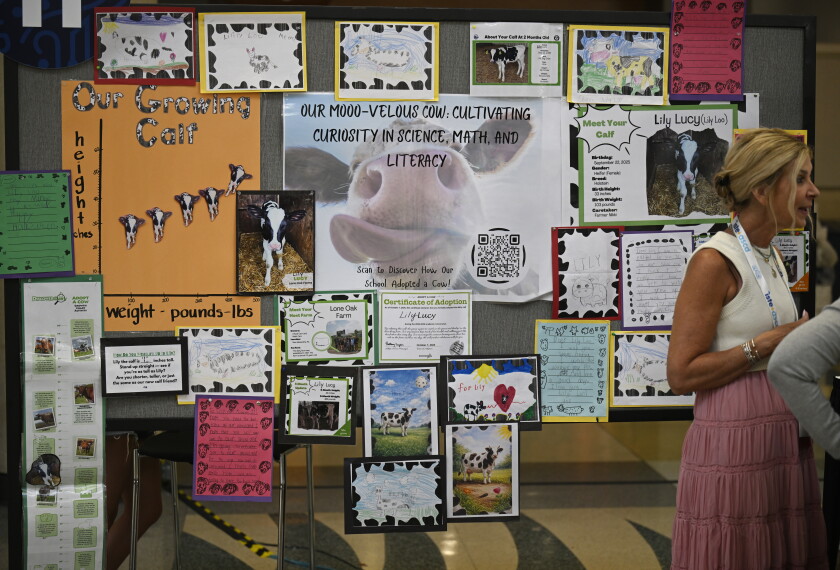
Science How a Cow 'Moooved' STEM and AI Learning Forward
The farm animal helped K-2 students explore artificial intelligence, data science, and chemistry.
3 min read
ISTEcow003
K-2 students at South Fayette Township Elementary School in Pennsylvania used data science to pick a name for a cow they adopted to follow at a local farm. A teacher from the school talked to other educators about how she used the cow to teach about data science, AI, and chemistry during the ISTELive 26 + ASCD Annual Conference in Orlando, Fla., on July 1, 2026.
Marvin Joseph/Education Week
Science Can a Science Museum Reshape Learning? Inside One District's Experiment
A state-of-the-art science museum and a formerly under-resourced elementary school form a rare partnership.
10 min read
DaVinciCentralAllentownPA 051826 SDL020
A 4th grade student vies for the attention of a turtle during her class’s weekly visit to the Da Vinci Science Center on May 18, 2026, as part of the center’s partnership with the Allentown school district’s Central Elementary STREAM Academy.
Scott Lewis for Education Week
Science Spotlight Spotlight on STEM That Sticks: How Schools Spark Curiosity and Build Future Skills
Find out how schools are cultivating enthusiasm for STEM learning through family STEM nights, low-cost innovations, and more!