
Reporter’s note: All cow puns in this story are udderly intentional.
South Fayette Township Elementary School in Pennsylvania enlisted a new teacher to help K-2 students explore artificial intelligence, data science, and chemistry.
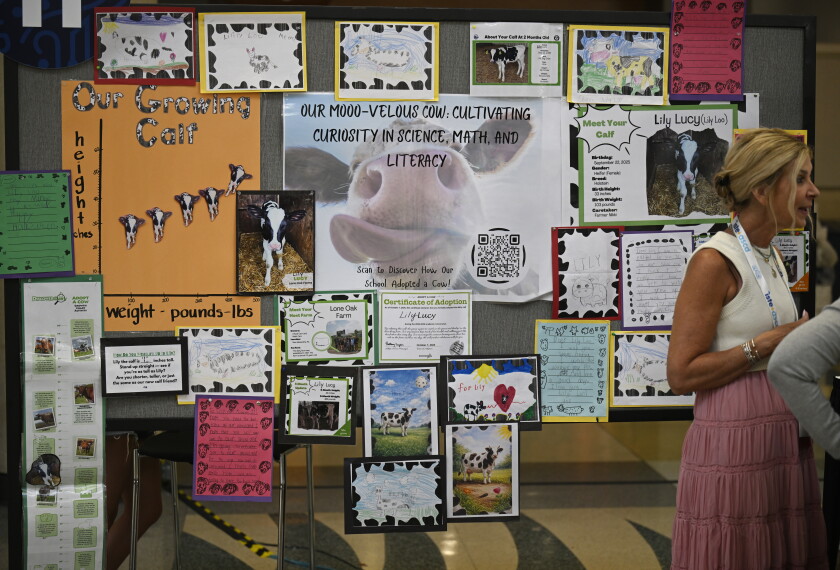
Lily, the cow.
Rebecca Colangelo, an elementary math and science enrichment coach, enrolled her Pittsburgh-area school in an “Adopt a Cow” program, offered free to teachers by Discover Dairy. (This did not result in a cow attempting to graze on the school playground. The adoption is temporary—just for the school year. And Lily stayed at her home, Lone Oak Farm in New Alexandria, Pa., about 37 miles from the school.)
Colangelo milked the program all year long for project-based-learning opportunities, across a wide range of disciplines. She presented on this work at the ISTELive 26 + ASCD Annual Conference held here from June 28 to July 1.
Here’s a look at how Colangelo used Lily to beef up project-based learning.
How the kids used data science to pick a name for the cow
South Fayette Township Elementary decided to come up with a name for their cow during the time that she was connected to the school.
So Colangelo’s students created a Google form asking for name recommendations and distributed it around the school. The students had to collect and track the data on each name in contention to figure out which had the most support. (Penelope was among the runners-up).
“We have about 800 students in our building, so it was a lot of data” to sort through, Colangelo said.
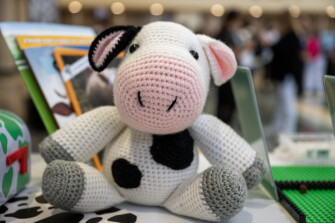
Kids also used appropriately colored Legos to determine whether they preferred white or chocolate milk—an easy visual data science display.
Then, with the help of the staff at Lone Oak Farm, the kids tracked Lily’s height and weight and plotted it on a graph. They compared their own heights and weights to hers.
Using AI to generate and critique images
The students drew their own pictures of Lily—or cows in general—then fed them into an AI tool to create a digital version.
The exercise helped kids understand how fallible the technology can be. For instance, one student drew a picture of the cow and wrote the words, “Heath the Cow” underneath. AI interpreted that as “Here I Am Cow.”
In another instance, a student drew a heart in her picture. AI turned the heart into a flower.
The exercise “teaches them that AI isn’t perfect,” Colangelo said.
Colangelo also set up a “moo mailbox” where the students could share letters with Lily.
Learning chemistry concepts by making milk
The students made their own “milk plastic”—a more environmentally-friendly form of the material—using warm milk and vinegar.
Milk plastic, which has been around for decades, is “brittle. It’s not perfect plastic,” Colangelo said. “We talked about the chemical changes” taking place.
South Fayette’s STEAM teacher also got on board. She made butter with the students, another demonstration of a chemical process.
Unfortunately, the Lone Oak Farm doesn’t allow for field trips—and Lily certainly couldn’t have come into Colangelo’s classroom.
So, Colangelo set up an iPad in the hallway where every student in the school could catch a live feed of Lily.
The kids also did a video call with the farm staff, who explained how they use robotics and other tools in milk collection. The students were excited to discover that Lone Oak Farm is a supplier of the company that provides the milk for their school lunches.
Lily also made an appearance on the video call. But she wasn’t a natural presenter, Colangelo said.
“She was a little shy,” Colangelo said. “She kept walking away from the camera.”
Colangelo’s students spent all year talking about Lily, she said.
“Everyone was excited,” Colangelo said. “There was such a buzz.”


