

Social-emotional learning is a must in the classroom, and that includes lessons about gratitude.
Today’s post kicks off a series in which educators share how they teach about it—and not just around Thanksgiving!
‘Awe’
Sarah Cooper teaches 8th grade U.S. history and civics and is the associate head of school at Flintridge Preparatory School in La Canada, Calif. She is the author of two books, Creating Citizens: Teaching Civics and Current Events in the History Classroom (Routledge) and Making History Mine (Stenhouse):
“Let’s go on an awe walk!” I said to my 8th grade U.S. History and Civics students at the beginning of second semester last year. We took five minutes to circle our building, head toward the soccer field, and come back along the fire lane. As these middle schoolers clustered like grapes, they looked for one thing that elicited a sense of awe—from the way the light fell on a tree’s leaves to a glimmer of appreciation for their friends. The walk idea was a little cheesy, but the concept stuck more than I had imagined.
Recently, I had come across Dacher Keltner’s Awe: The New Science of Everyday Wonder and How It Can Transform Your Life, and its scientific approach transformed my thinking on inspiration. Talking with thousands of people in dozens of countries, the authors distilled our experience of awe into eight wonders of life, including moral beauty (“other people’s courage, kindness, strength, or overcoming”) and collective effervescence (“buzzing and crackling with some life force together” at concerts, games, and other major events).
How could I incorporate these characteristics of awe into a social studies class? The answer coalesced as we were starting our third-quarter unit on social reform in U.S. history—following the catastrophic Los Angeles fires that wiped out eight days of school and brought back our community bruised but grateful to be together.
In previous years at the start of this reform unit, I had asked students to talk through in pairs each of the 10 Questions for Young Changemakers from Harvard’s Democratic Knowledge Project, 45 seconds per question. We had also covered the Universal Declaration of Human Rights (1948) and Sustainable Development Goals (2015) with the Declaration of Independence earlier on.
I had an epiphany that these three documents, plus the 8 Reasons for Awe, could coalesce into a guiding premise for our reformers project. In the students’ research papers, they would connect their reformer to one of these four frameworks for change, giving the paper more spark.
Several months later, in students’ year-end portfolios, I was surprised by how much the concepts from all four frameworks stuck, particularly moral beauty—by far the number one elicitor of awe around the world, according to Keltner.
After hearing about the compassion of battlefield nurse Clara Barton in his classmates’ Civil War stories project, one student wrote: “I was in awe of the moral beauty of her bravery in helping others. I admire how she not only did her job in the moment but continued pushing for what she fought for afterwards.”
Another reflected on a relative’s passion for making the world better: “Her morals and ideals remind me of what we learned about ‘the concept of awe to inspire change,’ more specifically, the first reason for Awe: ‘Moral beauty = other people’s courage, kindness, strength, or overcoming …’ [H]er advocacy for change is inspiring!”
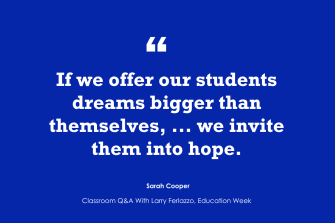
I was reminded that if we offer our students dreams bigger than themselves, no matter how cliched it might seem, we invite them into hope. This year, rather than deeming the awe walk “cheesy,” I might just call it transformative.
Poetry
Lily Howard Scott is an New York City-based educator. She is the author of The Words That Shape Us (Scholastic, 2025).
Empowering kids to lean into gratitude is a gift for now and for later. Research reveals that individuals who can slow down, notice moments of beauty or delight, and name out loud what they’re thankful for experience health benefits such as decreased anxiety, better sleep, and healthier relationships.
When it comes to inspiring kids to recognize moments and experiences that they’re grateful for, list poems are an accessible, joyful place to start. If you ask a group of students to write a paragraph about a few things they appreciate, they’ll likely stare at you blankly. But the playfulness of list poetry gets ideas churning and pencils moving.
Here’s what a gratitude list poem invitation might look like: In May or early June, an elementary school teacher can invite students to write “Memories I’ll Carry with Me” poems in response to (but not limited to) the prompts below. It’s important to emphasize that list poems don’t need to include full sentences and there’s no “wrong” way to write one; as long as kids share specifically and honestly, they’re creating poetry.
Questions to consider as your draft your gratitude list poem:
What really made you laugh this year?
What is an experience you hope to always remember?
When was a time your heart felt full?
What time of day do you especially look forward to?
Memories I’ll carry with me
By Aiden
When Julia’s gerbil escaped during her morning meeting share and everyone screamed
When my mom was the mystery reader
When Ms. Cleo turned on the twinkle lights during read-aloud
(And when she read Love That Dog, the best book in the world)
Quiet time after lunch, just scribbling and seeing where my pencil goes.
Other gratitude list poem invitations might include “Little things that bring me joy even on the hardest days” or “Inventions I’m grateful for.” To create a classwide gratitude list poem, simply ask each child to verbally contribute one line and weave their contributions together:
Little things that bring us joy even on the hardest days
A shared list poem
Goldfish
When my dog jumps up on me when I get home
When my dad lies down on my bed with me and sings to me before he tucks me in
Seeing funny-looking pigeons
Mister Rogers
When there are water beads at choice time
When my little brother does his chicken dance
Chocolate milk at lunch
Thinking about falcons
Wiggle breaks.
The secret power of gratitude list poetry is that it invites kids to exercise the muscle of deliberately searching for flickers of joy throughout their days at school (and beyond). As Ross Gay writes in The Book of Delights, “The more you study delight, the more delight there is to study.” Before long, kids begin to move through the world with eyes, ears, and hearts attuned to gratitude.

Letters Home
Marta Silva, Ph.D., is a teacher and researcher of Spanish as a heritage language. She is a passionate advocate for dual-language education, translanguaging, and the use of poetry as a form of social justice in the classroom:
As I reflect on the concept of gratitude, my mind immediately turns to community and the ways our students relate to their families and spaces with respect, love, and pride. One of my ongoing priorities in teaching Spanish as a heritage language is bridging the gap between school life and the lives our students lead beyond the school grounds. To close this gap, it’s essential to intentionally design activities aligned with our diverse curricula that invite students to bring their home and community experiences into the academic space and take their learning back into those personal contexts.
When some administrators express frustration about a lack of parent involvement from certain demographics, I question the foundation of that concern. Too often, it comes from a place that expects families to attend events in spaces that temporarily welcome them, but where they’re not made to feel they truly belong, instead of working to build bidirectional bridges of mutual respect and interest.
This is exactly what I strive to create in my courses. At the start of the school year, my students write physical letters to their loved ones explaining how their school days are structured—what they enjoy or dislike, what they study in different classes, and which teachers they find caring or funny. They include instructions on how to save the school’s attendance number in their family’s phones and mark important dates on their calendars.
We compile a list of teachers, administrators, and other staff members who speak Spanish and review what steps to take in case of an emergency or if a family member needs to communicate with a teacher.
We also take time to express gratitude to our families for supporting our education by getting students to school on time, providing a quiet space to complete assignments, and helping them carve out time for major projects or final exams by limiting work or family obligations when needed.
This kind of writing, which students then share with the adults responsible for their education, serves as a first step in fostering ongoing communication between home and school. Every letter goes home and comes back to me, signed and often accompanied by comments or questions. And each one begins and ends with gratitude—for the sacrifices of immigration, for leaving behind grandparents and siblings in pursuit of a more stable, joyful future for the next generation.
Gratitude in our immigrant communities is deeply rooted in separation and pain yet profoundly connected to pride and hope.

‘Simple Yet Powerful’
Gail Boushey is an educator, author, founder, CEO of Teach Daily, and the co-creator of the Daily 5 Framework and CAFE Literacy System.
Allison Behne teaches graduate courses at Upper Iowa University, is the primary writer for the Teach Daily resource library, and works with Teach Daily to foster critical thinking and innovative instructional practices:
Gratitude is one of those simple yet powerful practices that can shift the entire tone of a classroom. Over the years, we’ve woven gratitude into our routines in ways that feel natural, meaningful, and manageable—because if it’s not practical, it’s not happening during the morning bell rush.
One of our favorite tools is the Gratitude Jar. It sits in a visible spot in the room, and students can add notes anytime—things they’re thankful for, big or small. On Fridays, we randomly pull a few and read them aloud. It’s amazing how often students mention each other: “I’m thankful for Ava helping me with my math,” or “Thankful for our class being quiet during the fire drill.” It builds a sense of community and reminds us all of the good happening right in front of us.
We also use gratitude-themed read-alouds like Gratitude is My Superpower and A Little Thankful Spot to introduce the concept in age-appropriate ways. Afterward, students reflect with short writing prompts or quick partner chats. Even a simple question like “What’s one thing you’re thankful for today?” gets them thinking beyond the moment.
Another easy but powerful practice is our One-Minute Gratitude Journals. We take 60 seconds to jot down one or two things we’re thankful for. It’s quiet, focused, and helps us start the day on a positive note—especially helpful during testing season or on those gray-weather Mondays.
The results? Fewer behavior issues, more peer encouragement, and a noticeable boost in classroom morale. We find that gratitude doesn’t erase challenges, but it reframes them. And when students learn to look for the good, even in tough days, they’re building habits that will serve them far beyond our classrooms.

Thanks to Sarah, Lily, Marta, Gail and Allison for contributing their thoughts.
Responses today answered this question:
Are there lessons or activities around “gratitude” that you have done with your students? If so, what were they, why did you do them, and what social and academic benefit did you see from them?
Consider contributing a question to be answered in a future post. You can send one to me at lferlazzo@epe.org. When you send it in, let me know if I can use your real name if it’s selected or if you’d prefer remaining anonymous and have a pseudonym in mind.
You can also contact me on X at @Larryferlazzo or on Bluesky at @larryferlazzo.bsky.social
Just a reminder; you can subscribe and receive updates from this blog via email. And if you missed any of the highlights from the first 13 years of this blog, you can see a categorized list here.


