

In the final few months of this school year, it wasn’t uncommon to find videos on TikTok and Instagram of educators, generally newer to the profession, announcing that they were leaving teaching because they felt students were either “apathetic,” too far behind academically, always on their phones, always using artificial intelligence to do their assignments, or out of control and disrespectful in the classroom.
I, too, am leaving the classroom this year but not because of any of those complaints. Rather, I’m retiring after a 23-year career where I more or less successfully (the majority of the time, at least) dealt with all those listed challenges—and quite a few others.
I’m not interested in “dunking” on these soon-to-be former teachers. Though there may be other reasons for their discontent, I’d bet dollars to donuts that the primary reasons for their departures are really not the issues they listed. Instead, I’d suggest the real reason for their leaving the teaching profession is because their school and district administration did not provide them with adequate support to successfully mitigate those classroom problems.
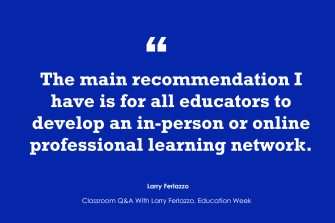
I have some suggestions for how teachers in the same boat can deal with each of those challenges, though the main recommendation I have is for all educators to develop an in-person or online professional learning network (PLN, also known as a personal learning network). Your colleagues want you to succeed, and are facing, or have faced, the same difficulties. Talk to them! In addition, thousands of other educators are active on social media, and there are countless ways to connect to them; they also want you to succeed!
In the meantime, though, here are a few simple suggestions on how to respond to each of the problems I’ve heard in these teacher-resignation videos and how to find additional resources to help on each one:
“Apathetic Students”
During the 19-year community-organizing career that preceded my entry into the teaching profession, it wasn’t uncommon to hear people initially complain about their “apathetic” neighbors. But my response was always, “There’s no such thing as an apathetic person. Everyone is interested in something; it might just not be what you want them to be interested in.”
Yes, we have standards to meet and a curriculum to follow. But it’s possible to often teach them in ways to create the conditions where students can motivate themselves. I’ve written four books on this very idea of facilitating the development of student intrinsic motivation, but the primary engines of creating this kind of environment are:
1. Autonomy: having a degree of control over what needs to happen and how it can be done.
2. Competence: feeling that one has the ability to be successful in doing it.
3. Relatedness: doing the activity helps them feel more connected to others and feel cared about by people they respect.
4. Relevance: the work must be seen by students as interesting and valuable to them and useful to their present lives and/or hopes and dreams for the future.
Not every lesson has to include all four elements, but it shouldn’t be too difficult to include at least one of them in most lessons.
Learn more practical ideas related to student intrinsic motivation here.
“They’re Too Far Behind”
Yes, it’s true—many, though by no means all, of our students are still suffering from the academic impact of COVID. The term “accelerated learning” has been bandied about generally by consultants who haven’t actually done it in a classroom, but there are a number of practical ways teachers can incorporate it in their practice. The term basically means that you don’t “remediate”; rather, you identify and reinforce only the key concepts and skills that are absolutely necessary for students to understand in order to learn the more advanced lessons you are going to teach and forget about the rest.
Teachers of English learners are typically masters of accelerated learning, and I always recommend that content teachers consult with them for advice. Learn more about what it can look like practically in a classroom here and here.
“They’re Always on Their Phones”
Tell me about it! It’s a challenge and has gotten worse since the height of the pandemic. In the world that I would like it to be, all these state legislatures passing cellphone bans in schools would accompany those laws with funds for schools to pay for pouches and staff to implement the ban. However, I live in the world as it is and know that’s highly unlikely to happen in most cases.
Given that, it’s difficult, if not impossible, for a single teacher to effectively respond to this problem unless everyone in their school is on board. Once all our teachers agreed to enforce a ban on cellphone use in class except when authorized by the classroom teacher, the problem became far more manageable at our school.. Here’s how I implemented the rule in my classroom, and here are some other ideas.
“All Their Assignments Are Written by ChatGPT”
Artificial intelligence tools can be a boon to English learners, and they can be a big help to teachers in developing and modifying student materials.
They can also be very seductive to some students who just don’t want to do the assigned academic work.
There are ways to semi-“AI-proof’ assignments and other strategies to reduce the odds of student “cheating” (like checking document history in Google docs to see if the student pasted 1,000 words at one time). It’s also possible to carefully incorporate AI in ways that support learning.
In addition to those efforts, though, I think the most effective strategy is helping students learn about AI, its ethics, its shortcomings, and, yes, what it’s good at, along with the advantages of not using it. Then, provide clear guidelines about its use—or not—in your class. (Even better, have students help develop them).
“They’re Out of Control in the Classroom”
Classroom management can often trip up newer—and experienced—teachers.
And there are no easy answers.
Positive relationships with students, I think, are key: being friendly, not being friends. Having engaging lessons (see above) can be a huge help, too. And being positive—recognizing, as the saying goes, that there are no bad students, just students who are having bad days (or weeks).
Of course, there’s a lot more that can, and should, be said about the topic. See what lots of other experienced teachers recommend here and here.
I’m definitely not suggesting that my suggestions are cure-alls, and I always keep in mind education researcher Dylan Wilam’s comment that “everything works somewhere, nothing works everywhere.”
These ideas are just a start.
But, with a little luck, perhaps we can all hope to see slightly fewer of these goodbye videos next year ...
Consider contributing a question to be answered in a future post. You can send one to me at lferlazzo@epe.org. When you send it in, let me know if I can use your real name if it’s selected or if you’d prefer remaining anonymous and have a pseudonym in mind.
You can also contact me on Twitter at @Larryferlazzo.
Just a reminder; you can subscribe and receive updates from this blog via email. And if you missed any of the highlights from the first 13 years of this blog, you can see a categorized list here.


