
Schools must determine if a student’s behavior is related to their disability before disciplining them, according to new U.S. Department of Education guidance meant to further clarify federal protections against discrimination.
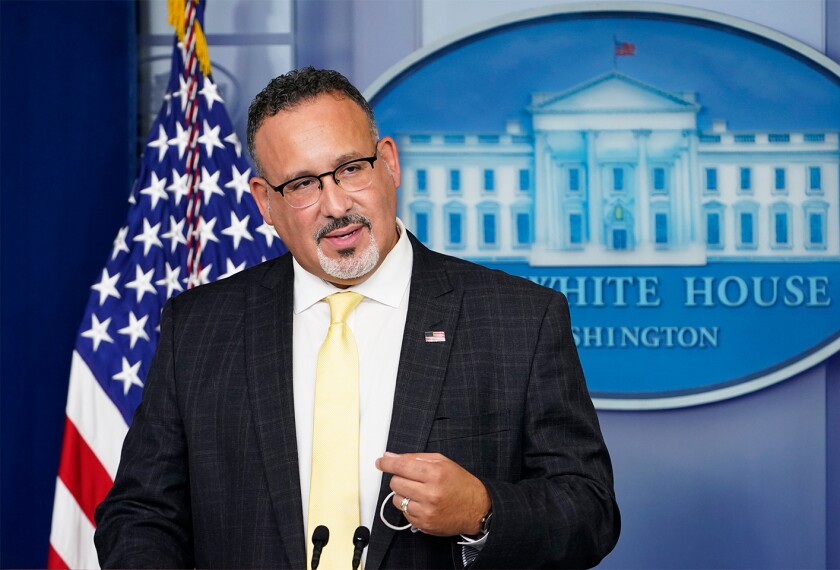
In a call with reporters Tuesday, U.S. Secretary of Education Miguel Cardona touted the new guidance as the “most comprehensive” the department has ever released on the topic.
Four new resources for school leaders include two guides on how Section 504 of the Rehabilitation Act of 1973 and the Individuals with Disabilities Education Act protect students from discriminatory discipline practices; a guide for stakeholders on “positive, proactive approaches to supporting the needs of children with disabilities”; and a letter from Cardona on the importance of supporting the needs of students with disabilities.
“As this guidance makes clear, the work to ensure students are safe at school is foundational to everything we do,” he said. “They must be safe and supported at schools.”
Separately, the Education Department is still reviewing its guidance for discipline as it relates to racial discrimination, department officials said Tuesday. They did not provide a timeline for release of that guidance.
Students with disabilities stand out statistically on discipline
Students with disabilities experience disproportionately high rates of expulsion and suspension, the most-recent data from the department’s office for civil rights show. In the 2017-18 school year, students with disabilities represented 13 percent of the total student enrollment but experienced 23 percent of all expulsions with educational services and 15 percent of all expulsions without educational services.
In its Section 504 guidance, the department explains that schools are required to provide behavioral supports and services to students with disabilities. Specifically, it states that schools must determine if a student’s behavior is related to their disability before expelling or suspending them for that behavior.
In cases where a student is exhibiting disruptive behavior related to their disability, the department encourages school officials to do further evaluation to see if the student needs additional behavioral supports or a change in educational setting to ensure they have access to a free and appropriate public education.
Schools are allowed to discipline students through suspension or expulsion if officials determine the behavior was not connected to the student’s disability as long as the discipline is handled in the same way it would be done with students without disabilities, according to the guidance.
The guidance also clarifies that Section 504 prohibits schools from not making reasonable modifications for students with disabilities such as adapting school policies to support student needs; unnecessarily treating a student differently because of their disability; or using policies that have an “unjustified discriminatory effect” on students with disabilities, such as sending students to detention for using profanities when students with Tourette Syndrome may not be able to control their use of those words.
In a question-and-answer document on IDEA, the department clarifies that a student’s IEP, or individualized education program, must include the use of “positive behavioral interventions and supports” to address disruptive behavior.
Those behavioral interventions can include “special education and related services, supplementary aids and services, and program modifications or supports for school personnel,” according to the document.
“The resources can strengthen school communities so that all students have an inclusive, safe environment that embraces their whole, unique selves,” Cardona said to reporters on Tuesday.
Some Democratic lawmakers praised the new guidance, saying it will lead to more-equitable school environments.
“This is an important step forward to help root out discriminatory disciplinary practices in our nation’s schools, and I applaud the administration for standing up for the rights of all students—including children with disabilities—to learn in a safe and supportive environment,” U.S. Sen. Patty Murray, D-Wash., said in a statement.
What the new guidance says about restraint and seclusion practices
The guidance released Tuesday also clarified that seclusion and restraint practices can constitute disability discrimination. Those practices include any time students are placed in a room alone without the ability to leave or placed in a restraint that restricts their movement as a form of discipline.
The department also said that physical restraints—when adults use their own physical force to restrain a student—could constitute discrimination. However, the use of “physical escort,” in which an adult temporarily touches or holds a student’s hand, wrist, arm, shoulder, or back “for the purpose of inducing a student who is acting out to walk to a safe location,” is not considered a restraint, according to the guidance.
The Education Department has found that restraint and seclusion are disproportionately used on students with disabilities. In the 2017-18 school year, the most recent year of data available, about 102,000 students experienced restraint or seclusion at school, according to the office of civil rights data. While only 13 percent of students enrolled that school year had a disability, 80 percent of students who experienced physical restraint and 77 percent of students who experienced seclusion had a disability.
The latest guidance is not the first time the department has provided clarity on that issue. In 2016, as assistant secretary for civil rights in the Obama administration, the current assistant secretary, Catherine Lhamon, wrote a “Dear Colleague” letter clarifying that the use of seclusion and restraint can constitute discrimination.
What’s ahead for efforts to promote racial equity as it relates to discipline
The new guidance is only part of the department’s examination of the issue of discrimination in discipline.
In June 2021, the department released a request for public comment on discipline and school climate. The department received over 3,000 comments regarding discrimination of students based on race, sexual orientation, gender, and disabilities, some of which informed Tuesday’s guidance.
In 2017-18, the office for civil rights reported that Black students represented 38 percent of the total students who receive one or more out-of-school suspensions but they only accounted for 15 percent of the total school enrollment.
Some civil rights organizations while applauding the guidance on students with disabilities are calling for swift action on the broader guidance.
“We look forward to working with students, families, educators, and the department to ensure the faithful implementation of the guidance and the promises made in our civil rights laws,” Liz King, senior program director of education equity at The Leadership Conference on Civil and Human Rights, said in a statement. “Now, we call on the department to move swiftly to update and publish school discipline guidance under Title VI of the Civil Rights Act of 1964 to clarify all students’ right to be free from racial discrimination. Every child deserves a safe, welcoming, and inclusive learning environment where they have the chance to learn, grow, and thrive.”


