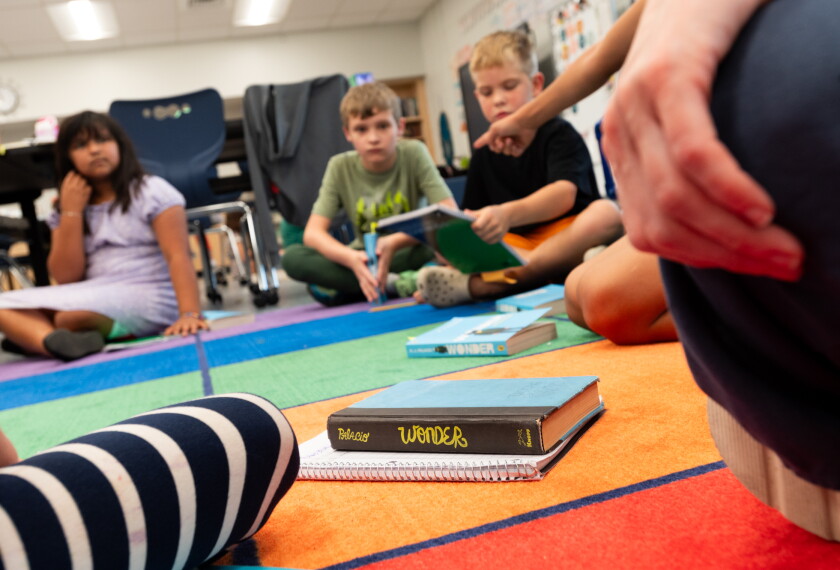

Every year in Shaun Banks’ class, her 4th graders write a biography about a philanthropist who has benefited their community.
Banks, who teaches in Chicago Public Schools, asks her students to use both print and online sources—books about the person they’re studying, but also web searches and online articles. And she sees stark differences in how her 4th graders approach the two formats.
A book is more “controlled, and it’s limited,” Banks said. “If they’re reading a book, that book is going to be all about that person. It’s easier for them to find the information they need, to home in.”
Google searches can provide a much wider variety of information. But when students are scanning text online, she said, “you have to guide them to kind of find the needle in the haystack.”
“There’s so much available to them, and they tend not to see it,” Banks said.
The vast majority of U.S. teachers are like Banks—they use a mix of digital and print texts in their classrooms, according to an Education Week survey. And research suggests that other educators would share Banks’ observations about the differences in her students’ comprehension.
The use of online curriculum and digital reading material long predates the pandemic. But the years of remote and hybrid learning during school shutdowns cemented the place of devices and digital resources in schools.
Studies show that kids tend to score worse on comprehension tests after reading digital text than they do after reading something on a printed page.
Even so, researchers say the evidence is too nuanced to say conclusively that reading physical books is superior. And some new research even shows that in certain cases, with young emerging readers, digital books outperform their print counterparts.
Instead of feeling like they need to choose one or the other, elementary teachers should focus on figuring out the best ways to support kids’ comprehension in both print and digital formats, said Virginia Clinton-Lisell, an associate professor of educational psychology at the University of North Dakota.
“I see in the future in the literary world, there’s room for both,” she said.
Print fosters deeper concentration, studies show
The past few years have seen a massive influx of technology into schools—a change that many educators predict will be permanent.
At the beginning of the 2022-23 school year, the EdWeek Research Center asked teachers, principals, and district leaders how big of a role technology played in their classroom or school compared with before the pandemic. Three-quarters of respondents said it played a bigger or much bigger role.
In a separate survey in early 2023, just over half of teachers said their students do at least a quarter of their reading on screens.
There’s less research on digital reading among elementary age children than there is for older kids or college students, said Naomi Baron, a professor emerita of world languages and cultures at American University in Washington, D.C., and the author of How We Read Now: Strategic Choices for Print, Screen, and Audio.
Still, she said, the findings that do exist are mostly consistent across age groups. Students generally have better comprehension with print text than digital.
“If you’re sitting down in a concentrated way with a print book, you tend to get more out of it,” she said.
In a 2019 metanalysis, Clinton-Lisell found that reading on screens had a negative effect on comprehension compared with reading text on a printed page. Readers of print books also had a more accurate sense of their own comprehension, while those who read online thought that they had understood the text better than they actually had.
Specific studies offer some nuance, though, which Baron outlines in her book (available in both print and digital formats).
For instance, readers can more easily identify specific, concrete details from passages they’ve read in a digital format than in print. But they’re better able to access the text’s overarching, more abstract ideas when they read it in a printed format. These same results have been found in both undergraduate students and preschool-age children.
Social context matters, too.
In a 2022 study, Clinton-Lisell examined “mind-wandering” among college students while they were reading. She started her research before the pandemic began, and continued it through the period when schools—including college campuses—relied on remote learning.
“I found that my participants after COVID reported a lot more mind-wandering, but only from screens,” she said.
During this time, students were learning on screens, but also using them for all kinds of other things—talking to friends, telehealth appointments, and more, Clinton-Lisell said. “My sense is that students overall were just reporting screen fatigue, or techno-stress is another term, where they were just exhausted of being on screens,” she said.
Why young children are different
For very young children, studies come to different conclusions.
In a 2021 metanalysis, researchers May Irene Furenes, Natalia Kucirkova, and Adriana G. Bus examined 39 studies comparing print and digital reading in children ages 1-8.
In some of those 39 studies, the print and digital books were very similar. The digital version might have some audio narration, or certain sections of the text might be highlighted, but those were the only differences. In these studies, children could understand the print books more easily than the digital versions. The researchers wrote that the novel task of navigating the digital book—the clicking and swiping involved—might “attract young children’s attention at the expense of attention paid to the storyline.”
When parents and young children read print books, they talked more about the story—topics that included, for example, discussing what might happen next, pointing out characters, or relating the story to children’s lives. When they read digital books, they talked more about the technology. Parents were more likely to make comments related to format and process, such as telling kids how to advance the page or reminding them not to adjust audio controls.
But in some cases, design features enhanced digital books—so much so that they outperformed their print counterparts. These kinds of features were designed to enhance the story’s content—being able to click on characters to receive additional background knowledge about them, for example.
When adults talked with children about story content and used these add-ons to drive their conversations, kids’ reading comprehension was better than when adults talked with them as they read print books.
But Kucirkova cautioned that not all digital bells and whistles are created equal. “Enhancements that are not helpful take the child out of the narrative with mini-games, distracting imagery or sounds,” she said in an email. These are effects like clicking on a picture of an animal to hear the sound that it makes.
How research could translate to the classroom
Teachers vary in their perceptions of students’ digital reading ability.
In the 2023 EdWeek Research Center survey, 46 percent said their students read slightly or much worse on screens than in print. Forty-three percent said it was about the same.
But teachers’ No. 1 request for enhancing digital materials doesn’t have to do with text features. Forty-three percent said they would want to be able to prevent students from accessing the internet while using their devices to read.
Still, “digital is increasingly part of the new normal,” Baron writes in her book. “Even in contexts that seem better suited for reading in print, we and our students sometimes have no choice. Therefore, a vital job is strategizing how to level the playing field, where possible, between print and digital.”
She recommends teachers “take stock” of the reading environment in digital. How can teachers and students reduce distractions? Is it possible to minimize certain windows, or even block the internet altogether? Can students put their phones in a separate location while they read?
Metacognition—thinking about and monitoring one’s own understanding—has been shown to improve reading comprehension generally. It may be especially important when students are reading on screens, Baron said.
She suggests that teachers coach students to slow down and set goals for what they hope to take away from the text. Teachers can remind students that short blocks of texts won’t necessarily be easy to read.
Much of the reading that students do on screens only requires “shallow” attention, she said—reading a tweet, an Instagram caption, a restaurant review. It’s possible that reading complex text on screens is more challenging because readers only pay shallow attention to anything read digitally—even if it requires more focus, Baron hypothesized.
“There’s lots more text coming our way than ever before,” Baron said. “If what you’re reading is heavily digital, your model for how to do it is most influenced by where you put your eyeballs. And that holds for kids, too.”
This is where teachers can help students set goals, Baron wrote. Are they skimming something for the main points, or will they need to pause to reflect and analyze arguments as they go? The objective should shape the approach.