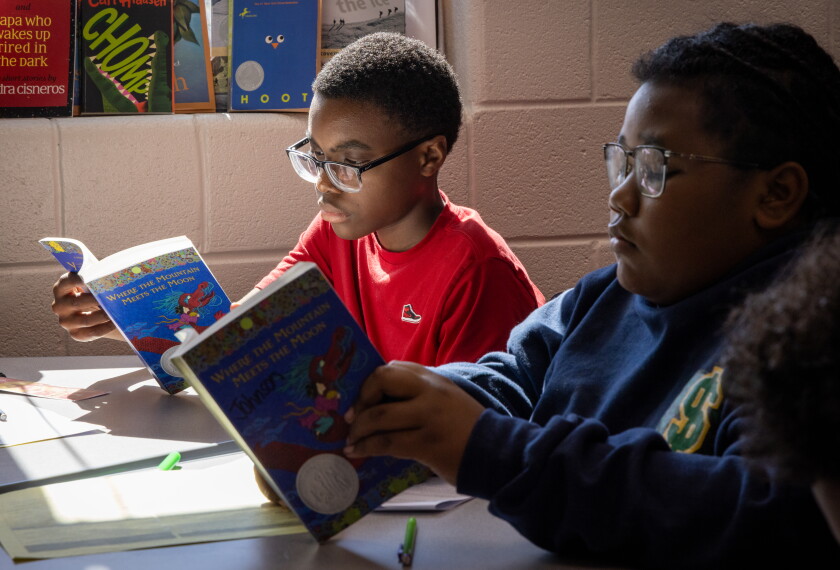

As book bans have spread across the country and some librarians advocate for students’ rights to access a wide range of information, students themselves don’t seem to notice when a book is challenged in their district, according to more than half of school library staff.
Fifty seven percent of the 1,730 library personnel who participated in a nationally representative survey conducted by the EdWeek Research Center in April said students aren’t aware when a book is challenged.
But when they do find out a book is under challenge, students’ interest in those titles goes up, 33 percent of respondents said. Eight percent said they noticed students using library services more often after books are challenged.
The challenges and bans are also influencing students’ reading behavior, respondents said: 18 percent said that students become more interested in reading in general.
However, a majority of respondents said students’ interest in the challenged book, reading overall, and using library services remains unchanged after a book challenge.
The survey includes responses from 994 librarians, 434 library paraprofessionals, 189 media center directors, and 113 employees with school-library-related jobs. It asked respondents about how book banning has impacted their district over the past two years.
From 2021 to 2022, more than 4,000 book bans have spread across 32 states, impacting thousands of school districts, according to PEN America, a free speech organization that tracks such bans. Librarians who work in schools want to keep providing books to students, but they say they are facing pressure because of book bans, even if no book is challenged in their own district, according to the survey.
Some students care about access to diverse books
Districts or schools may not notify students of book challenges or bans, but that does not mean students don’t care about their access to books, particularly titles that represent their experiences, according to Edha Gupta, a former student from Central York High School in Pennsylvania. Gupta, along with a student group called Panther Anti-Racist Union, gained national attention for protesting book bans in her district in 2021. The group eventually succeeded in getting some books back on shelves, Gupta said.
“In my experience, the students that I protested with all cared very deeply about this issue, cared about their education being effective and shared about the education of the kids from generations to come,” she said.
“I don’t think it’s sheer indifference from the students towards the issue. I do think students really truly care.”
Gupta said she initially found out from her local newspaper, the York Dispatch, about book banning, because the district did not communicate with students when it decided to remove books. The Central York district did not respond to requests for comment.
That may be why library personnel think students don’t seem to notice, Gupta said, because when a book is challenged, they are often not notified.
More than 60 percent of survey respondents said parents and community members are not informed about book challenges and bans. About 15 percent said their school board holds a public meeting to discuss a book challenge or ban, and seven percent said the district posts information about the books in question on its website.
What librarians said about student reactions
The survey also asked library employees to submit comments about book banning. Many talked about the importance of keeping diverse books in school libraries for students.
Some library employees also described experiences with students who objeced to books because of specific words or content in them. They usually are able to resolve these concerns by having conversations with students or parents, said Jennisen Lucas, a librarian who works in the Park County school district in Cody, Wyoming.
Parents or students who are willing to discuss books with librarians rarely challenge books, she said.
“As librarians, we are very concerned with the growth of our students and with their well-being,” Lucas said. “And we’re very willing to work as partners with families to help make sure that students are getting the materials that their families want them to read.”
While some students may not notice when books are challenged, others like Gupta have publicly opposed book challenges across the country, according to dozens of respondents to the EdWeek survey.
Some library employees said students in their districts have spoken at school board meetings asking schools to reconsider frequently banned books such as Gender Queer: A Memoir, by Maia Kobabe. They’ve also asked librarians for specific content areas, such as books about LGBTQ+ issues, which has helped librarians curate a collection tailored to student needs, according to survey responses.
A small number of library personnel said they have chosen not to stock books about those topics because of their religious beliefs, and have referred students to public libraries in those cases, according to the survey responses.

Data analysis for this article was provided by the EdWeek Research Center. Learn more about the center’s work.